

Non-Oil exports soar to ₦9.2trn as Lagos plans new industrial policy launch

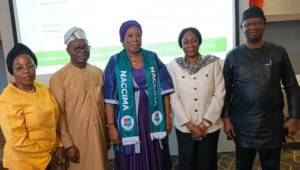
L-R: Head, Trade Facilitation, Nigerian Association of Chambers of Commerce Industry Mines and Agriculture (NACCIMA), Hajiya Amina Alawal Aliyu; President, Badagry Chambers of Commerce, Alhaji Yaya Oladimeji; Honourable Commissioner for Commerce, Cooperatives, Trade, and Investment, Lagos State, Mrs Folashade Kaososarat Bada Ambrose; Internal Consultant, NACCIMA, Mrs Oyefunke Oworu and Director General, NACCIMA, Dr Shola Obadimu, at the NACCIMA Round Table Breakfast Meeting on Trade and Export Competitiveness in Lagos on Tuesday.
Chinedum Ukaegbu
As part of intensified efforts to build a $1 trillion economy, the Lagos State Government has announced plans to unveil its new Industrial Policy by the end of April 2026, a strategic framework aimed at boosting investment, industrial growth, and export competitiveness in the state.
This was disclosed by the Honourable Commissioner for Commerce, Cooperatives, Trade and Investment, Lagos State, Mrs. Folashade Kaosarat Bada Ambrose, at the Nigerian Association of Chambers of Commerce, Industry, Mines and Agriculture (NACCIMA) Roundtable Meeting on Trade and Export Competitiveness on Tuesday in Lagos.
The Commissioner noted that a targeted industrial policy must guide national efforts, with clear designation of export priority sectors such as shea, cocoa, lithium, textiles, and petrochemicals.
According to her: “These sectors should be supported through tax incentives, subsidised power, and dedicated industrial clusters. The shea industry provides a clear example. Nigeria supplies 40 percent of global raw shea nuts yet captures only 1 percent of global market value. With coordinated policy, processing zones can be established, financing made accessible, raw exports regulated, and Nigerian shea products positioned competitively on the global stage. This challenge is not about resources, but about coordination.
“In Lagos State, we are proud to announce that we are aligning with the Federal Government in the area of industrial policy. Following the successful launch of the national industrial policy recently, the Lagos State Industrial Policy (LSIP) will also be launched at the end of this month, April 2026. The LSIP underscores the State’s commitment to creating an enabling business environment that encourages sustainable investment, infrastructure development, and industrial growth—pillars that are essential to achieving the objectives outlined in the State’s major development policy documents: the T.H.E.M.E.S+ Development Agenda and the Lagos State Development Plan (LSDP 2052). It aims to recalibrate the State’s industrial policies to align with both domestic imperatives and international best practices. I hereby call on other states to also align for effective and efficient implementation of the national industrial policy.”
She noted that Lagos is already working ahead for the Intra-African Trade Fair in 2027, adding that it requires full domestication of the African Continental Free Trade Area (AfCFTA) Agreement.
“As we look ahead to the Intra-African Trade Fair in 2027, Lagos will stand before the continent and the world not merely as a host, but as a statement that Nigeria is ready. However, readiness is not a slogan; it is a system.
Achieving this system begins with policy alignment. Our policies can no longer operate like isolated islands; they must function as a coordinated engine. This requires the full domestication of AfCFTA across all states, where each state establishes an implementation desk that translates federal trade policies into actionable strategies at the local level.
States must leverage their comparative advantages, whether in agro-processing, manufacturing, logistics, or services.
Export incentives must also be reformed to prioritise value addition.
A company exporting processed cocoa products should receive greater support than one exporting raw beans. Regulatory harmonisation is equally critical. Agencies must adopt shared digital compliance systems so that certifications are recognised across all ports and aligned with continental trade frameworks,” she stressed.
“Again, Lagos State has set an example with the launch of a ₦10 billion non-collateralised loan at single-digit interest rates for cooperative-based MSMEs to access finance of up to ₦10 million, with repayment periods spanning up to three years.
Small producers must aggregate to meet large international demand, whether in agriculture or manufacturing. The cocoa value chain illustrates this opportunity clearly. Instead of exporting raw cocoa, Nigeria can invest in processing hubs, partner with global firms for technology transfer, and build indigenous brands that compete regionally and globally.
Excellence in exports is not accidental; it is built through deliberate systems, skills, and scale,” the Commissioner added.
Earlier in his welcome address, the National President of NACCIMA, Engr. (Dr.) Jani Ibrahim, noted that the theme “Unlocking Nigeria’s Export Potential: Policy Alignment, Private-Sector Readiness, and Trade Facilitation” was timely.
Represented by the National Vice President of NACCIMA, Alhaji Yaya Oladimeji, who also doubles as the President of Badagry Chamber of Commerce, he said export is evolving significantly from a crude oil-dominated structure to diversified export products.
According to him: “We gather at a time when Nigeria’s export narrative is evolving significantly from one heavily dominated by crude oil to a broader, more diversified trade footprint that reflects the ingenuity and resilience of our private sector.
Recent trade data shows that Nigeria’s non-oil exports climbed to approximately $6.1 billion in 2025, marking an 11.5 percent year-on-year growth and representing the highest non-oil export value ever recorded in the nation’s history.
In naira terms, non-oil exports hit a record ₦9.2 trillion in the first nine months of 2025, up 48 percent compared to the same period in 2024, underscoring how our producers and exporters are responding to improved price incentives and expanded market access.
These gains reflect concrete progress in sectors such as agriculture, processed goods, and solid minerals, with exports spanning over 280 products and total non-oil export volumes climbing to over 8 million metric tonnes.
Nigeria’s geographical export profile is also shifting. While traditional markets in Europe and Asia remain significant, African markets have emerged as major destinations for Nigerian goods. In 2024, Africa collectively accounted for roughly ₦8.74 trillion in exports, with intra-ECOWAS trade representing a growing share of this activity.
Furthermore, exports to African countries climbed by 14 percent in the first half of 2025, with West Africa absorbing over 62 percent of those goods, reflecting strengthening regional trade momentum and the early impacts of AfCFTA implementation.”
He stated that export growth requires stable, predictable, and coordinated policies across trade, finance, taxation, customs administration, standards, infrastructure, and industrial development, adding that fragmentation slows progress while alignment accelerates it.
“We must ensure that national strategies are harmonised with implementation frameworks, and that regulatory processes are efficient, transparent, and business-friendly.
Our businesses, especially MSMEs, must be equipped to meet international standards in quality, packaging, certification, and traceability. They must have access to affordable finance, reliable infrastructure, market intelligence, and capacity-building support. Export competitiveness is not accidental; it is built through deliberate investment in knowledge, innovation, and productivity.
Time is money in global commerce. Efficient ports, simplified customs procedures, digitalised documentation systems, and seamless border operations are critical to reducing the cost of doing business. If Nigerian products are to compete globally, we must reduce domestic bottlenecks that erode margins and discourage exporters.
NACCIMA remains committed to advancing these three pillars and to creating platforms where government and business can engage constructively, align priorities, and turn export opportunities into socio-economic impact.
We must also leverage regional frameworks such as the African Continental Free Trade Area, which presents one of the largest integrated markets in the world. By deepening our participation, Nigeria can secure preferential market access, diversify export products, and build stronger value-chain linkages across the continent,” he added.
In his presentation titled “The Three Pillars of Transformation”, Mr. Taiwo Ajetunmobi, Head of Investment and Management, Nigerian-China Trade Partnership at the Office of the President, noted that Nigeria’s export ambitions cannot succeed without clear policy signals, as exporters need clarity, predictability, and coordination, adding that Nigeria is already moving in the right direction.
Ajetunmobi noted that Nigeria has gazetted the AfCFTA Provisional Schedule of Tariff Concessions, enabling preferential continental trade—unlocking a market of 1.5 billion people and a combined GDP of $3.4 trillion.
On the 2026 Fiscal Policy and Tariff Amendments aimed at boosting local production, he noted that the government has imposed tariffs ranging between 0%–40% for a list of 197 imported goods, adding that the National List has 127 items, with 125 enjoying reduced import duties to stimulate critical sectors of the economy.
He stated that the Federal Government has introduced a Green Tax Model for electric vehicles, pointing out that 115 items across 17 categories have been placed under import prohibition.
He emphasised that weak access to working capital and short-term financing constraints hinder SME growth, stressing that poor aggregation and logistics, fragmented supply chains, warehouse receipt systems, and low export scale remain major trade challenges.
He explained that weak market intelligence is also a major hindrance to trade, noting that limited access to digital market intelligence and sector-specific guidance remains a critical gap.
According to him: “Speed is now a competitive advantage. Propelling Nigeria into a global supply chain hub requires focus on: National Single Window, robust execution frameworks, and streamlined cargo clearance; end-to-end automation by digitising processes across all agencies and eliminating manual processes; harmonised risk-based inspections to reduce delays and ensure consistency; and digital AfCFTA certificates with simplified rules of origin for efficient preferential trade within Africa.”





University of Benin Alumni unite in Massachusetts to celebrate two decades of global impact
University of Benin Alumni Association North America (UBAANA) has celebrated two decades o…