

Public funds must deliver measurable benefits, FENRAD tells authorities over ₦780m Bende project


Nkem Ukaegbu, Umuahia
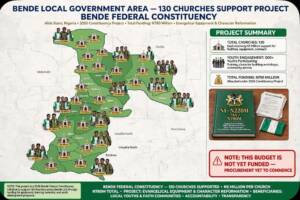
Foundation for Environmental Rights, Advocacy and Development (FENRAD), has called on the Federal Government and relevant authorities to ensure full transparency, accountability and effective public oversight in the proposed ₦780 million youth reorientation intervention captured in the 2026 Appropriation Act for Bende Federal Constituency in Abia State.
The organisation’s demand follows concerns surrounding the proposed provision of musical equipment under the Youth Reorientation Programme, listed as part of the Zonal Intervention Projects (ZIPs), otherwise known as constituency projects, under the Office of the Deputy Speaker of the House of Representatives, Rt. Hon. Benjamin Okezie Kalu.
In a statement signed by its Executive Director, Comrade Nelson Nnanna Nwafor, and made available to journalists in Umuahia, FENRAD said the clarification recently issued by the Deputy Speaker regarding the actual budgetary figure was noted, but stressed that the clarification should not diminish the need for comprehensive public disclosure on how the intervention would be implemented.
According to the organisation, citizens deserve to know the implementation framework, beneficiary selection criteria, procurement procedures, monitoring mechanisms and financial accountability structures that would govern the proposed expenditure.
FENRAD said it was particularly concerned that public resources must be managed in accordance with the principles of openness, equity, efficiency and measurable public benefit, irrespective of the nature or category of the intervention.
The organisation noted that youth reorientation programmes and interventions designed to address drug abuse, cultism, youth violence and other social vices were legitimate public policy objectives that deserved appropriate government attention.
However, it insisted that programmes funded with taxpayers’ money must be implemented through transparent, accountable and inclusive structures capable of inspiring public confidence and allowing for effective monitoring and independent evaluation.
FENRAD therefore called on the relevant authorities to publicly disclose the implementation framework for the proposed intervention and explain the criteria that would be used in selecting beneficiaries and implementing organisations.
The organisation also demanded clarity on the procurement process for the proposed musical equipment, including the quantity and specifications of the equipment to be procured, as well as the proposed distribution plan.
It further requested information on whether faith-based organisations, community groups, civil society organisations or government agencies would be engaged as implementing partners and the accountability mechanisms that would regulate their participation.
The civil society organisation also called for the publication of a clear monitoring, evaluation and reporting framework through which the impact and outcomes of the programme could be independently assessed.
It urged the relevant authorities to provide periodic financial and performance reports throughout the implementation period to enable citizens and other stakeholders to track the utilisation of public funds and assess whether the intervention was delivering its intended objectives.
FENRAD stressed that any institution or organisation entrusted with the management of public funds—whether governmental, community-based, civil society-based or faith-based—must be subjected to clear financial reporting obligations and appropriate accountability standards.
It added that, where applicable, independent auditing should form part of the accountability framework, in line with Nigeria’s public finance laws, procurement regulations and established financial management guidelines.
The organisation also called on the National Assembly, relevant oversight committees, anti-corruption agencies and other accountability institutions to exercise their constitutional and statutory responsibilities by ensuring that the implementation of the intervention complies with due process and established procurement procedures.
FENRAD said such oversight was necessary to ensure value for money and guarantee that the funds ultimately translated into meaningful and measurable benefits for the people of Bende Federal Constituency.
The organisation further observed that, since implementation of the intervention had not yet commenced, there was still an opportunity for the relevant authorities to review the implementation framework and consider improvements that could enhance its developmental impact.
It also suggested that, where legally and administratively permissible, the authorities could consider a virement or other lawful budgetary adjustment to redirect the funds towards interventions with clearer and more measurable outcomes for the people of the constituency.
Among the alternative areas suggested by FENRAD were youth skills acquisition, entrepreneurship support, drug rehabilitation programmes, digital innovation hubs, educational infrastructure, sports development and broader community empowerment initiatives.
According to the organisation, such interventions could provide young people with sustainable opportunities, reduce vulnerability to social vices and contribute more directly to human capital development and economic empowerment.
FENRAD emphasised that its position was not opposed to youth reorientation programmes or interventions designed to tackle social challenges among young Nigerians.
Rather, it said its concern was that every public intervention must be subjected to transparent processes and measurable accountability standards, particularly when significant public funds are involved.
The organisation maintained that transparency should not be regarded as an obstacle to governance but as a fundamental foundation for public trust and effective democratic administration.
It argued that citizens have a legitimate and constitutional interest in knowing how public resources are allocated, managed and utilised, stressing that public confidence is strengthened when government programmes are implemented through open processes that guarantee accountability and measurable impact.
FENRAD therefore reiterated its call for full transparency throughout the entire project cycle, from budgeting and procurement to implementation, monitoring, evaluation and final reporting.
The organisation said it remained committed to working constructively with government institutions, development partners, civil society organisations and citizens to promote responsible public financial management and strengthen democratic governance in Nigeria.
The statement was signed by Comrade Nelson Nnanna Nwafor, Executive Director of the Foundation for Environmental Rights, Advocacy and Development (FENRAD Nigeria).
FENRAD Nigeria is a non-governmental, non-profit civil society organisation focused on environmental justice, human rights, transparency, accountability, good governance, sustainable development and citizen participation in democratic processes.
Through research, advocacy, public policy engagement, civic education, strategic litigation and partnerships, the organisation said it promotes responsible governance and works to safeguard the rights and welfare of communities across Nigeria.





Twenty-five years in vineyard: Celebrating Priestly journey, legacy of Rev. Fr. Sebastian Ngene
By Jerome-Mario Utomi Some anniversaries simply mark the passage of time, and there are an…
