

Nigeria 2030: Can agribusiness SMEs drive a GDP boom?

By Chi Tola
As the world races toward 2030, Nigeria finds itself at a critical juncture. With over 70% of its population engaged in agriculture and a pressing need to diversify its economy, the question is no longer if agribusiness can change Nigeria’s economic future, but how fast and sustainably it can.
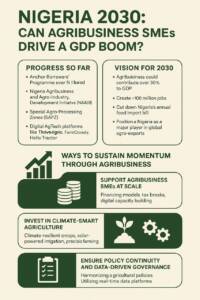
The progress so far
Agricultural reforms in Nigeria over the past five years have seen a mix of policy innovation, technology adoption, and increased private sector participation, particularly among SMEs and youth-led ventures.
Through initiatives like the Anchor Borrowers’ Programme (ABP) and the Special Agro-Processing Zones (SAPZ) in partnership with the African Development Bank, thousands of smallholder farmers and agri-entrepreneurs have gained access to financing, storage, and market infrastructure.
Digital platforms such as ThriveAgric, FarmCrowdy, and Hello Tractor have transformed how small-scale farmers access loans, hire equipment, and find markets. Meanwhile, more young Nigerians are venturing into agribusiness — not just as farmers, but as processors, marketers, exporters, and tech innovators.
Yet, despite these advancements, Nigeria still battles the same age-old problems: low mechanization, poor rural infrastructure, high post-harvest losses, insecurity, and fragmented policies.
The Vision for 2030
By 2030, projections show that Nigeria’s agribusiness sector could contribute over 30% to GDP, up from the current 23–24%. This would not only reflect a diversified and resilient economy but could also:
Create 10 million+ jobs across value chains
Cut down Nigeria’s annual food import bill (currently over $10 billion)
Position Nigeria as a major player in global agro-exports
But how do we sustain this momentum and turn today’s potential into tomorrow’s prosperity?
5 Key Ways to Sustain Momentum Through Agribusiness
1. Scale Support for Agribusiness SMEs
Agricultural SMEs are the real engine of innovation and productivity. Financing models must evolve — from high-interest bank loans to blended finance, equity partnerships, and cooperative savings platforms. SMEs should also benefit from targeted tax breaks, export incentives, and digital capacity building.
2. Embrace Climate-Smart Agriculture
With climate change threatening yields and food security, Nigeria must embrace climate-resilient crops, solar-powered irrigation, and precision farming. Public-private partnerships can introduce technology that ensures both profitability and sustainability.
3. Prioritize Agro-Value Chains and Storage
Nigeria loses up to 40% of its farm produce due to poor storage and logistics. Investing in agro-processing zones, cold-chain systems, and transport corridors will add value, reduce waste, and improve food supply.
4. Ensure Policy Continuity and Data-Driven Governance
For any reform to last, policies must outlive political terms. The government must engage stakeholders across federal and state levels to harmonize agricultural policies. Real-time data platforms should guide decisions on pricing, weather forecasts, and crop distribution.
5. Empower Women and Youth
Women contribute over 50% of the agricultural workforce, yet have limited access to land, credit, and training. Youth engagement is also key through agritech, branding, processing, and export-led models. We must invest in both groups to truly transform agriculture.
Final Word
Nigeria’s agricultural future isn’t in bigger farms — it lies in smarter, scalable agribusiness models powered by small and medium enterprises. With the right mix of capital, consistency, and creativity, agribusiness SMEs can usher in a new GDP era — one that’s green, inclusive, and export-ready.
2030 is not far off. But the seeds of that future must be planted today.





NUJ honours FCC Commissioner Peter Eze for Outstanding Youth leadership in Enugu
Stanley Ihedigbo Nigeria Union of Journalists (NUJ), Enugu State Coun…