
Rainbow Coalition is dead on arrival in FCT, Hon. Opara


Abel Lazarus, Abuja
The much-talked-about Rainbow Coalition will not see the light of day in the Federal Capital Territory, Abuja.
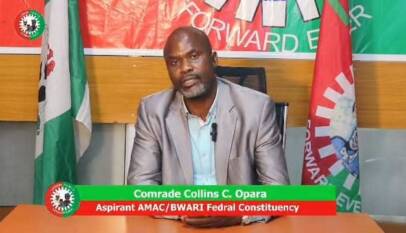
That is the firm position of the Labour Party candidate for the AMAC/Bwari Federal Constituency, Hon. Chimobo Collins Opara, who spoke in an exclusive interview with The Mirror Newspaper in Abuja.
Hon. Opara, a grassroots politician and one of the leading opposition voices in the FCT, said the proposed coalition, as presently constituted, does not represent the choice of the people, does not reflect the cosmopolitan nature of Abuja, and does not align with the political realities on the ground in the Territory.
According to him, Abuja is not like any other state in Nigeria. It is the capital of the nation, a home to all Nigerians irrespective of tribe, religion, state of origin, or political leaning. Any political arrangement that ignores that unique character, he argued, is bound to fail before it even starts.
“Rainbow Coalition is dead on arrival in the FCT,” Hon. Opara declared. “It does not represent the choice of the cosmopolitan nature of the FCT.”
He explained that the word rainbow itself represents the combination of several colours coming together to form one beautiful spectrum. Ironically, he said, the proposed coalition is a sharp contrast to that combination.
Instead of bringing together all the diverse colours, shades and interests that make up Abuja, he said, the coalition appears to be a narrow arrangement built around a few individuals, excluding the very voting blocs that decide elections in the FCT.
“The voting strength of the FCT is not represented in this so-called Rainbow Coalition,” he said. “You cannot claim to be forming a rainbow when you have left out the major colours. Abuja is made up of original inhabitants, long-time residents, non-indigenes from all 36 states, civil servants, business owners, students, traders, and artisans. If these groups are not carried along, what rainbow are we talking about?”
Question of credibility
Hon. Opara also questioned the credibility and electoral value of some of the figures driving the coalition.
He argued that many of those presenting themselves as leaders of the new movement have held elected offices in the past and failed to deliver meaningful development to the people of the FCT.
According to him, the people of Abuja are now more politically conscious than ever before. They are no longer moved by big names, big gatherings, or colourful slogans. They ask questions: What did you do when you had the opportunity? What projects did you attract to your constituency? How did you improve the lives of the people who voted for you?
“You cannot fail in your various elected capacities in the past and then come back to claim you are the saviour of the FCT,” Hon. Opara said. “The people remember. They remember who stood for them and who abandoned them after winning elections. That is why the credibility of the candidates in this coalition must be questioned.”
He added that participation in the development of the FCT should be the yardstick for leadership, not mere political noise or media hype.
“Abuja needs leaders who have been part of its development story, not people who only show up during election season to divide the votes and disappear after,” he said.
The non-indigene voting bloc must be recognized
A central point in Hon. Opara’s argument is the place of non-indigenes in FCT politics.
He noted that non-indigenes constitute a very large and decisive voting bloc in Abuja. From AMAC to Bwari, from Gwagwalada to Kuje, Kwali and Abaji, non-indigenes have lived, worked, paid taxes, built businesses, raised families, and contributed immensely to the growth of the Territory for decades.
Yet, he lamented, they are often treated as spectators in political arrangements that will ultimately affect their lives.
“For a rainbow coalition to work in the FCT, the voting bloc of non-indigenes must be recognised and accorded opportunity in any meaningful coalition,” Hon. Opara stressed.
“Any coalition that sidelines non-indigenes is not a coalition at all. It is an exclusion. And exclusion cannot win elections in Abuja.”
He said the philosophy of inclusiveness, which he described as “Enye ndi eba Enye di ndi eba”, a principle associated with the FCT Minister, His Excellency Nyesom Wike, captures the true spirit of Abuja: give to one, give to the other; carry everybody along; no one should be left behind.
According to Hon. Opara, that philosophy is why the current administration has been able to record progress in infrastructure and governance in the FCT, because it recognises the diversity of the Territory and works with all groups.
“Anybody who wants to lead Abuja must first understand Abuja. Abuja belongs to everybody. If your coalition does not reflect that, it has already failed,” he said.
Call for genuine synergy
Hon. Opara, however, did not dismiss the idea of a coalition entirely. He said he believes in unity among opposition parties, but insisted that it must be genuine, broad-based, and built on mutual respect.
He suggested that for any meaningful coalition to succeed in the FCT, there must be synergy with all opposition party candidates, not a top-down arrangement imposed by a few.
“Let all opposition candidates sit together. Let us discuss. Let us agree on a common agenda for the people of the FCT. Let us respect each other’s strength and structure. That is how a real coalition is built,” he said.
He warned that a coalition built on selfish ambition, personal interest, or the desire to hijack structures will collapse under its own weight long before election day.
Labour Party’s position
Speaking on his own candidacy for the AMAC/Bwari Federal Constituency under the Labour Party, Hon. Opara said his campaign is built on inclusion, competence, and grassroots development.
He said his focus remains on the people, quality representation, youth empowerment, women’s inclusion, infrastructure, education, and the protection of the rights of both indigenes and non-indigenes in the constituency.
He urged residents of AMAC/Bwari and the entire FCT to look beyond noise and examine the track record, character, and capacity of every candidate seeking their votes.
“The people of Abuja deserve better. They deserve leaders who will carry everybody along, who will respect the cosmopolitan nature of the FCT, and who will deliver real development,” Hon. Opara concluded. “That is what the Labour Party stands for, and that is what we are offering.”




$100bn, question every Nigerian must ask
By Abel Lazarus Let us put the party aside for a moment. Forget All Progress…