

Governor Umo Eno’s most strategic political decision

Emmanuel Nicholas
The political landscape of Akwa Ibom began to tremble the moment Governor Umo Eno, having been elected under the Peoples Democratic Party (PDP) and sworn in on the 29th of May, 2023, confronted the disintegration of the very party that had midwifed his ascendancy.
As his administration commenced with measured resolve, the PDP, once a monolith of formidable cohesion, began to exhibit the unmistakable symptoms of institutional decay. Its internal organs, which had hitherto functioned with calibrated precision, now succumbed to centrifugal forces that threatened to rend the party asunder.
Three formidable and irreconcilable factions emerged from the rubble of consensus. There was the Atiku faction, carrying the gravitas of presidential ambition; the Wike faction, wielding the unyielding influence of the Federal Capital Territory; and the Governor Makinde faction, projecting the gravitas of the progressive Southwest.
Each contended not merely for ideological supremacy, but for the very soul and custodianship of the party. The leadership tussle, which commenced over the contentious office of National Secretary, metastasized into a broader war over who possessed the legitimate authority to control the party’s apparatus.
From the maelstrom of this internecine conflict emerged a constitutional absurdity: two National Chairmen and two National Secretaries, each claiming unimpeachable legitimacy. Ambassador Umar Damagum occupied the chair as Acting National Chairman, with Senator Samuel Anyanwu as National Secretary. Arrayed against them stood Alhaji Yayari Ahmed Mohammed as factional Acting National Chairman, and Ude Okoye as factional National Secretary.
The PDP had thus become a party of parallel realities, each faction brandishing its own organs and directives.
The crisis deepened and proliferated into the judicial arena, where the interpretation of the party’s constitution became the battlefield. In the matter of Samuel Anyanwu v. Ude Okoye & Ors, the Supreme Court, in its wisdom, delivered a landmark judgment that annulled all decisions taken by the PDP National Working Committee under Damagum’s leadership without Anyanwu’s participation.
The apex court declared that the internal affairs of a political party, particularly the selection of its officers, were non-justiciable except where constitutional provisions were violated. Yet the judgment, rather than assuage, intensified the schism.
Simultaneously, the Federal High Court in Abuja, in Ude Okoye v. PDP & Ors had earlier recognized Okoye as the authentic National Secretary, ordering INEC to deal with him as such.
The Court of Appeal later affirmed this position. Thus, the judiciary found itself adjudicating competing truths, while the Independent National Electoral Commission navigated the treacherous terrain of recognizing one faction over another, thereby becoming an inadvertent arbiter in a fratricidal war.
It was within this vortex of institutional entropy that rumors concerning Governor Umo Eno’s political future began as a mere zephyr and burgeoned into a tempest. Upon his return from Abuja on the 11th of April, the Governor, with characteristic circumspection, uttered words of profound implication.
He intimated that he might be compelled to migrate to the All Progressives Congress, citing the unrelenting instability and anarchic disposition of the PDP. The utterance, though tentative, detonated across the polity.
From that moment, conjecture transmuted into reality. A statewide chorus of rejection and condemnation erupted, for Akwa Ibom had been the inviolable citadel of the PDP for twenty-six unbroken years.
From the administration of Obong Victor Attah, through the transformative tenure of Senator Godswill Akpabio, to the meticulous stewardship of Deacon Udom Emmanuel, and into the first two years of Governor Umo Eno, the PDP had been more than a party in the South-South state. It was, in the collective consciousness, a political religion.
Cognizant of the historical weight of his decision, Governor Umo Eno embarked upon an unprecedented statewide consultation that spanned over three months. With humility that bordered on supplication, he traversed the length and breadth of the state, appealing to the political class, traditional institutions, and the grassroots to apprehend the strategic imperatives underpinning his contemplation.
He sought not to impose, but to persuade; not to dictate, but to elucidate.
Initially, there was revolt. Emotions ran high as loyalists recoiled at the prospect of severing ties with a party that had become synonymous with Akwa Ibom identity. Yet, as the PDP’s internal hemorrhaging intensified , as court orders contradicted one another, as parallel primaries loomed, as the party’s capacity to field credible candidates descended into farce , the political class began to recalibrate. Reason supplanted sentiment, and pragmatism eclipsed nostalgia.
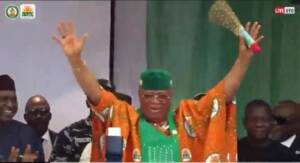
On the 6th of June, 2025, the Governor formalized his decision. At the Government House in Uyo, before a convocation of stakeholders, Governor Umo Eno officially decamped from the Peoples Democratic Party to the All Progressives Congress.
The announcement was not a defection; it was a political realignment executed with surgical precision. He did not depart alone.
The magnitude of the exodus was unprecedented. He departed with twenty-four members of the House of Assembly, eight members of the House of Representatives, two Senators, all his Commissioners save one, all his aides save three, twenty-nine Local Government Chairmen, twenty-six Vice Chairmen, and the entire retinue of Councilors and Supervisory Councilors. In effect, he relocated the operational infrastructure of governance.
He carried with him the entire architecture of appointed and elected political structures, along with the preponderance of political stakeholders. What remained behind was merely the titular PDP structure , a skeletal frame bereft of the sinew and muscle that had animated it.
The Governor had not abandoned government; he had preserved it from impending collapse.
Inevitably, accusations of betrayal surfaced. Many lamented that he had forsaken his political benefactor, His Excellency Deacon Udom Emmanuel. Yet the irony was stark.
The very mentor who had anointed him, even after the Governor’s migration to the APC, continued to publicly enjoin Akwa Ibom people to support Governor Umo Eno to succeed.
This enduring endorsement illuminated a truth hitherto obscured: the former Governor had been duly consulted and comprehended the existential predicament that would have ensnared his successor had he remained in the PDP.
The contemporary reality vindicates the Governor’s foresight. Had Governor Umo Eno not acted with alacrity and departed from the PDP, his prospect of securing a platform for a second-term bid would have been consigned to political oblivion.
The PDP, at present, presents a grotesque spectacle: in every state, it boasts two gubernatorial candidates; at the national level, two presidential candidates; and across the entire National and State Assemblies, dueling claimants to every ticket.
The complexity of candidate nomination has been thrown into utter disarray. Multiple court cases remain sub judice, while INEC, caught in the crossfire, has recognized the faction backed by Wike. Undeterred, the Makinde faction has again approached the courts to challenge that recognition by the electoral umpire.
The party is thus mired in litigation, its electoral machinery paralyzed by juridical uncertainty.
Even as principal actors who precipitated the crisis, such as Alhaji Atiku Abubakar, have departed the scene, their lieutenants remain entrenched, perpetuating the commotion and ensuring that the party remains incapable of forward momentum.
The PDP has become a cauldron of unending contention, where ambition eclipses organization and litigation supplants legislation.
One must therefore interrogate the counterfactual: what would have become the fate of Governor Umo Eno had he not executed that single, most intelligent political decision to decamp from the PDP?
His hope toward re-election would have been mired in legal quagmires, crippled by factional primaries, and ultimately jeopardized by a party incapable of presenting a coherent candidacy. The platform would have disintegrated beneath his feet.
What perplexes the discerning observer is the persistence of bitterness from those who have witnessed the calamitous descent of the PDP into a political quagmire.
They profess sincerity, yet their admonition that the Governor should have remained in the party betrays an intention antithetical to his success. Their public agitation was a façade; their private intent was the anticipation of his political demise. They sought not his survival, but his stagnation.
Governor Umo Eno, PhD, is not merely a politician; he is a strategist of rare acumen and a statesman of prescient vision.
He perceives from afar what others discern only when calamity is upon them. To take a decision that might be misconstrued as betrayal of trust required the courage of a prudent leader.
Yet history is already recording the verdict: it was a decision of surpassing intelligence, eclipsing all other political calculations of the moment.
In my final analysis, the most intelligent political decision of Governor Umo Eno was not the abandonment of a party, but the preservation of a mandate.
He chose governance over gridlock, stability over schism, and the welfare of Akwa Ibom over the wreckage of a collapsing structure.
In an era where political loyalty is often mistaken for political wisdom, he demonstrated that the highest form of loyalty is to the people. And in that choice, he secured not just his second term, but the enduring history of progress for the state and maintains the political aspirations of his mentor, Deacon Udom Emmanuel.

Ogun 2027: APC names Olamilekan candidate, petitions IGP, DSS against Hunye
Jeremiah Adeshina All Progressives Congress (APC) has d…