

FG threatens tough measures against South Africa if xenophobic violence persists

Michael Olumide
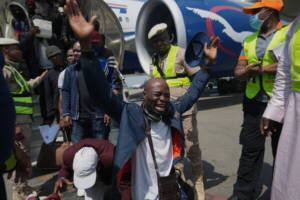
Federal Government has assured Nigerians stranded in South Africa that no citizen willing to return home will be abandoned, even as it warned that it could take stronger diplomatic and other measures against South Africa if the ongoing xenophobic attacks against foreign nationals continue.
The assurance was given by the spokesperson of the Ministry of Foreign Affairs, Kimiebi Imomotimi Ebienfa, during an exclusive interview on Frontline, a current affairs programme on Eagle 102.5 FM, Ilese-Ijebu, Ogun State.
Ebienfa disclosed that President Bola Tinubu had directed that every Nigerian willing to return home must be safely evacuated, prompting the Federal Government to expand the ongoing evacuation exercise.
According to him, after the successful completion of the initial evacuation operation, the government secured approval for four additional flights to repatriate more Nigerians.
He explained, however, that the latest scheduled flight suffered a setback after the Air Peace aircraft assigned for the mission developed a technical fault involving the cockpit windscreen.
Despite the delay, he expressed confidence that the evacuation programme would continue as planned.
“So far, we have evacuated 859 Nigerians from South Africa. The aircraft being deployed has a capacity of 271 passengers. If the remaining flights are fully utilised, over 500 additional Nigerians will return home within the next few days,” he said.
Ebienfa assured that if the approved flights prove insufficient, the Ministry of Foreign Affairs would seek fresh approval from the Presidency for additional evacuation operations.
He stressed that President Tinubu had made it clear that no Nigerian willing to return home would be left stranded in South Africa.
The ministry spokesman also dismissed reports suggesting that evacuees were required to pay for their transportation.
He clarified that the entire evacuation exercise was fully funded by the Federal Government.
“It is purely free of charge. The Federal Government has paid for all the five approved evacuation flights. No Nigerian is paying a kobo,” he said.
According to him, Nigerians displaced by the attacks have also been receiving temporary accommodation and welfare support at the Nigerian High Commission in Pretoria pending their evacuation.
He revealed that officials of the High Commission had been providing sleeping materials, food and other necessities for displaced Nigerians.
Ebienfa further disclosed that a Nigerian philanthropist voluntarily sponsored the return of 66 Nigerians through commercial flights operated by South African Airways.
The Ministry of Foreign Affairs also confirmed that it has intensified diplomatic engagements with the South African government, demanding stronger protection for Nigerians and other foreign nationals.
Ebienfa said Nigeria recently issued a strongly-worded diplomatic protest calling on South Africa to strengthen security and prevent further attacks.
He explained that beyond evacuation, the government continues to provide consular services to Nigerians abroad, including monitoring court proceedings involving Nigerian citizens and facilitating access to legal representation where necessary.
According to him, every Nigerian remains important to the Federal Government irrespective of where they reside.
On compensation, Ebienfa disclosed that the government has commenced documentation of businesses abandoned by Nigerians fleeing South Africa because of the attacks.
He maintained that Nigerians who legally established businesses and paid taxes in South Africa should not be forced to lose their investments without compensation.
He noted that once sufficient records have been compiled, Nigeria would formally engage the South African government to demand compensation for affected business owners.
He argued that South African companies continue to operate freely in Nigeria without harassment, making it unacceptable for Nigerians to be subjected to violence and intimidation in South Africa.
Responding to criticism that Nigeria had relied excessively on diplomacy despite repeated attacks on its citizens, Ebienfa acknowledged the growing frustration among Nigerians.
He recalled Nigeria’s enormous contributions to the struggle against apartheid, saying the present hostility toward Nigerians was particularly painful.
“It is on record that Nigeria committed enormous resources, estimated at over $63 billion, to support South Africa’s liberation from apartheid. Civil servants also contributed through mandatory deductions from their salaries during that period,” he said.
Despite public calls for immediate retaliation, he maintained that diplomacy remains Nigeria’s preferred option because Africa continues to occupy the centre of the country’s foreign policy.
Nevertheless, he warned that Nigeria’s patience should not be mistaken for weakness.
He disclosed that stronger retaliatory measures remain under consideration should the attacks continue.
“We have put the South African government on notice. If this trend continues, Nigeria will take more drastic actions. We are pursuing diplomacy for now, but appropriate commensurate actions remain on the table,” Ebienfa stated.
While declining to disclose the specific measures being considered, he assured Nigerians that the government had developed serious options should diplomatic efforts fail.
On the continental response, Ebienfa revealed that Nigeria is pushing for the xenophobic attacks to be discussed at the African Union, arguing that the crisis has implications for the entire continent rather than Nigeria alone.
He disclosed that the Minister of State for Foreign Affairs, Ambassador Olaoluwa Enikanolaiye, had already raised the issue during a recent meeting with members of the African Union Peace and Security Council in Abuja.
According to him, Nigeria intends to ensure that the matter is formally placed on the agenda of the African Union for collective action.
He warned that failure to address the situation could encourage similar anti-foreigner attacks in other African countries.
“If Africa fails to act collectively today, another country could tomorrow decide to target foreign African nationals in the same manner,” he warned.
Ebienfa also announced that the Ministry of Foreign Affairs is considering new policies aimed at strengthening the protection of Nigerians travelling abroad for employment.
He lamented that many Nigerians leave the country without informing Nigerian diplomatic missions, making it difficult for embassies to locate or assist them during emergencies.
Drawing lessons from the Philippines, he suggested that Nigeria may introduce a mandatory registration system for citizens travelling abroad for work.
Such a policy, he explained, would enable government agencies to verify employers, authenticate job offers and prevent Nigerians from falling victim to human trafficking, exploitation and unsafe working conditions.
He noted that the proposal became necessary following repeated cases of Nigerians being lured to dangerous destinations, including conflict zones, under false promises of employment.
Ebienfa also disclosed that the ministry is reviewing the welfare of Nigerians facing hardship in countries such as Kuwait and Ethiopia while exploring bilateral agreements that would allow convicted Nigerians serving prison sentences abroad to complete their jail terms in Nigeria.
He assured that the Federal Government remains committed to protecting Nigerians everywhere in the world through stronger consular services, diplomatic engagements and policy reforms aimed at ensuring their safety and welfare.




Sustainable fishing: NPERA seeks stronger port regulation, cold-chain investment
Stanley Ihedigbo Nigerian Ports Economic Regulatory Agency (NPERA) ha…