

Delta’s Economic Reset: How state government is repositioning economy, infrastructure

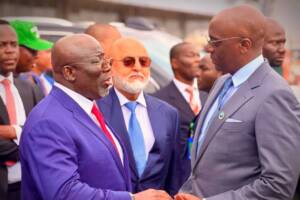 Delta State Governor, His Excellency Rt. Hon. (Elder) Sheriff Oborevwori and Chairman, Governing Board of the Niger Delta Development Commission (NDDC), Mr. Chiedu Ebie, among other dignitaries, at the opening ceremony of the recently held Delta State Economic Summit at the Dome Event Centre, Asaba, Delta State.
By Jerome-Mario Utomi
When governors speak of economic transformation in Nigeria, the conversation is often dominated by ambitious projections and political slogans. In Delta State, however, recent developments suggest a more deliberate attempt to shift the state from dependence on federal allocations and crude oil revenues toward a diversified, infrastructure-driven economy.
The recently held Delta State Economic Summit 2026 has become a major reference point in this conversation, highlighting the state government’s strategy of linking investment promotion, industrial development, infrastructure renewal, and human capital advancement into a single economic agenda.
The summit, convened under the administration of Governor Sheriff Oborevwori, brought together policymakers, investors, development experts, and private sector leaders to examine the future of Delta’s economy.
Beyond the speeches and communiqués, the event underscored a growing recognition that Delta’s long-term prosperity will depend less on its oil wells and more on its ability to build productive infrastructure, attract private capital, and create opportunities across agriculture, manufacturing, logistics, tourism, and technology.
For decades, Delta State has occupied a paradoxical position within Nigeria’s economy. As one of the country’s major oil-producing states, it has generated enormous petroleum wealth, yet many communities have continued to face unemployment, inadequate infrastructure, and limited industrial activity.
The Economic Summit 2026, therefore, served as both a stocktaking exercise and a roadmap for change.
At the summit, state officials emphasized the need to expand internally generated revenue through productive sectors rather than taxation alone. Agriculture featured prominently in the discussions, with renewed attention to oil palm, cassava, aquaculture, rubber, and rice production. Delta possesses vast arable land and riverine resources, and the government is increasingly positioning agriculture not merely as a subsistence activity but as a commercial value chain capable of supporting processing industries, export opportunities, and rural employment.
This approach aligns with broader national efforts to strengthen food security and reduce import dependence. By encouraging agro-processing clusters and improving access to rural roads and storage facilities, the state is attempting to connect farmers to markets and investors to raw materials.
One of the clearest signals emerging from the Oborevwori administration is the prioritization of infrastructure as an economic enabler. The governor’s MORE Agenda—an acronym for Meaningful Development, Opportunities for All, Realistic Reforms, and Enhanced Peace and Security—places significant emphasis on roads, bridges, drainage systems, and urban renewal.
Across the state, several road projects have been presented as strategic economic corridors rather than isolated construction works. Improved connectivity between Asaba, Warri, Ughelli, Sapele, Kwale, and other commercial centres is expected to reduce transportation costs, facilitate the movement of agricultural produce, and stimulate trade within the state and with neighbouring regions.
In Asaba, the state capital, urban infrastructure expansion has continued to support its emergence as a regional administrative and commercial hub. Better road networks, drainage improvements, and public facility upgrades are enhancing the city’s attractiveness to businesses and real estate investors.
Similar interventions in Warri are intended to revive its historic role as a major industrial and maritime centre in the Niger Delta.
The emphasis on infrastructure is significant because investors typically evaluate not only tax incentives but also the reliability of transport, power access, drainage, security, and urban services. By improving these fundamentals, the state government is attempting to create conditions in which private enterprise can operate more efficiently.
Another important dimension of Delta’s repositioning strategy is the effort to unlock the economic potential of the Warri axis. Historically, Warri served as one of Nigeria’s most important oil and shipping centres, supported by its port infrastructure and proximity to offshore petroleum operations. However, years of underinvestment and economic disruption reduced its competitiveness.
The state government has increasingly advocated for the revitalization of Warri Port, improved access roads, and complementary industrial infrastructure that could support petrochemicals, manufacturing, logistics, and marine services.
Discussions at the Economic Summit highlighted the possibility of leveraging Warri’s strategic location to attract industries that require both coastal access and proximity to energy resources.
If successfully implemented, such initiatives could help Delta move beyond crude oil extraction into higher-value industrial activities, creating more sustainable employment opportunities for young people.
Economic transformation cannot be achieved through physical infrastructure alone. Recognizing this, the Delta State Government has continued to invest in human capital development, particularly through youth empowerment and skills acquisition programmes.
Delta has previously gained national attention for initiatives such as the Youth Agricultural Entrepreneurs Programme (YAGEP), the Skills Training and Entrepreneurship Programme (STEP), and other vocational support schemes designed to equip young people with practical skills in agriculture, ICT, fashion, welding, catering, and small business management. These programmes have provided a useful foundation for the broader economic diversification agenda.
At the 2026 summit, participants repeatedly stressed that infrastructure projects must be complemented by a workforce capable of participating in emerging industries. The integration of technical training, entrepreneurship support, and access to finance is therefore becoming increasingly important to the state’s development strategy.
Delta’s economic repositioning also extends to sectors that have traditionally received less policy attention. The state possesses significant tourism and cultural assets, including riverine landscapes, festivals, historical sites, and a vibrant entertainment culture.
Recent government efforts to improve public spaces, support cultural festivals, and enhance hospitality infrastructure suggest an attempt to broaden the state’s economic base through tourism and the creative economy.
While this sector may not immediately rival oil revenues, it offers important opportunities for small businesses, artisans, performers, transport operators, and hospitality providers.
The experience of states such as Lagos, which has successfully leveraged entertainment and tourism as major economic drivers, provides a relevant example of how cultural assets can contribute meaningfully to employment and internally generated revenue when supported by infrastructure and effective promotion.
Lessons from Other States
Delta’s current strategy can also be better understood when compared with developments elsewhere in Nigeria. Kaduna State has pursued industrialization through investment promotion and business environment reforms; Edo State has emphasized technology, digital skills, and public sector modernization; and Lagos State has demonstrated how sustained infrastructure investment can support commerce, real estate, transport, and creative industries.
What distinguishes Delta’s approach is its attempt to combine oil-sector advantages with non-oil growth opportunities. Rather than abandoning its petroleum economy, the state appears to be using oil revenues and federal allocations as a platform for building transport infrastructure, supporting agriculture, promoting industry, and strengthening human capital.
Challenges that remain
Despite these positive indicators, significant challenges remain. Infrastructure deficits are still substantial in many rural communities. Flooding continues to threaten roads, farmlands, and settlements across parts of the state. Power supply constraints, bureaucratic bottlenecks, and security concerns can also discourage investment if not consistently addressed.
Moreover, the success of the Economic Summit will ultimately be judged not by the quality of its presentations but by the implementation of its recommendations. Investors will be watching for measurable progress in project delivery, regulatory efficiency, land administration, and public-private partnership execution.
The Delta State Economic Summit 2026 has helped crystallize an important narrative: Delta is seeking to transition from a resource-dependent economy to a diversified, infrastructure-led growth model. Through road and urban infrastructure expansion, agricultural commercialization, industrial corridor development, youth empowerment, and renewed engagement with the private sector, the Oborevwori administration is attempting to lay the foundations for a more resilient economy.
The process is still unfolding, and many of the promised outcomes will require sustained political commitment, transparent implementation, and effective collaboration with investors and local communities. Nevertheless, the emerging direction is clear. Delta State is no longer presenting itself solely as an oil-producing state; it is increasingly positioning itself as a regional hub for agriculture, industry, logistics, commerce, and human capital development.
If the momentum generated by the Economic Summit is matched by consistent execution on the ground, Delta may well become one of the most compelling examples of subnational economic repositioning in contemporary Nigeria—a state using infrastructure not merely as a symbol of government activity, but as the engine of long-term economic transformation.



APC Campaign Council denies plot to assassinate Atiku, challenges Timi Frank
Stanley Ihedigbo All Progressives Congress (APC) Presidential Campaign Counc…
