

AGFCS marks legal win for Emmanuel Acha, calls for united resistance against rights abuses

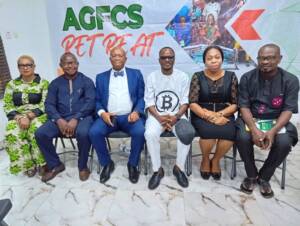
L-R: Publisher, Security Alert Media, Ms. Juliana Francis; Executive Director, Foundation for Environmental Rights, Advocacy and Development (FENRAD), Com. Nelson Nnanna Nwafor; Principal Counsel, Akaraiwe Associates,
Mr. Ikeazor Akaraiwe, SAN; Prominent Human Rights Defender, Emmanuel Acha: Senior Legal Officer, Spaces for Change (S4C), Barrister Chetachi Udeh; and Executive Director, Rule of Law & Accountability Advocacy Centre (RULAAC), Com. Okechukwu Nwanguma, at the Action Group on Free Civic Space press briefing on the judicial victory of Comrade Emmanuel Acha, in Lagos
Stanley Ihedigbo
Action Group on Free Civic Space (AGFCS) on Friday celebrated a landmark judicial victory following the discharge and acquittal of Human Rights activist, Comrade Emmanuel Acha, while raising serious concerns over the continued shrinking of civic space in Nigeria.
They acknowledged the support of the Fund for Global Human Rights (FGHR), noting that its contribution was critical to achieving the coalition’s shared objectives.
They also commended the lead lawyer of the case, a Senior Advocate of Nigeria, Mr. Ikeazor Akaraiwe.
Speaking at the Action Group on Free Civic Space (AGFCS) press briefing held at Spaces for Change (S4C) office in Lagos State, the Executive Director of the organisation, Ms. Victoria Ibezim Ohaeri, described the court victory as a testament to the power of collective action between civil society organisations and the media.
Addressing journalists and civil society partners, Ohaeri said the success of the legal battle underscored the importance of collaboration in defending civil and political rights.
According to her, sustained media engagement through interviews, press briefings, and publications amplified advocacy efforts by AGFCS and its partners, ultimately contributing to Acha’s discharge and acquittal.
“This judicial victory is not just about Comrade Emmanuel Acha; it reflects what is possible when the media and civil society stand together in defence of justice and human rights,” she said.
Similarly, she referenced the case of a social media commentator, Abubakar Salim Musa, who was remanded at the Keffi Correctional Centre over criticisms of President Bola Tinubu’s administration.
“These cases reflect a disturbing pattern where state actors appear quick to suppress the exercise of civic freedoms,” Ohaeri noted, stressing the need for sustained vigilance.
She urged the media and civil society to maintain a united front in pushing back against restrictions on civic space, describing the partnership as vital to reversing repressive tactics by both state and non-state actors.
“With the media’s reach and the civil society’s capacity for mobilisation and advocacy, this collaboration can play a decisive role in protecting civic freedoms in Nigeria,” she said.
Reaffirming Spaces for Change’s commitment, Ohaeri disclosed that the organisation would continue to support coalition members through technology-driven monitoring systems, policy advocacy, community engagement, and resource mobilisation.
Representative, Fund for Global Human Rights (FGHR), James Savage, commended the coordinated efforts of members of the Action Group on Free Civic Space, noting that their use of multifaceted strategies and sustained solidarity played a critical role in securing Acha’s freedom.
According to him, the case underscores the importance of collective action in protecting activists targeted with trumped-up charges and in driving long-term positive change.
He reaffirmed its office support for Spaces for Change and the Action Group through flexible funding, which it said enables rapid response, adaptability and tactical innovation in challenging situations.
Beyond Acha’s case, Savage stressed that the issue reflects deeper concerns around unequal power, citizen agency and the social contract.
Emphasising a human security approach, he argued that true safety for communities goes beyond militarisation to include access to food, housing, clean water, education, employment and a healthy environment—conditions best achieved when civic space is open and civil society is allowed to thrive.
He call for sustained collaboration among civil society groups, funders and allies, describing the defence of civic space and human rights as a long-term effort that requires broad-based solidarity across regions.
In his remarks, the Executive Director, Rule of Law and Accountability Advocacy Centre (RULAAC), Mr. Okechukwu Nwanguma, described the discharge and acquittal of Comrade Emmanuel Acha after more than 200 days in detention as a significant victory for the rule of law and the protection of civic space in Nigeria.
He said that acquittal of Comrade Acha went beyond personal relief for the activist and his family, stressing that it represented a collective triumph for justice, democratic accountability, and civic freedoms.
“This outcome is not just a personal victory for Comrade Acha; it is a victory for civic space and for all human rights defenders working under increasingly hostile conditions in Nigeria,” Nwanguma stated.
He recalled that Acha’s arrest, prolonged detention, and prosecution followed a familiar pattern in which individuals who lawfully challenge government actions are subjected to the coercive powers of the state.
According to him, the activist was arrested in the early hours of the morning, denied immediate access to legal counsel and family members, and charged with serious offences that were ultimately found by the court to be unsupported by evidence.
He further said it identified the case early on as emblematic of a broader national problem, including the criminalisation of dissent, the misuse of the criminal justice system, and the deployment of Strategic Litigation Against Public Participation (SLAPPs) to intimidate critics and silence opposing voices.
“What unfolded in court was revealing,” Nwanguma noted. “Despite allegations of arms possession, murder, and instigation of violence, the prosecution failed to produce firearms, failed to identify victims, and failed to establish any credible link between Comrade Acha and the alleged crimes.”
While welcoming the court’s decision, RULAAC lamented the human cost of delayed justice, noting that the months-long detention caused unnecessary suffering, disrupted family life, and created a chilling effect on civic engagement.
The Human Rights Activist also encouraged Comrade Acha, when ready, to document his prison experience, noting that first-hand accounts of incarceration are powerful tools for exposing systemic abuses and strengthening advocacy for prison and criminal justice reforms.
Executive Director, Foundation for Environmental Rights, Advocacy and Development (FENRAD), Com. Nelson Nnanna Nwafor, noted that in December 2024, Acha initiated a legal action against the Ebonyi State Government at the Federal High Court (Suit No: FHC/AI/CS/FHR/221/24), challenging the handling of the protracted Effium–Ezza land conflict in Ohaukwu Local Government Area.
“The suit sought accountability, protection of affected communities, and adherence to constitutional and human rights standards. Rather than addressing the substance of the legal challenge, state authorities responded with repression.
“In March/April 2025, Acha was arrested in Enugu under circumstances widely described as sudden and resembling an abduction. He was subsequently transferred to the Abakaliki Correctional Centre in Ebonyi State, far from his home base and support networks.
“The arrest sent shockwaves through civil society circles, with many viewing it as retaliation for his decision to seek judicial redress against the state government.
Following his arrest, the Ebonyi State Government charged Acha with illegal arms possession and other grave offences allegedly linked to the communal conflict. Civil society organisations, legal experts, and his supporters consistently described the charges as fabricated and politically motivated, aimed at punishing him for challenging state actions through lawful means,” he explained.
According to him, despite repeated bail applications, Acha remained in detention for several months.
“During this period, there were disturbing allegations of physical abuse, psychological mistreatment, and denial of adequate access to his lawyers and family members. Concerns were also raised about judicial impartiality, particularly due to the involvement of a judge from a community affected by the Effium–Ezza conflict.
“In response, a coalition of civil society organisations under the Action Group on Free Civic Space (AGFCS) mobilised to defend Acha and protect civic space. The coalition included Spaces for Change (S4C), the Rule of Law and Accountability Advocacy Centre (RULAAC), the Foundation for Environmental Rights, Advocacy and Development (FENRAD), Restorative Justice for Africa, and several other organisations.
“In July 2025, the coalition formally petitioned Ebonyi State Governor, Francis Nwifuru, condemning Acha’s arrest as a gross violation of his constitutional rights. The petition demanded his immediate and unconditional release, withdrawal of all politically motivated charges, accountability for officials involved in the abuse of power, access to medical care and legal representation, and independent monitoring of the peace and justice processes related to the Effium–Ezza dispute.
“AGFCS sustained pressure through press briefings, public statements, and engagement with national and international human rights mechanisms. The coalition repeatedly warned that Acha’s continued detention symbolised a broader assault on civic freedoms, democratic values, and the rule of law in Nigeria.
“His incarceration, they argued, was not an isolated incident but part of a growing pattern of using state institutions to intimidate activists, silence critics, and criminalise dissent. After more than 200 days in detention, a Nigerian High Court in December 2025 discharged and acquitted Emmanuel Acha of all charges. The court held that the prosecution failed to provide credible evidence and effectively exposed the case as a misuse of state power”, he lamented.
Emmanuel Acha, a prominent human rights defender and civil society leader in Nigeria, widely respected for his principled advocacy and commitment to justice.
Who serves as the Chairperson of the Enugu State Civil Society Network and has been at the forefront of efforts to protect communities affected by conflict, particularly those impacted by the long-running Effium–Ezza land dispute in Ebonyi State.
He commended the groups and media for their support and encouragement.





Youth question: Nigeria’s greatest asset or its greatest missed opportunity?
A three-part series by The Conscience Chronicler Part one-the generation that could…
