

2026: Year of people’s budget

By Emmanuel Nicholas
Governor Umo Bassey Eno embarked on an extensive constituency-level consultation across all ten federal constituencies of Akwa Ibom State, systematically cataloguing the socio-economic needs of each constituency and their constituent local government areas.
The administration’s stated objective is to translate these grassroots diagnostics into targeted public investments that produce verifiable, welfare-enhancing outcomes for residents.
As economist David Jave remarks, “The most effective economic impact occurs when government implements programmes and policies that directly benefit the populace, rather than embarking on projects that do not address the people’s basic needs.”
Guided by that principle, the Governor and his economic advisory team subjected the compiled needs assessments to structured ex-ante appraisal, including prioritisation, cost–benefit assessment, and fiscal impact analysis, to determine which interventions should receive precedence at the local government level.
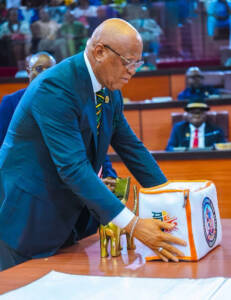
On 25 November 2025, the Governor submitted a consolidated fiscal framework for the 2026 fiscal year to the State House of Assembly—a budget of ₦1.39 trillion.
Following conventional legislative oversight, during which ministries, parastatals, departments, commissions, and statutory boards defended their estimates, the Assembly subsequently approved the “People’s Budget of Expansion and Growth.”
The approved appropriation allocates ₦354.87 billion (approximately 25 per cent of the total) to recurrent expenditure and ₦1.035 trillion (approximately 75 per cent) to capital expenditure.
The 2026 budget is distinguished by three principal features:
An unusually large capital-to-recurrent ratio, with capital expenditure accounting for three-quarters of total outlays;
A pronounced emphasis on roads and physical infrastructure; and
The breadth and scale of discrete capital projects planned across sectors.
The administration frames this heavy capital tilt as an intentional countercyclical and growth-stimulating stimulus designed to accelerate aggregate demand, reduce infrastructure bottlenecks, and catalyse private-sector investment through complementary public goods.
Sectoral allocations within the capital envelope include ₦387.5 billion earmarked for roads and related infrastructure, ₦136.1 billion for health-sector investments, and ₦31.6 billion for education. Budget documents further indicate that roughly 1,000 kilometres of roads are either completed or currently under construction—an indicator of execution momentum.
In addition, the budget provides ₦31 billion for direct empowerment grant initiatives, structured as ₦1 billion allocations to each local government.
This reflects a degree of fiscal decentralisation intended to enhance local-level absorptive capacity, inclusive access to resources, and direct impact on the people.
In sum, the 2026 People’s Budget represents a strategic reallocation toward public capital formation and human-capital-enhancing sectors, accompanied by procedural fiscal scrutiny and a declared focus on translating constituency-level priorities into measurable public investments.
Beyond the sectors already cited, the budget will underwrite flagship projects such as the 350-bed Ibom International Hospital; the dualisation of the Nung Udoe–Afaha Nsit Road; a four-star hotel in Abuja; the Ibom Deep-Sea Port; the expansion of the Ibom Air fleet; and the completion of the Ibom International Hotel, Conference Centre, and shopping mall, among other major undertakings.
With the 2026 budget principally devoted to the welfare of the populace, Governor Umo Eno intends to accelerate the construction of Arise Homes, the government’s housing initiative for the poor and vulnerable, and has set an ambitious target of increasing the total number of units from 301 to 1,000 within the year.
Owing to the extensive road programmes incorporated in the budget, the total length of roads to be delivered by Governor Umo Eno’s administration is projected to reach approximately 1,750 kilometres by the end of 2026, as every local government area has one or more roads slated for construction.
The 2026 budget also provides for the completion of additional model schools at both primary and secondary levels. Furthermore, it makes provision for completing the teaching hospital for Akwa Ibom State University, thereby enabling the institution to secure full accreditation for its Medicine and Surgery, Pharmacy, and other professional medical programmes.
With respect to estate development, the budget will underwrite the finalisation of ongoing projects, including the Judiciary Estate, Judges’ Estate, Ewet Luxury Estate, Dakkada Estate, and the 18-storey real-estate investment in Lagos.
Additionally, the budget will support the construction of more health centres to expand rural residents’ access to healthcare and employment opportunities.
By allocating funds specifically for human and capital development, the budget will also significantly advance small-business empowerment, create jobs for the masses, and increase internally generated revenue for the state.
Overall, the 2026 People’s Budget represents a deliberate reorientation of Akwa Ibom’s fiscal priorities toward capital formation and human development, grounded in exhaustive constituency-level consultations and structured ex-ante appraisal.
The ₦1.39 trillion appropriation—about 75 per cent of which is devoted to capital expenditure—channels substantial resources into roads (₦387.5 billion), health (₦136.1 billion), education (₦31.6 billion), and direct local empowerment (₦31 billion), while underwriting high-profile flagship projects such as the Ibom International Hospital, Ibom Deep-Sea Port, expanded Ibom Air fleet, major estate developments, and hospitality investments, alongside an ambitious social housing expansion under Arise Homes.
The scale and breadth of planned interventions—including a projected 1,750 kilometres of roads by end-2026, new model schools, rural health centres, and the completion of a university teaching hospital—signal a concerted effort to translate grassroots needs into tangible public investments that stimulate demand, reduce infrastructure bottlenecks, and strengthen human capital.
In realising the People’s Budget, Governor Umo Eno has pledged to hinge implementation on rigorous execution, transparent procurement, and sustained legislative and public oversight to secure verifiable welfare gains and long-term fiscal sustainability.




“Machines may operate, but humans still set rules”
Founder and CEO of Scrubbe (also known as Scrubbe Inc.), an autonomous incident-response p…
