

YALI Network Anambra, Climalearnation champion climate awareness among Onitsha students

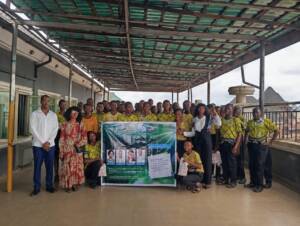
Students of Learning Field International Secondary School, Housing Estate, Onitsha, were equipped with practical knowledge on environmental sustainability and climate responsibility during a Climate Action Workshop jointly organised by YALI Network Anambra and Climalearnation.
The workshop, held on Friday, was themed “Building a culture of reuse, repair, and recycling,” and focused on promoting environmental awareness, responsible waste management, and youth participation in climate action.
The programme was facilitated through the strategic collaboration between Victor Onyekwelu and Ruth Chigbo, whose partnership brought together YALI Network Anambra and Climalearnation in a shared commitment to environmental education and youth engagement.
The event commenced with opening remarks by the Communications and Social Media Manager of YALI Network Anambra, Precious Ogbuka, who welcomed the students and introduced the theme of the workshop. She also introduced the Climalearnation facilitation team led by Mr. Chibuike Ezejiofor, alongside Chinazo Ejiogu, Mmesoma Praise, and Marycynthia Nwasike.
In her presentation, Ogbuka stressed the urgent need for responsible environmental practices, particularly in the area of plastic waste management.
She educated the students on the importance of reusing and recycling materials while also highlighting the need for caution and hygiene in reuse practices.
According to her, environmental sustainability begins with simple individual actions that can create long-term positive impacts within communities.
She encouraged students to establish collection points for used plastic bottles within their homes and schools, explaining that such materials could be packaged and sold, thereby transforming waste into economic value.
Ogbuka further noted that human activities remain major contributors to environmental degradation and climate change, urging the students to become more conscious of their actions and environmental responsibilities.
She also linked the discussion to the United Nations Sustainable Development Goals (SDGs), with special emphasis on SDG 13, Climate Action, explaining that local environmental efforts contribute significantly to global sustainability targets.
The workshop continued with an engaging presentation by Mr. Chibuike Ezejiofor of Climalearnation, who provided deeper insights into the concept of reusing materials and the broader implications of environmental practices.
Ezejiofor challenged the students to think critically and creatively about environmental issues, encouraging them to become innovators and problem-solvers within their communities.
He illustrated the dangers of environmental negligence with a real-life story of how waste pollution in a water body contributed to illness within a community, a narration that resonated strongly with the students and reinforced the practical consequences of improper waste disposal.
According to him, environmental challenges should not only be seen as problems but also as opportunities for young people to provide solutions and demonstrate leadership.
The programme also benefited from the active involvement of other team members. Chinazo Ejiogu coordinated discussions and played a key role during the interactive question-and-answer session, while Mmesoma Praise supported on-ground coordination throughout the workshop.
Marycynthia Nwasike served as the official documenter, capturing important moments and ensuring smooth backstage coordination.
Students actively participated during the interactive session, asking questions and sharing their understanding of climate-related issues.
To encourage participation, educational materials such as exercise books, pens, and mathematics sets were distributed to students who answered questions correctly.
Additionally, all students present received pens as part of the outreach effort, while the overall best-performing student was specially recognised with a school bag as the grand prize.
Participants described the workshop as enlightening and impactful, noting that it increased their understanding of climate change, recycling, and environmental responsibility.
The organisers expressed satisfaction with the level of engagement displayed by the students and reaffirmed their commitment to continuing climate education and youth-focused environmental advocacy programmes across schools and communities.
The workshop concluded with a renewed call for students to become active advocates of sustainability by promoting proper waste disposal, recycling practices, and environmental protection within their schools and communities.





Delta has lost a distinguished statesman, compassionate leader — Ebie mourns Uduaghan
Chairman of the Governing Board of the Niger Delta Development Commission (N…