

“We can’t breathe when it rains, hot”
Inside climate reality facing millions in Lagos

Jeremiah Adeshina
When rain falls in Lagos, it rarely arrives quietly anymore.
Roads disappear beneath muddy water. Traffic freezes for hours. Homes flood from the ground upward. Drains overflow into streets already crowded with vehicles, traders and pedestrians struggling to move. Then, when the storm finally passes, another discomfort settles in almost immediately, intense, humid heat that lingers through the night.
For millions living in Nigeria’s commercial capital, climate change is no longer discussed as a distant environmental threat. It has become a lived reality measured in flooded rooms, sleepless nights and rising uncertainty.
“I used to think flooding was just normal Lagos behaviour,” says Aisha, a trader in Lekki. “But it has changed. It comes faster now, and it destroys more. You can lose everything in one night.”
Across the city, many residents tell similar stories. What once felt seasonal now feels relentless.
A megacity under pressure
Lagos is one of the fastest-growing urban centres in the world, home to more than 20 million people and still expanding. Built partly on coastal land and lagoon systems along the Atlantic Ocean, the city faces a dangerous combination of rapid urbanisation, poor infrastructure pressure, rising sea levels and intensifying temperatures.
Experts have repeatedly described Lagos as one of Africa’s most climate-vulnerable cities.
But for ordinary residents, the science is visible in everyday survival.
In Ajegunle and other waterfront communities, houses sit precariously above waterlogged ground. Wooden structures lean against narrow walkways while drainage channels struggle under the weight of heavy rainfall.
“When it floods, sleep becomes impossible,” says a father of three living near the waterfront. “You keep lifting your belongings higher and praying the water stops rising.”
Many residents say the predictability of weather patterns has disappeared. Rainfall that once arrived gradually now falls suddenly and heavily, overwhelming roads and homes within hours.
Heat that refuses to leave
When the rain disappears, the heat takes over.
In densely populated districts such as Mushin, Agege and Oshodi, residents describe temperatures that feel harsher than in previous decades. Concrete buildings absorb and trap heat during the day, while limited vegetation and shrinking green spaces reduce natural cooling.
Environmental experts identify this as the “urban heat island effect,” where heavily built-up cities retain significantly more heat than surrounding areas.
But in neighbourhoods where electricity supply is inconsistent, the experience feels far more personal than technical.
“I don’t remember Lagos being this hot when I was younger,” says Mrs. Bamidele, a seamstress in Mushin. “Even at midnight, the heat remains. If there is no electricity, nobody sleeps.”
For outdoor workers, bus drivers, market traders, construction labourers and street vendors — the rising heat is becoming a health concern as much as an inconvenience.
Medical workers report growing cases of dehydration, fatigue and heat-related stress, particularly among elderly residents and people working long hours outdoors.
The combination of humidity, overcrowding and unreliable electricity has made extreme heat another silent burden in the city.
When drainage systems collapse
Lagos possesses one of the largest drainage networks in West Africa. Yet each heavy rainfall exposes the fragility of the system.
Blocked canals, indiscriminate waste disposal and uncontrolled construction continue to reduce the city’s ability to channel stormwater effectively. Plastic waste and debris clog drainage paths, transforming waterways into stagnant flood zones.
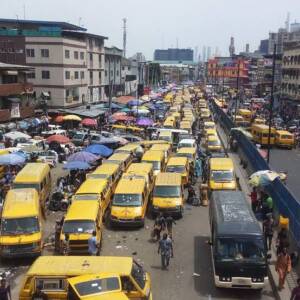
Along major roads such as the Lekki-Epe Expressway and Ikorodu Road, commuters often find themselves trapped for hours after intense rainfall.
Vehicles break down in submerged sections while pedestrians wade through dirty floodwater to continue journeys on foot.
“It’s no longer ordinary rain,” says a commercial bus driver. “Every rainfall now feels like a shutdown.”
Environmental advocates argue that climate change is amplifying existing weaknesses in urban planning and infrastructure. Rainfall that might once have been manageable now becomes destructive because systems are overstretched or poorly maintained.
The Atlantic keeps moving closer
Along Lagos’ coastline, another danger advances more quietly.
Coastal erosion and rising sea levels continue to reshape communities near the Atlantic. In several coastal settlements, land loss has become gradual but visible. Saltwater intrusion damages soil and weakens building foundations, while fishing communities face shrinking access to traditional livelihoods.
Areas once considered safe distances from the shoreline are increasingly exposed to ocean pressure.
For fishermen like Tunde, the changes are impossible to ignore.
“The sea used to be far from where people stayed,” he says. “Now it feels like the ocean is chasing the city.”
Places that once served as gathering points for fishing and recreation have either disappeared or changed dramatically due to erosion and coastal engineering projects.
What disappears first is often not infrastructure, but memory.
The Human Cost Beyond the Headlines
Behind every flooded street is a quieter chain of consequences rarely captured in headlines.
Children miss school after storms. Small businesses lose goods and income overnight. Families temporarily relocate from flooded homes, only to return and repeat the cycle weeks later.
Hospitals frequently record spikes in malaria infections after flooding, while prolonged heat worsens exhaustion and dehydration among vulnerable residents.
Yet many of these impacts are rarely discussed explicitly as climate-related disasters. Instead, they are absorbed into the rhythm of daily struggle.
For low-income communities, especially, climate disruption deepens existing inequalities. Families with limited resources often live in the most flood-prone areas and have the fewest options for recovery.
In many cases, adaptation is no longer a choice. It is survival.
Efforts to respond
Authorities and environmental planners say efforts are underway to strengthen Lagos against climate threats.
Drainage expansion projects, coastal protection initiatives and tree-planting campaigns have all been introduced as part of wider resilience strategies. Urban planners continue to advocate for better waste management systems, improved housing regulation and expanded green spaces.
But many experts warn that the scale of the challenge continues to outpace the speed of intervention.
“Trees are not decoration in cities like Lagos,” says an environmental planner. “They are cooling systems. They reduce heat, absorb water and improve air quality.”
Yet rapid urban growth continues to replace vegetation with concrete, roads and commercial structures.
As population pressure intensifies, the balance between development and environmental protection becomes harder to maintain.
A Younger Generation Is Watching
Among younger Lagos residents, awareness around climate issues is growing rapidly.
On social media platforms, flooded roads, blocked drains and extreme weather conditions are documented daily. Young activists and environmental groups increasingly organise clean-up campaigns, awareness drives and tree-planting projects.
For many young people, climate change is no longer an abstract global conversation. It is visible outside their homes.
“I don’t want to leave Lagos,” says Emmanuel, a university student. “But sometimes I wonder what this city will look like in twenty years.”
That uncertainty hangs heavily over conversations about the future.
A city still moving
Scientists have long warned that coastal cities across West Africa would face some of the world’s harshest climate pressures. Lagos is already confronting that reality.
Yet despite the flooding, the heat and the growing environmental strain, the city continues moving with familiar intensity — markets crowded with buyers, danfo buses forcing through traffic, street traders calling for customers beneath an unforgiving sun.
Life adapts because it must.
But the central question remains unresolved:
How does a city built on water, heat and explosive growth adapt quickly enough to survive all three at once?
For now, Lagos continues adjusting one rainy season at a time — not because the crisis has passed, but because stopping is not an option.




Tinubu’s reforms on course, yielding results — Ebie
Chairman, Governing Board of the Niger Delta Development Commission (NDDC), …