

CAPPA calls for stronger sugar tax as documentary highlights public health crisis

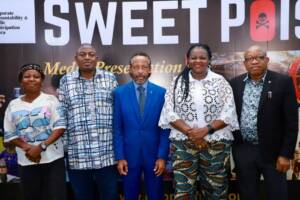
L-R: Diabetes “Lived experience expert” Ronke Opaleye; Executive Director of Corporate Accountability and Public Participation Africa (CAPPA) Akinbode Oluwafemi; Lagos Chairman, Nigeria Medical Association Dr. Saheed Balogun; Founder of the Diabetes & Limb Salvage Foundation (DLSF) Ms. Osarenkhoe Chima-Nwogwugwu; and the CEO of Stradev Nigeria, Dr. Leslie Adogame at the screening of CAPPA’s latest documentary “Sweet Poison” in Lagos recently.
Stanley Ihedigbo
Corporate Accountability and Public Participation Africa (CAPPA) has premiered a new documentary titled Sweet Poison, exposing the growing health and environmental dangers associated with the consumption of Sugar-Sweetened Beverages (SSBs) in Nigeria.
The 20-minute documentary was unveiled during a media presentation in Lagos on Wednesday, where the organisation warned that the increasing popularity of sugary drinks across homes, schools and communities is contributing to a surge in non-communicable diseases (NCDs) such as Type 2 diabetes, hypertension, obesity and cardiovascular diseases.
According to the CAPPA’s Media and Communications Officer, Robert Egbe, the statement described the documentary as both a warning and a call to action against the unchecked consumption of sugary beverages in Nigeria.
The statement explained that the documentary critically examines how ultra-processed food and beverage companies have embedded sugary drinks into everyday Nigerian life through aggressive advertising strategies and widespread market penetration, despite the serious public health implications.
Speaking during the premiere, CAPPA Executive Director, Akinbode Oluwafemi, said the documentary was designed to connect medical realities with the lived experiences of ordinary Nigerians affected by excessive sugary drink consumption.
“Sweet Poison is an attempt to connect the dots,” Oluwafemi said. “It combines medical evidence, lived experiences and on-the-ground realities to show how growing dependence on sugary drinks is quietly reshaping the nation’s health profile.”
Blending expert analysis, personal testimonies and compelling visuals, the documentary features contributions from policymakers, medical professionals, non-communicable disease patients, traders, fishermen and university students.
CAPPA noted that the film also highlights the environmental consequences of the beverage industry, including plastic pollution and resource-intensive production processes that continue to impact communities and ecosystems.
Beyond health concerns, the documentary raises critical questions about the effectiveness of Nigeria’s current Sugar-Sweetened Beverage tax policy introduced under the Finance Act 2021.
The policy imposed a N10 per litre excise duty on non-alcoholic, sweetened and carbonated drinks as part of efforts to reduce excessive consumption while generating revenue for health-related interventions.
However, CAPPA argued that the present structure and scale of the tax have not significantly altered consumer behaviour or curbed harmful industry practices.
The organisation is therefore advocating a stronger and more effective tax framework, including a 50 per cent excise tax on the final retail price of sugary drinks, or at the minimum, a 20 per cent rate, alongside the allocation of part of the generated revenue to public healthcare initiatives.
“With the burden of non-communicable diseases rising and healthcare costs climbing, Nigeria cannot afford half-measures,” Oluwafemi added. “A stronger SSB tax is a fiscal tool, and a necessary public health intervention.”
The screening attracted key stakeholders in the health sector, including Saheed Balogun, diabetes advocate Ronke Opaleye, Founder of the Diabetes & Limb Salvage Foundation Osarenkhoe Chima-Nwogwugwu, Chief Executive Officer of Stradev Nigeria Leslie Adogame, and publisher of Nigeria Health Online Sam Eferaro, among others.
CAPPA disclosed that the documentary first premiered on TVC News on May 5, 2026, and is currently being aired across several media platforms nationwide.
The film is also available on CAPPA’s official YouTube channel and other social media platforms.
According to the organisation, Sweet Poison is intended to spark broader conversations around food systems, public health and government policy, while urging policymakers, the media and citizens to confront what it described as a growing but often overlooked public health crisis.





Caleb University Postgraduate Students celebrate Bello, Aondover, Okunade’s academic elevations
Mercy Iheoma Ihedigbo 2025/2026 Set of postgraduate students of Mass Communi…