

Three years of ARISE agenda: An analysis of Governor Umo Eno’s stewardship in Akwa Ibom

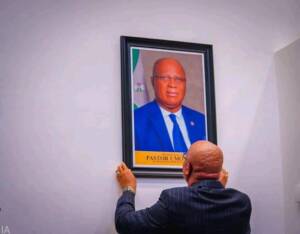
By Emmanuel Nicholas
When Governor Umo Eno assumed office on May 29, 2023, Akwa Ibom faced the familiar paradox of oil wealth coexisting with infrastructural and human capital deficits. Three years later, the state’s landscape bears the imprint of a deliberate, methodical administration that has prioritized completion, expansion, and direct impact over rhetoric.
The ARISE Agenda has served as both a policy compass and public contract. Under the agricultural and educational revolution, healthcare advancement, rural development, infrastructural expansion, security management, economic advancement, and human empowerment, the government has converted budget lines into visible projects that touch rural farmers, civil servants, students, and investors alike.
Infrastructural expansion stands as the administration’s most tangible legacy. Over 1,304 kilometres of roads have been constructed or rehabilitated across the 31 local government areas, opening previously inaccessible communities to trade and mobility. This network is complemented by 43 bridges that have reconnected severed settlements and shortened travel time across riverine and swampy terrain.
The road portfolio also includes 11 dualized highways, collectively spanning more than 200 kilometres. These dual carriageways, particularly around Uyo and the major economic corridors, have eased congestion, reduced accidents, and projected an image of a state preparing for larger economic flows.
Education has received structural attention through the transformation of the College of Education into a University of Education, and the construction of 34 model primary schools. Designed to meet modern standards, these schools have altered the learning environment for thousands of children who once studied in dilapidated structures. The policy signals that quality education begins with dignity in the classroom.
Education financing has been extended to cover terminal examinations. The state now provides free and qualitative education from primary to secondary level and pays approximately ₦800 million annually for West African Examination Council (WAEC) for final-year students. The policy removes a major barrier that once forced many students out of school at the final hurdle.
The governor also provides bursaries to students in tertiary institutions and has made education free from primary to secondary schools.
Healthcare has been addressed at every tier. Twenty-six primary health centres have been built or rehabilitated to bring basic care closer to the people. Four general hospitals have been constructed, with one fully completed and commissioned. Most ambitious is the 300-bed specialty hospital, conceived to reduce medical tourism and provide advanced care within the state and for patients from beyond its borders.
The civil service has been strengthened through merit-based recruitment. Over 8,000 new staff have been employed in the state workforce, addressing manpower shortages in health, education, and administration.
This has been paired with the payment of all outstanding allowances, a ₦80,000 minimum wage, and consistent 13th-month salaries. Leave grants, furniture allowance, wardrobe allowance, promotion allowance, and special grants to workers in rural areas have also been paid.
Pensioners have not been forgotten. More than ₦82 billion in gratuities has been disbursed, restoring confidence among retirees and the current workforce that service will not end in neglect. For a state where gratuity arrears once bred despair, this intervention has carried both economic and psychological weight.
Aviation has emerged as a flagship sector. The international terminal has been completed, and international flights to Ghana have commenced, positioning Akwa Ibom as a regional gateway. Ibom Air has added four aircraft to its fleet, with two more underway, expanding capacity and job creation while keeping the airline competitive.
The feasibility report for the Ibom Deep Seaport has been received, moving one of Nigeria’s most anticipated port projects closer to realization. If executed, the port will alter the economic geography of the South-South and create a maritime and logistics hub with continental reach.
Real estate and hospitality investments have extended beyond the state’s borders. The 12-floor Ibom International Hotel is set to redefine high-end hospitality in Uyo, while an 18-storey real estate investment in Lagos signals the state’s intent to diversify assets and secure revenue outside its territory.
Capacity building has been addressed through the 5,000-seat International Conference Centre, designed to host national and international events. The facility positions Akwa Ibom to compete for conferences, exhibitions, and summits that previously bypassed the state due to inadequate venues.
Housing and urban renewal have been pursued with specificity. The Ewet Luxury Garden Estate targets business-class residents, while the Judiciary Estate and Aviation Village provide structured housing for professionals whose work is critical to governance and transport. Separate housing schemes have been built for members of the House of Assembly and other exclusive cadres.
Social welfare has been anchored on direct support. Over 22,000 youths, men, and women have received grants ranging from ₦500,000 to ₦5,000,000, alongside equipment, with total disbursement exceeding ₦12 billion. The 438 two-bedroom bungalows for vulnerable families, each furnished, solar-powered, and paired with ₦500,000 seed capital, link shelter to economic agency.
Agriculture has been treated as a production and employment engine. The model farm in Nsit Ubium local government area exemplifies the administration’s push toward mechanized, large-scale farming that can absorb labour and stabilize food supply. The government has also established a leasing company to provide mechanized equipment to farmers, and has released several grants, fertilizers, and seedlings to support commercial farming.
Transportation costs have been mitigated through the phased rollout of the Compressed Natural Gas mass transit system. The Ibom CNG terminal at Ikot Akpe, with its training school and maintenance workshop, is designed to create skilled jobs while lowering fares for commuters across the 31 local government areas.
Security and rural development have been pursued through infrastructure and inclusion. Roads into agrarian communities have reconnected farmers to markets, while engagement with traditional institutions has helped contain communal tensions without heavy-handed militarization. This has been done through RAAM projects, and just last week, the 11km Owot-Uta-Ede Ebom Road was completed and commissioned.
Fiscal discipline has underpinned the administration’s programme. Governor Umo Eno cleared ₦34 billion in commercial loans inherited from the previous administration and has not borrowed a single naira since assuming office three years ago. In a period when many sub-nationals have relied on debt for recurrent spending, this restraint has preserved the state’s balance sheet and expanded fiscal space for capital projects.
What has endeared Governor Umo Eno to many Akwa Ibom people is the governing temperament behind these projects. He engages directly, avoids unnecessary confrontation, and maintains a visible presence at project sites. In a political culture often marked by distance, that accessibility has built trust beyond party lines.
The first triennium of the Umo Eno administration will likely be judged by its insistence on finishing what was started, opening new frontiers in aviation and maritime, and tying social investment to productive assets. The challenges of inflation, unemployment, and revenue volatility remain, but the record shows a government attempting to govern with continuity, fiscal restraint, and a focus on outcomes the people can see and use.
Tourism and recreation have been given deliberate attention through the ARISE Palm Resort. The facility integrates a golf course, swimming pools, an artificial river, restaurants, bars, lodging, lawn tennis and volleyball courts, a water park, and a recreational park for both children and adults. Beyond leisure, the resort is conceived as a revenue earner and a symbol of the state’s capacity to host high-value domestic and international guests.
Perhaps the most cited achievement beyond bricks and mortar is the administration’s role in uniting the state. Through a consistent spirit of reconciliation, Governor Umo Eno has drawn actors across political parties and ethnic lines into a shared project of governance. Former adversaries now sit at the same table, and public discourse has shifted from acrimony toward measurable performance.
That spirit of inclusion has produced tangible civic dividends. Akwa Ibom is widely regarded as one of Nigeria’s most peaceful states, with a crime rate estimated at 0.5. The reduction is not accidental; it reflects sustained engagement with traditional rulers, youth groups, and security agencies, coupled with economic programmes that give young people alternatives to violence.
Environmental sanitation has reinforced this image of order. The state has retained its reputation as Nigeria’s cleanest, with regular waste management, public enlightenment, and enforcement ensuring that urban and peri-urban centres remain habitable.
Cleanliness, often dismissed as cosmetic, has become part of the state’s identity and a factor in attracting investors and visitors.
Women’s inclusion in governance has been elevated to an unprecedented level. Forty-five percent of the State Executive Council are women, and 65 percent of Permanent Secretaries are female. Both the Head of Service and her deputy are women, a first in the state’s history. The policy signals that competence, not gender, determines placement at the highest levels of administration.
This commitment extends to the grassroots. Twenty-six of the 31 vice chairmen in the local government administration are women, ensuring that policy implementation at the community level reflects the perspectives and priorities of women. The deliberate opening of political and bureaucratic space has altered the calculus of participation and inspired a new generation of female leaders.
Taken together, these interventions suggest a governing approach that values cohesion as much as construction. Roads and hospitals address material need, but reconciliation, public order, and inclusion address the social conditions in which development takes root. If the next phase sustains this balance, Akwa Ibom may offer a model of sub-national governance where infrastructure, inclusion, and peace reinforce the state’s emergence as one of Nigeria’s most prosperous.



APC Campaign Council denies plot to assassinate Atiku, challenges Timi Frank
Stanley Ihedigbo All Progressives Congress (APC) Presidential Campaign Counc…