
Doherty’s Lagos Plan: Affordable education, cheaper transport, housing, jobs at centre

Michael Olumide
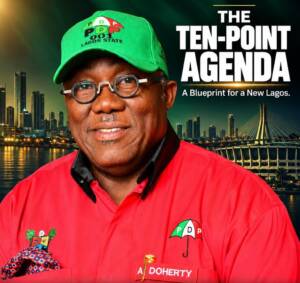
For Engr. Adedeji Doherty’s ambition to govern Lagos is not the product of a sudden political awakening. It is the culmination of a political journey that stretches back to 1999 and includes five attempts at the governorship ticket before finally securing the Peoples Democratic Party (PDP) candidacy in 2026.
An engineer and entrepreneur who built the DAIN Group of Companies from the ground up, Doherty is now presenting himself to Lagos voters with a campaign message centred on what he describes as practical, measurable and delivery-driven governance.
His philosophy is captured in his 10-point agenda, which moves beyond broad political promises to focus on some of the most persistent challenges confronting residents of Lagos — education, transportation, housing, healthcare, youth unemployment, food prices, investment, waste management, tourism, power and taxation.
For Doherty, the experience of building a business is relevant to building a state.
He argues that Lagos requires the same discipline associated with engineering and enterprise: identifying problems, designing workable solutions, allocating resources efficiently and ensuring that projects are delivered.
Education: Taking the pressure off families
At the heart of the agenda is education.
Doherty proposes a partnership between the Lagos State Government and low- and middle-cost private schools to support pupils from identified low-income households through tuition payments.
The objective, according to the candidate, is to ensure that children are not forced out of school because their parents cannot afford school fees.
He frames the proposal not as charity, but as an investment in the future workforce of Lagos.
The broader philosophy is that government should intervene where household economic pressure threatens access to basic opportunities.
Transport: Cutting costs and completing infrastructure
Transportation is another major pillar of the proposed blueprint.
Doherty wants the state’s Bus Rapid Transit fleet converted to Compressed Natural Gas (CNG), arguing that lower operating costs could create room for significant reductions in fares.
His proposal includes a targeted reduction of BRT fares by 50 per cent, alongside additional rebates for qualifying taxpayers.
He also proposes completing the Red and Blue rail lines at what he describes as a reasonable and transparent cost.
The underlying argument is that public transportation should be viewed not merely as infrastructure but as an economic service capable of reducing the daily financial burden on workers, students, traders and businesses.
Housing: Unlocking land for ordinary Lagosians
On housing, Doherty argues that Lagos’ challenge is not simply the availability of land, but the ability and political will to make land accessible for affordable development.
His proposal is to establish partnerships with landowners to develop large-scale low-cost and affordable housing schemes, particularly in the outskirts of the metropolis and underserved Local Government Areas.
He says the model would prioritise genuine affordability and community participation rather than developments designed primarily for high-income residents.
Youth: From Job Seekers to Skilled Workers
For a state with a large youthful population, Doherty places considerable emphasis on skills acquisition and apprenticeship.
His proposed statewide apprenticeship programme would provide structured training while participants receive monthly stipends.
The idea is to give young people an incentive to remain in training long enough to acquire marketable skills.
Rather than relying solely on conventional white-collar employment, the proposal seeks to strengthen vocational and technical pathways into the economy.
Healthcare: Protecting children and the elderly
Healthcare also occupies a central position in the proposed agenda.
Doherty proposes expanding health insurance coverage for children and elderly residents, with indigent residents receiving coverage at no cost.
He also proposes a mandatory insurance arrangement for taxpayers as part of a broader effort to expand the state’s healthcare safety net.
The goal, he says, is to reduce the number of residents who are unable to access medical treatment simply because they cannot afford it.
Food security: Closing the Farm-to-Market gap
With food prices becoming an increasing concern for households, Doherty’s agenda also focuses on agricultural production and logistics.
He argues that the cost of food is influenced not only by what happens on the farm but also by the long chain between production and the final consumer.
His proposal, therefore, combines investment in farm-to-market production with a more efficient logistics network aimed at reducing the gap between the price received by farmers and the price paid by consumers.
For Lagos, which relies heavily on food coming from other parts of Nigeria, an efficient distribution system could become an important component of food security.
Investment: Making Lagos easier to Do business
Doherty’s economic agenda also targets what he describes as bureaucratic bottlenecks confronting investors.
He proposes strengthening institutions responsible for regulating and facilitating investment while reducing unnecessary layers of bureaucracy.
His vision is for a system in which investors can operate within a transparent and predictable regulatory environment.
The ultimate objective, he argues, is to encourage productive investment, job creation and economic expansion.
Waste: Turning a Problem into an Economic Resource
Waste management features prominently in the blueprint, but Doherty approaches it from both an environmental and economic perspective.
His proposal combines modern waste-management technology with community participation and source separation at household and market levels.
He also advocates greater value addition to waste, arguing that materials currently treated as refuse can become economic resources capable of attracting investment and creating employment.
The approach would require residents, markets, businesses and government agencies to participate in a coordinated waste-management system.
Entertainment and Tourism: Expanding Lagos’ Creative Economy
Doherty also wants Lagos to take greater advantage of its reputation as Africa’s entertainment capital.
His agenda proposes increased investment in entertainment, recreation and tourism, including cultural festivals, recreational parks and creative hubs.
The objective is to transform Lagos’ cultural and creative strengths into more jobs, investment opportunities, tourism revenue and civic pride.
Given the state’s large entertainment and creative ecosystem, the sector could potentially become an even larger component of the state’s economic strategy.
Power, jobs and fair taxation
The final component of the agenda brings together power, employment, taxation and institutional respect.
Doherty says his approach to infrastructure and power would be informed by his engineering background and experience building the DAIN Group of Companies.
He also promises an industrialisation-focused approach to job creation, arguing that employment programmes must be connected to real economic activity.
On taxation, he advocates fairness, while also pledging full payment of the approved minimum wage.
He further promises greater respect for traditional institutions and the civil service.
A different political proposition?
Doherty’s political journey is itself part of the story.
A PDP loyalist since 1999, he has contested the party’s governorship primary on several occasions. After five primary contests since 2007, he finally emerged as the party’s candidate in 2026.
That history gives his current campaign a different narrative from that of a newcomer suddenly seeking public office.
His candidacy is being presented as the next stage of a political journey that has survived repeated electoral setbacks and continued within the same political platform.
But securing a party ticket is one challenge; convincing Lagos voters is another.
The state’s political landscape is complex, its electorate highly diverse, and its expectations enormous.
Doherty is therefore placing his campaign around a central proposition: that Lagos needs governance designed around practical solutions rather than political rhetoric.
His 10-point agenda seeks to make that proposition concrete — through cheaper transportation, broader access to education and healthcare, affordable housing, skills development, food security, investment reforms, modern waste management, stronger creative industries, jobs and infrastructure.
Whether those proposals can be translated from campaign commitments into implementable public policy will ultimately be determined by the electorate and, if elected, the capacity of his administration to execute them.


Khadijat Bello: PDP Deputy Governor Candidate brings banking, business experience to Lagos 2027 Race
Mercy Iheoma Ihedigbo Peoples Democratic Party (PDP) deputy go…