

NDDC projects strengthen Tinubu’s development credentials in Niger Delta ahead of 2027

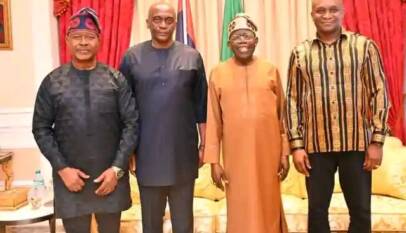
 L/R: Executive Director, Corporate Services (NDDC), Hon. Ifedayo ‘Abena’ Abegunde; Chairman, Governing Board of NDDC, Mr. Chiedu Ebie; President, Federal Republic of Nigeria, His Excellency, Bola Ahmed Tinubu (GCFR); and Managing Director NDDC, Chief Sam Ogbuku Phd, during a recent visit to the Presidential Villa.
By Jerome-Mario Utomi
Niger Delta Development Commission (NDDC) is increasingly emerging as a critical instrument for translating President Bola Ahmed Tinubu’s Renewed Hope Agenda into tangible development across the Niger Delta, with its growing portfolio of infrastructure and human-capital projects offering a compelling narrative ahead of the 2027 general elections.
From roads and bridges to electricity, scholarships, youth empowerment and digital skills acquisition, the Commission’s interventions are strengthening the Federal Government’s development footprint in a region whose stability and prosperity remain vital to Nigeria’s economic growth.
This development featured prominently during a recent visit by the NDDC Governing Board Chairman, Mr Chiedu Ebie; Managing Director/Chief Executive Officer, Chief Samuel Ogbuku; and Executive Director, Corporate Services, Hon. Ifedayo ‘Abena’ Abegunde, to President Tinubu.
The delegation briefed Mr. President on the Commission’s programmes and achievements.
At the heart of the NDDC’s strategy is a commitment to align its operations with the Renewed Hope Agenda, translating policy objectives into projects that directly improve the lives of the people.
Ogbuku has, in like manner, reaffirmed this commitment by noting that the Commission’s priority is to deliver development, complete abandoned projects and accelerate infrastructure delivery in line with the President’s directives.
The figures provide an indication of the scale of the task. According to the Commission, its project database contains more than 21,000 projects and programmes, with over 9,000 completed across its 13 mandate states and 18 development sectors.
Among its flagship interventions is the 1.2-kilometre Kaa-Ataba Bridge in Rivers State, linking Khana and Andoni Local Government Areas.
The bridge is expected to ease transportation difficulties, connect previously underserved communities and stimulate commerce.
Its completion reflects the administration’s emphasis on turning inherited infrastructure commitments into functional assets.
Other strategic projects, including the Benin-Sapele Expressway, Kaa-Ataba Road and Bonny Ring Road, further demonstrate the importance of sustained investment in regional connectivity.
Beyond infrastructure, the NDDC’s Light Up the Niger Delta initiative deploys solar-powered streetlights to improve security, encourage night-time economic activities and support community stability.
Education, postgraduate scholarships, school facilities and targeted empowerment programmes for women, young people and persons with disabilities also feature prominently in its development agenda.
These interventions reinforce a fundamental political reality: government performance becomes meaningful to citizens when policies translate into visible improvements in their daily lives.
Ebie, the Governing Board Chairman, has at different times and places stressed the importance of communicating development outcomes and ensuring that communities experience the benefits of government programmes.
His position underscores the need for projects that citizens can see, use and evaluate, particularly in a region long burdened by infrastructure deficits.
By linking the Commission’s interventions to the broader transformation objectives of the Tinubu administration, Ebie has also advocated sustained support for the President’s Renewed Hope Agenda ahead of 2027.
The underlying argument is straightforward: continuity becomes more persuasive when it is supported by measurable results and projects that address longstanding community needs.
Ogbuku has equally made his political position clear. In November 2024, while dismissing speculation that he intended to contest the Bayelsa governorship election, he declared that his priority was to serve the Niger Delta and support President Tinubu. He indicated that, if he had a political ambition, it would be to work for the President’s re-election in 2027.
His emphasis on service delivery is significant. Political endorsements may communicate loyalty, but completed projects provide the tangible evidence that can make a government’s development claims credible.
In April 2026, NDDC’s leadership/Management again briefed President Tinubu on progress with the Commission’s legacy projects, attributing the achievements to the support of the Presidency and reaffirming the directive to complete projects for the benefit of Niger Delta residents.
The Commission’s partnerships, including collaboration with Nigeria LNG Limited on strategic infrastructure, also show how institutional cooperation can expand development opportunities and accelerate project delivery.
As the 2027 elections approach, the NDDC’s performance could strengthen the Tinubu administration’s appeal in the Niger Delta.
Better roads can reduce travel costs and improve the movement of goods; reliable electricity can support businesses; and scholarships and digital skills programmes can widen opportunities for young people.
These benefits matter in a region central to Nigeria’s oil and gas economy, where development, investment and peace have national implications.
The political implications are clear. While the NDDC’s performance alone cannot determine the outcome of the 2027 elections, sustained delivery can provide President Tinubu with a stronger development record to present to voters in the region.
With Ebie providing board-level leadership and Ogbuku driving management and project execution, the Commission has an opportunity to demonstrate that the Renewed Hope Agenda can produce practical results where they matter most.
Ultimately, the strongest argument for continuity is performance.
As NDDC continues to sustain its momentum, complete strategic projects and expand opportunities for Niger Delta communities, its achievements could become a significant asset to President Tinubu’s 2027 re-election campaign.



Ondo aircraft crash: Jani Ibrahim expresses solidarity with Tinubu, Armed Forces
Charles Okonji (Group Business Editor) Nigerian Association of Chambers of C…