

NCC, REA unite to bridge power, connectivity gaps in underserved communities

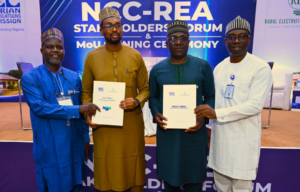 L-R: Director, Legal Services, Rural Electrification Agency (REA), Mr. Kashim Ibrahim; Executive Director, Technical Services (REA), Engr. Umar Abdullahi Umar; Executive Commissioner, Technical Services Nigerian Communications Commission (NCC), Engr. Abraham Oshadami; and Director, Commission Secretariat (NCC), Mr Gwa Tobbie Mohammed, during the NCC-REA Stakeholders’ Forum and MoU Signing Ceremony, at the Commission’s Annex, Mbora, Abuja.
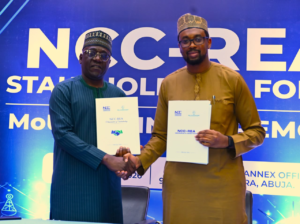
L-R: Executive Commissioner, Technical Services, Nigerian Communications Commission (NCC), Engr. Abraham Oshadami, and Executive Director, Technical Services, Rural Electrification Agency (REA), Engr. Umar Abdullahi Umar, during the NCC-REA, Stakeholder Forum and MoU Signing Ceremony, held on July 24, 2026, at the NCC Annex Office, Mbora, Abuja.
Stanley Ihedigbo
Nigerian Communications Commission (NCC) and the Rural Electrification Agency (REA) have signed a Memorandum of Understanding (MoU) aimed at accelerating the expansion of sustainable digital infrastructure across Nigeria through the integration of renewable energy solutions with telecommunications infrastructure.
The agreement was formalised during the NCC–REA Stakeholder Workshop held at the NCC Annex Office Auditorium, Mbora, Abuja.
The workshop, themed “Unlocking the Energy–Telecoms Nexus for Scalable Digital Infrastructure in Nigeria,” brought together government officials, telecommunications operators, tower companies, renewable energy developers, financiers, development partners and other key stakeholders.
According to Director, Public Affairs
Nigerian Communications Commission, Mrs. Nnenna Ukoha, speaking at the event, the Executive Vice Chairman and Chief Executive Officer of the NCC, Dr. Aminu Maida, was represented by the Executive Commissioner, Technical Services, Engr. Abraham Oshadami described the partnership as a significant milestone in Nigeria’s quest to achieve inclusive digital connectivity and improved access to electricity.
According to Oshadami, reliable electricity and digital connectivity are inseparable pillars of national development and economic growth.
“Reliable electricity and digital connectivity are not two separate development goals. They are mutually reinforcing foundations of the same objective that produce an inclusive and productive economy,” he said.
He explained that communities lacking stable electricity often struggle to sustain telecommunications infrastructure, while areas without digital connectivity are unable to maximise the benefits of electrification projects.
Oshadami disclosed that the partnership provides a practical framework for harmonising telecommunications and rural electrification programmes through coordinated planning, infrastructure sharing and renewable energy deployment.
Under the arrangement, the REA will provide geospatial information on existing and planned rural electrification projects, while the NCC will supply data on Universal Service Provision Fund (USPF) projects.
The shared information, he noted, will enable both agencies to identify underserved communities and plan interventions more effectively.
He added that the collaboration would also explore powering telecommunications infrastructure, including base stations and fibre repeater sites, with renewable energy generated through REA’s off-grid projects. In addition, telecom infrastructure may be co-located on REA-developed energy assets wherever technically feasible.
According to him, the initiative will significantly reduce infrastructure deployment costs, improve operational efficiency and accelerate broadband expansion to underserved and unserved communities across the country.
Also speaking was the Managing Director and Chief Executive Officer of the REA, represented by the Executive Director, Technical Services, Engr. Umar Abdullahi Umar stressed that reliable energy remains the backbone of Nigeria’s growing digital economy.
He noted that renewable energy mini-grids offer a cleaner, more sustainable and cost-effective alternative to diesel-powered telecommunications facilities, creating new commercial opportunities for telecom operators and renewable energy developers.
“Reliable power and universal connectivity are not competing priorities. They are the same priority, approached from two directions. Where we deliver them together, the cost of each falls, and the reach of both extends,” he stated.
The workshop also featured presentations by the NCC–REA Collaboration Committee, highlighting geospatial analysis, pilot project opportunities and implementation strategies.
Panel discussions focused on financing models, policy and regulatory frameworks, as well as infrastructure planning needed to support the initiative.
Oshadami urged stakeholders to move beyond expressions of support by identifying practical financing mechanisms, sustainable commercial models and enabling regulatory measures capable of translating the partnership into large-scale projects with lasting impact.
The NCC said the Memorandum of Understanding marks a major step towards strengthening collaboration between both agencies in support of the Federal Government’s digital economy and rural development agenda.
Through the partnership, the NCC and REA aim to improve infrastructure planning, expand broadband connectivity, promote the adoption of renewable energy in telecommunications networks and deliver resilient, scalable and sustainable digital infrastructure that will stimulate socio-economic development and bridge Nigeria’s digital divide.



Tinubu’s reforms on course, yielding results — Ebie
Chairman, Governing Board of the Niger Delta Development Commission (NDDC), …