

Legal experts push to turn migrants’ rights into reality in West, Central Africa

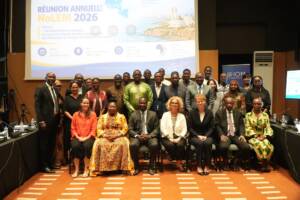 Participants at the third annual meeting of the Network of Legal Experts on Migration in West and Central Africa (NoLEM), working to strengthen migration law and access to justice across the region. Photo: IOM / Moustapha Kalil Ouattara, 2026
Stanley Ihedigbo
Legal experts from across West and Central Africa have renewed efforts to strengthen migrants’ rights and improve access to justice, following the third annual meeting of the Network of Legal Experts on Migration for West and Central Africa (NoLEM) in Dakar, Senegal.
The five-day meeting brought together more than 30 participants, including NoLEM members, representatives of the Senegalese government, United Nations agencies, the International Detention Coalition (IDC), law students and the Swiss Agency for Development and Cooperation (SDC).
The meeting focused on strengthening regional cooperation on migration law, reviewing the Network’s achievements and establishing strategic priorities for the coming years.
Established in November 2022, NoLEM brings together legal experts committed to upholding migrants’ rights across West and Central Africa. Since its establishment, the Network has developed expertise in key areas of migration law, including migrant detention and access to justice, while identifying legal and institutional barriers confronting people on the move.
Speaking at the opening of the meeting, NoLEM Chair, Professor Abdou Khadre Diop, emphasised the need to ensure that legal expertise translates into tangible improvements in the lives of migrants.
“Behind every recommendation we make is a worker detained at a border, a woman denied access to legal protection, a family displaced by land that has become barren,” Diop said.
He added that the Network’s success should not be measured by the number of publications it produces but by its ability to narrow the gap between rights proclaimed and rights experienced.
The renewed commitment comes amid complex migration realities across West and Central Africa, where population movements are closely linked to economic, social, environmental and security challenges.
An estimated 11.3 million migrants live across the region, with 77 per cent originating from another country within West and Central Africa, highlighting the importance of regional cooperation in addressing migration-related challenges.
However, migration journeys can expose people to significant risks, particularly along routes crossing deserts, oceans and international borders.
In 2025, more than 3,800 deaths or missing migrants were recorded along routes crossing the Western and Central Mediterranean, the Atlantic Ocean and the Sahara Desert.
Similarly, between 2021 and 2025, the International Organization for Migration (IOM) assisted 191,050 migrants with voluntary return, including 55,525 in 2025.
Against this background, participants at the Dakar meeting advanced plans to strengthen NoLEM’s institutional structure and expand its membership to accommodate additional countries and areas of legal expertise.
The meeting also laid the groundwork for establishing a regional network of legal clinics, an initiative expected to support access to justice and strengthen practical legal assistance for migrants.
Members further agreed on the direction of the Network’s next publication, with the aim of translating its research, knowledge and professional exchanges into practical contributions to migration policy and legal practice across the region.
IOM Deputy Regional Director for West and Central Africa, Anna Eva Radicetti, said the priority was to ensure that the knowledge and partnerships developed by the Network reached professionals, institutions and researchers working on migration issues.
“The question is no longer only what NoLEM has achieved, but how the knowledge, exchanges and partnerships it has fostered can be further leveraged and made available to professionals, institutions and researchers working in the field of migration,” Radicetti said.
At the conclusion of the five-day consultations, NoLEM members adopted a 2026–2027 roadmap to guide the Network’s future activities and establish a common framework for its priorities.
The roadmap is expected to support the consolidation of NoLEM as a regional platform for legal expertise, dialogue and cooperation on migration law.
The Network’s next phase will focus on building stronger institutional partnerships, broadening its regional reach and promoting practical approaches to ensuring that migrants can effectively exercise their rights and access justice across West and Central Africa.




Obi interview with ARISE TV
By Kunle Oyatomi Peter Obi must be living in a different world outside Niger…