

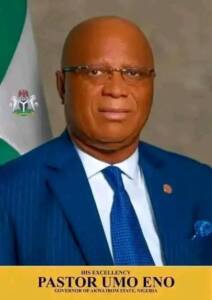
Gov. Umo Eno operates strictly within approved budget framework, Aide insists

Tony Okoh, Uyo
Special Assistant to Akwa Ibom State Governor Umo Eno on Social Media, Revd. Richard Peters has defended the fiscal management approach of the state government, maintaining that the administration operates strictly within the confines of an approved budget and established financial regulations.
Speaking during a live radio programme monitored by journalists on Tuesday, Peters dismissed allegations of reckless or unapproved spending by the state government, insisting that all expenditures undertaken by the administration are backed by legislative approval and guided by the state’s fiscal framework.
According to him, government spending in a constitutional democracy cannot be conducted arbitrarily, stressing that every financial commitment made by the administration is tied to specific provisions contained in the state’s approved budget.
“Governor Umo Eno operates within this framework, fully aware that accountability is not optional but mandatory, and that every expenditure must be justified within the limits of the approved fiscal plan,” Peters stated.
He explained that no state government possesses the legal authority to spend public funds outside the appropriation process without first obtaining legislative approval through supplementary budgetary procedures where necessary.
Reacting to criticisms suggesting that the governor was engaging in frivolous spending outside structured approval channels, Peters described such claims as misleading and unsupported by facts.
He noted that beyond the annual budget, there are existing fiscal responsibility structures and performance monitoring mechanisms designed to evaluate government spending, revenue generation and project implementation.
“These are not subjective assessments. They are carried out by regulatory and oversight bodies that track revenue inflows, expenditure patterns and development outcomes,” he said.
Peters further disclosed that Akwa Ibom State’s fiscal performance index for 2025 reportedly stood above 80 per cent, which he described as a strong indication that budget implementation remains largely on course and within acceptable benchmarks.
He argued that available performance indicators and official records do not support allegations of financial opacity or mismanagement against the administration.
“It is therefore misleading to suggest that with several indicators already pointing to improved budget performance this year, it becomes difficult to sustain claims of financial opacity or mismanagement without evidence drawn from official records,” he said.
“The state’s budget performance documents, expenditure breakdowns and allocation details are not hidden. They are in the public domain and accessible to journalists, analysts and citizens willing to consult verified government sources.”
The governor’s aide urged critics and commentators to base public discourse on verifiable data rather than speculation or sensational narratives.
He cautioned against what he described as attempts to use graphics and unverified figures to create misleading impressions about the state’s finances, emphasizing that public accountability should be anchored on facts and documented evidence.
“Before rushing to sensational claims and graphic insinuations, it is important to ground the conversation in the basic realities of public finance and governance. In every constitutional democracy, including Akwa Ibom State, government spending does not occur in a vacuum or at the whim of any individual,” Peters stated.
He reiterated that every kobo expended by the administration is linked to clearly defined budgetary allocations approved through due legislative processes.
Addressing concerns about the state’s financial obligations, Peters pointed out that monthly revenue inflows are utilized to meet critical responsibilities such as salary payments, pensions, gratuities, overhead costs and ongoing infrastructure projects.
He noted that major government initiatives, including housing programmes, extensive road construction projects spanning over a thousand kilometres and other development interventions, are funded through the same resources that have come under public scrutiny.
According to him, these projects constitute tangible investments aimed at improving the welfare of citizens and stimulating economic growth across the state.
Peters concluded by emphasizing that governance should be evaluated through measurable outcomes, audited reports and documented performance records rather than emotional rhetoric.
“Ultimately, governance should be assessed through evidence, documentation and measurable outcomes, not through emotional slogans or misleading graphics. If accountability is truly the concern, then it must begin with a proper review of published budgets, audited reports and performance data, not through rhetorical accusations detached from fiscal reality,” he said.




APC Campaign Council denies plot to assassinate Atiku, challenges Timi Frank
Stanley Ihedigbo All Progressives Congress (APC) Presidential Campaign Counc…
