

Gov. Eno, deliberate imprint in aviation sector

By Solomon Essiet
Since assuming office, Governor Umo Bassey Eno has shown that aviation is not a side issue in his development plan for Akwa Ibom State. His administration has continued from where previous governments stopped, but with its own clear direction under the ARISE Agenda.
What is taking shape is more than airport expansion. It is a deliberate push to make aviation a real part of the state’s economy, with attention to infrastructure, airline growth, technical capacity, human capital and long-term investment.
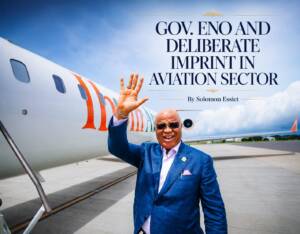
One of the clearest signs of this progress is the steady growth of Ibom Air, Nigeria’s only state-owned airline and one of the most respected carriers in the country. The airline now operates from the newly unveiled International Terminal wing of the airport, giving passengers a better travel experience and raising the profile of the state’s aviation sector.
Under Governor Eno’s watch, Ibom Air has strengthened its fleet. The arrival of two additional CRJ 900 Bombardier aircraft in late 2024, together with the introduction of Airbus A220-300 aircraft, has improved the airline’s capacity and competitiveness. With at least four aircraft added during this administration, it is clear that the government understands the need for scale, reliability and consistency in the aviation business.
Another major milestone was the Federal Government’s approval in November 2025 for full international flight operations at Victor Attah International Airport. Such approval does not come by chance. It followed serious work on airport facilities and technical systems needed to bring the airport closer to international standards.
The administration has worked on the terminal, replaced navigational aids, upgraded airfield lighting and addressed important obligations required for smoother operations. The resumption of night flights in 2025 was also a major step, especially for an airport seeking to function beyond limited daytime operations. With international flights expected to commence fully, Akwa Ibom is gradually moving from promise to delivery.
The ongoing Maintenance, Repair and Overhaul facility is another project with long-term value. When completed and fully operational, the MRO will not only serve Akwa Ibom or Nigeria, but could become useful to the wider West African aviation market.
This kind of investment can help reduce the dependence on foreign aircraft maintenance facilities. It can also create skilled jobs, save foreign exchange and attract aviation-related business into the state. It shows that Governor Eno is not only thinking about flights and passengers, but about building a proper aviation economy.
That wider vision can also be seen in the Aviation Village project at Victor Attah International Airport. The idea is to build an integrated aviation environment with space for training, accommodation and other support services around the airport.
This is the kind of planning that looks beyond immediate political applause. It is about future demand, industry support and long-term relevance. If pursued with discipline and consistency, the Aviation Village could become one of the strongest pillars of Akwa Ibom’s economic transformation.
Human capacity development has also been part of the governor’s approach. His administration has supported the training of Akwa Ibom indigenes in specialised aviation fields, including pilot training and aeronautical engineering.
In 2025, the governor received beneficiaries of overseas training programmes, including trainees from the Airbus Flight Academy in France. This is important because no aviation sector can grow on buildings and aircraft alone. It must also be supported by skilled people who can operate, maintain and manage the system.
By investing in young professionals, the Eno administration is laying a foundation that can outlive one government. These trainees represent the future workforce of the state’s aviation industry, and their exposure to global standards is a gain for Akwa Ibom.
The progress has not gone unnoticed. The Minister of Aviation and Aerospace Development, Festus Keyamo, has acknowledged the work being done in Akwa Ibom’s aviation infrastructure. That recognition is important, but what matters even more is the way these projects connect to the bigger economic picture.
A stronger airport can support tourism, trade, investment, job creation and wider access to the Niger Delta region. Ibom Air continues to give the state visibility, while the airport infrastructure is helping Akwa Ibom position itself as a serious gateway for business and travel.
Governor Umo Eno’s interventions in the aviation sector are not isolated projects. They are part of a broader development philosophy that sees aviation as a tool for opening up the state, attracting investors, creating opportunities and projecting Akwa Ibom beyond Nigeria’s borders.
This is the ARISE Agenda in motion. It is practical, steady and forward-looking. With the right management and sustained commitment, Akwa Ibom is well-positioned to become one of the important aviation growth centres in West Africa.
Arise, that same God.
Essiet, ACIA, Special Assistant on New Media to the Governor of Akwa Ibom State


IOM hands over irrigation farms to Ghana communities, targets year-round farming
IOM Ghana Chief of Mission joins community members in planting seedlings during the handov…