

Effective policing is key to national security, says Prof. Nwokolo

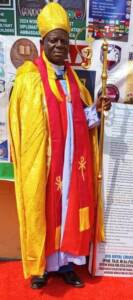
Stanley Ihedigbo
Marking his 64th birthday and decades of service to the nation, Prof. Michael Nwokolo, Nigeria’s first Police Professor and Archbishop, has renewed his call for a digital overhaul of the Central Criminal Registry to enhance crime investigation, speed up prosecutions and improve national security.
Speaking at his birthday ceremony, the man of God said that the Nigeria Police Force, widely regarded as one of the leading law enforcement agencies in Africa, has recorded notable milestones over the decades.
“From peacekeeping operations in the 1990s in Namibia and Somalia under the United Nations and African Union frameworks to its modern successes in cybercrime control, the Force continues to demonstrate professionalism and relevance in a changing security environment.
“In 2024, the Nigerian Police received international recognition from the Interpol Cybercrime Directorate in Singapore. The Nigeria Police National Cybercrime Centre (NPF–NCCC) recovered over ₦8.8 billion, $84,000 and 115,237.91 USDT from cybercriminals, arrested and prosecuted more than 751 suspects and seized hundreds of digital devices and properties. The award affirmed Nigeria’s growing capacity in digital security and crime prevention.
“Policing involves all lawful activities undertaken by security agencies to maintain law and order, protect lives and property, regulate behaviour and prevent crime. Effective policing goes further by prioritising community engagement, intelligence gathering, crime prevention, problem-solving and trust-building between the police and the citizens,” he explained.
He noted that the recent partnerships with community intelligence agents and security stakeholders have yielded encouraging results, confirming that community-based policing remains central to sustainable internal security.
“At the heart of police operations lies criminal investigation and crime prevention, functions anchored by the Force Criminal Investigation Department and the Central Criminal Registry (CCR). Established on November 16, 1922, in Lagos and later expanded to Kaduna in 1956, the CCR remains Nigeria’s foremost forensic identification centre,” he explained.
Prof. Nwokolo, who served for 27 years at the Central Criminal Registry within his 35 years of meritorious service in the Nigeria Police Force from 1992 to 2019, further noted that under successive Inspectors-General, he headed the Latent Fingerprint Section for over two decades, lectured in police colleges, served as expert witness in courts and contributed directly to numerous criminal convictions.
According to him, the CCR derives its authority from the Prevention of Crime Act of 1958 and the Administration of Criminal Justice Act (2015).
“Its functions include fingerprint registration, criminal record management, crime scene analysis, identification parades, ballistic examination, forensic photography and document analysis. Despite its importance, Nigeria’s criminal record system remains largely manual.
Prof. Nwokolo therefore appealed to the Inspector-General of Police to complete the digitalisation of criminal records, retrain forensic personnel in both manual and electronic methods and enforce the mandatory transmission of fingerprints from courts and correctional facilities to the CCR.
He stressed that the CCR remains the sole custodian of fingerprints in Nigeria and should be strengthened as the nation’s equivalent of Scotland Yard.
“With over two million criminal records, digital reform is essential for faster investigations, inter-agency cooperation and modern crime detection,” he further stressed.
Between 2007 and 2012, Prof. Nwokolo visited 114 crime scenes and examined 47 disputed documents, leading directly to confessions and convictions. In several landmark cases in Lagos and other states, suspects who initially denied their fingerprints later confessed after forensic reports were tendered in court.
His areas of specialisation include fingerprint science, criminal profiling, criminal intelligence, forensic handwriting analysis and security consultancy.
These multifaceted contributions earned him several national and international honours, including the 2023 Most Versatile Security Consultant Award and the 2025 Global Icon Premium Award.
Challenges Confronting the Nigerian Police
The Retired Senior Police officer and Security Expert lamented that despite notable progress, the Nigerian Police continued to face serious challenges, including: absence of a functional national criminal database, incomplete digitalisation of criminal records, poor salary and pension structure, inadequate barracks accommodation, shortage of patrol vehicles and communication gadgets, as well as insufficient arms, ammunition and modern forensic equipment.
Prof. Nwokolo observed that welfare and infrastructure directly affect morale and efficiency, noting that a well-protected police force is better positioned to protect citizens.
“Beyond conventional crime, emerging social behaviours now pose security risks. Harmful skits and pranks on social media generate false alarms, emotional trauma and public disorder,” he emphasized.
Drawing from the Broken Window Theory, he warned that unchecked minor misconduct often escalates into serious crime.
He called on the Inspector-General of Police, the National Assembly and the Presidency to regulate harmful online content, educate citizens and empower institutions such as the National Orientation Agency, broadcasting regulators and educational bodies to promote responsible conduct.
As Nigeria continued to confront evolving security threats, Prof. Nwokolo maintained that effective policing anchored on science, discipline, integrity and digital transformation remains the surest path to national stability.
“There is no doubt that if these issues are addressed,” he said, “Nigeria will become safer and stronger for all.”


NDLEA freezes drug traffickers’ accounts, seizes hotels, assets
Taiwo Adeyeye National Drug Law Enforcement Agency (NDLEA) has intensified i…