

Domestic image determines Nigeria’s Global standing, says Otubanjo


Stanley Ihedigbo
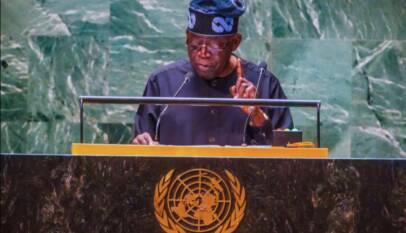
A Research Professor at the Nigerian Institute of International Affairs (NIIA), Professor Femi Otubanjo, has defended President Bola Tinubu’s absence from the United Nations General Assembly (UNGA), arguing that the President’s annual leave and Nigeria’s national interest should be considered in assessing the decision.
Otubanjo made the remarks on Tuesday while speaking on ‘Frontline’, a current affairs programme on Eagle 102.5 FM, Ilese-Ijebu, Ogun State, during a discussion on Tinubu’s absence from the 81st UNGA in New York.
According to the professor, the controversy surrounding the President’s non-attendance has overlooked the circumstances of his absence and the diplomatic significance of Nigeria’s representation at the international gathering.
“The majority of people talk without putting it in the proper context. Number one context is that President Bola Tinubu is on his annual leave, and when he is on leave, he leaves the work of the office to other people to do it, and UNGA is not so important,” he said.
Otubanjo stressed that Nigeria’s national interest, rather than the physical presence of the President at the General Assembly, should be the primary consideration.
“The main thing is Nigeria’s national interest,” he declared.
He noted that Vice President Kashim Shettima was leading Nigeria’s delegation to the gathering, arguing that the country remained adequately represented at a senior level.
“What is important, very important, is that we are represented. And we are represented at the highest level. That is the Vice President,” he said.
Shettima is expected to deliver Nigeria’s national statement and participate in high-level meetings and bilateral engagements with world leaders, international organisations and development partners.
Presidential attendance not compulsory, says Professor
Otubanjo maintained that a president’s physical attendance at the UNGA should not be treated as a compulsory requirement, noting that diplomatic responsibilities could be delegated to other senior government officials.
“It is not compulsory for a president to be at the United Nations General Assembly. What is important is representation, and this time we are represented by the number two man in the country,” he said.
He also questioned the assumption that a president’s presence at international gatherings automatically translates into meaningful diplomatic engagements.
According to him, some encounters between world leaders at such events are largely ceremonial, involving brief exchanges of goodwill rather than substantive negotiations.
Otubanjo explained that more detailed diplomatic discussions could take place through bilateral meetings and established diplomatic channels outside the main General Assembly sessions.
He cited the experience of the COVID-19 pandemic as evidence that technology has made it possible for leaders to conduct official engagements remotely.
“COVID taught all of us how to work remotely. The President is talking to his ambassadors and talking to businessmen outside Nigeria,” he said.
The professor’s comments came amid renewed debate over Tinubu’s absence from the gathering, with former Vice President Atiku Abubakar questioning the President’s repeated non-attendance and arguing that the Vice President’s representation could not entirely replace the President’s personal authority and visibility.
The Presidency has maintained that Nigeria is fully represented and that Shettima is attending with the President’s mandate.
Domestic governance determines international image
Beyond the controversy surrounding the President’s attendance, Otubanjo argued that Nigeria’s international reputation depends significantly on its domestic governance and the welfare of its citizens.
“A nation’s domestic image determines its international image,” he said.
He noted that the growing accessibility of information means developments within Nigeria increasingly influence how the country is perceived by the international community.
“There is no remote country as information is easily accessed from any location on earth,” he added.
The professor called for a domestic reset anchored on good governance, accountability, transparency and prudent management of public resources.
He argued that Nigeria’s ambition to exercise greater influence in Africa and the wider international system must be supported by credible governance and a demonstrated commitment to citizens’ welfare.
According to him, the country cannot effectively project itself as a leading African nation while neglecting the domestic issues that shape its international standing.
Otubanjo questions government spending priorities
The NIIA professor also criticised what he described as misplaced priorities in government expenditure, citing spending on infrastructure, an aircraft and religious pilgrimage.
He alleged that the Federal Government had spent N21 billion on a residence for the Vice President, $150 million on an aircraft and N90 billion on the Hajj pilgrimage.
“Those listening to him know that the Federal Government had just spent N21 billion on building a house for Shettima; spent $150 million on an aircraft; wasted N90 billion for people to go to Mecca,” he said.
Otubanjo argued that government spending should be guided by the needs of ordinary Nigerians, with greater emphasis on public welfare and accountability.
“Nigeria has leaders who don’t know how to order their priorities and focus on their people,” he said.
His comments linked the debate over Nigeria’s international visibility to broader concerns about how public resources are allocated and whether government expenditure adequately addresses citizens’ needs.
Nigeria’s global ambitions require domestic reforms
Otubanjo also addressed Nigeria’s ambition to maintain its position as the Giant of Africa and strengthen its influence in international affairs.
He noted that Nigeria seeks a stronger role in regional organisations, including the African Union and the Economic Community of West African States, while supporting efforts to secure permanent African representation on a reformed United Nations Security Council.
He maintained that achieving these objectives requires Nigeria to combine diplomatic engagement abroad with effective governance at home.
Nigeria’s participation in the 81st UNGA is taking place under the theme, “Restoring trust, managing transformation: A United Nations that delivers for all.”
The gathering provides an opportunity for participating countries to discuss global institutional reform, sustainable development, climate finance, international cooperation and Africa’s representation in global decision-making.
For Otubanjo, however, Nigeria’s ability to achieve its diplomatic objectives depends not merely on who attends international meetings but also on the policies pursued, the interests advanced and the quality of governance at home.
He insisted that the country’s national interest should remain the guiding principle in evaluating its participation in international engagements, adding that senior government officials could provide representation when the President was unavailable.
“The main thing is Nigeria’s national interest,” he reiterated.

Medical brain drain: Tinubu calls for sustainable solutions across West Africa
Stanley Ihedigbo President Bola Ahmed Tinubu has urged medical professionals across…