

Building collapse: Experts fault negligence, poor supervision in Enugu
“Buildings don't collapse on paper, it's collapse on construction site,” Enebe

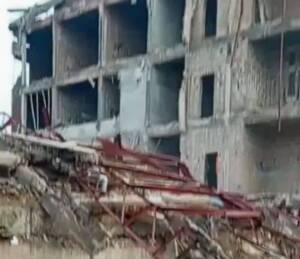
Cyprian Ajah, Enugu
Town planning and building construction experts have blamed negligence, inadequate supervision and the possible use of substandard construction materials for the collapse of a four-storey building in Enugu, which claimed one life and left another person critically injured.
The building, located a few metres from the Enugu State Government House, popularly known as Lion Building, collapsed on Sunday.
Following the incident, officials of the Nigerian Institute of Town Planners (NITP) and the Nigerian Institute of Building (NIOB) visited the site on Monday for an on-the-spot assessment.
The experts, however, cautioned that a forensic investigation and structural integrity tests would be required before the actual cause of the collapse could be conclusively established.
Speaking during the inspection, the Second National Vice-President of the Nigerian Institute of Building, Dr. Eucharia Enebe, said it would be premature to attribute the collapse to a particular factor without a detailed investigation.
“We cannot just say this is actually the cause, because an investigation has to be done,” she said.
Enebe explained that investigators would have to examine critical structural elements, including the columns, their dimensions and the quality of concrete used in the construction.
She added that investigators would also need to establish whether the approved building design was faithfully followed during construction.
“Because buildings don’t collapse on paper, they collapse on the construction site,” Enebe said.
She expressed concern over the adjoining four-storey building that remained standing at the site, warning that it could also pose a danger until its structural integrity was properly assessed.
“This one has already fallen; it affects the other one. So these are things we need to check before we can say that this other one is safe for people to live in or make use of,” she said.
Enebe also called for the national approval and effective enforcement of the National Building Code, noting that while some states, including Lagos and Ogun, had domesticated the code, Enugu State had yet to do so.
She stressed the need for architects, builders and structural engineers to perform their respective professional responsibilities and work collaboratively throughout the construction process to minimise building failures.
Also speaking, the Vice Chairman of the NIOB in Enugu State, Builder Ani Stephen Chukwunoso, said the institute’s visit was aimed at conducting a preliminary forensic assessment of the collapsed structure.
Chukwunoso called for non-destructive testing and structural integrity assessment of the remaining building before it could be considered safe.
According to him, the incident has serious implications for the construction profession and the image of Enugu State.
He advocated the domestication of the National Building Code in the state, saying this would provide a clearer framework for defining the responsibilities of professionals involved in building development.
The NIOB official also urged authorities to ensure that construction projects have complete documentation, including architectural, structural, electrical and mechanical drawings, as well as health and safety plans, quality management plans and construction programmes.
He further stressed the need for professional builders to be involved from the pre-construction approval stage through the construction phase to ensure compliance with approved specifications.
“Let the builders, professional builders, be given a chance so that they can manage this project properly to avoid all this menace to the image of the state,” Chukwunoso said.
The Chairman of the NITP, Enugu State Chapter, Dr. Christopher Anierobi, described the incident as “an appalling situation” and called for stronger planning regulations and enforcement across the state.
Anierobi urged the state government to expedite the domestication and approval of the Nigerian Urban and Regional Planning Law, while also developing a comprehensive master plan for Enugu.
“What we had was an unapproved 1979 document that was supposed to be a master plan as far back as the regime of His Excellency, Dr. Jim Nwobodo. That document is lying there, unapproved, unadopted,” he said.
He explained that an effective master plan would help regulate building heights, zoning, setbacks and other planning requirements, particularly as high-rise buildings continue to emerge in areas originally designed for lower-density residential development.
Anierobi attributed the incident, among other possible factors, to what he described as negligence on the part of the developer.
“This collapse is, one, as a result of negligence. Negligence on the part of the developer. Because from what you can see there, as experts in the built environment, you can see that the mixture is inadequate,” he said.
He also alleged “gross negligence” on the part of the site engineers, arguing that inadequate professional supervision may have contributed to the disaster.
“From the foundation, you look at the mixture, what the builders, what the engineers, what the developer is doing on-site, to stop colossal damage. So, proper supervision by qualified professional experts is another thing that was not carried out,” Anierobi stated.
He criticised what he described as an “all-comers affair” in land and building development, urging the government to ensure that only qualified professionals are engaged at every stage of construction.
Anierobi said the loss of life underscored the urgent need for stricter enforcement of building and planning regulations, stressing that no compensation could adequately replace a human life.
He maintained that the priority should be to prevent building failures before they occur by strengthening professional oversight, regulatory enforcement and compliance with approved construction standards.
This version keeps the experts’ allegations attributed and avoids presenting the suspected causes as conclusively established before the forensic investigation.



African Church celebrates 125th anniversary, lauds Gov. Eno’s leadership strides in A’Ibom.
Tony Okoh, Uyo African Church, founded on 13th October 1901, will begin its …