

Book Review: Author’s Gamble by David Mozie

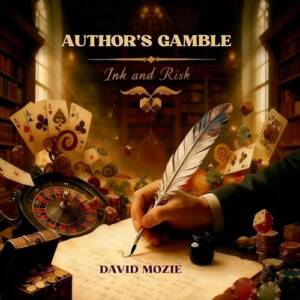
Reviewer name: Peter Okonkwo
Reviewer Date: February 6th, 2026
Every writer, at some point, goes looking for a book that tells them the truth about what they have gotten themselves into.
The blank page, the rejection letters, the algorithm-driven marketplace, the creeping anxiety that artificial intelligence is making the whole enterprise of human authorship redundant.
David Mozie’s Author’s Gamble promises to address all of this, and for long stretches of its eight chapters, it delivers.
The problem is that it also promises more than it can consistently keep, and the gap between its best moments and its most generic ones is wider than it should be.
The book’s central conceit is gambling. Every aspect of a writing career, from sitting down to face the blank page to negotiating a publishing contract to building an audience on social media, is framed as a wager, a bet placed on uncertain odds.
It is a clever and genuinely useful metaphor. Writing is risky. It demands an investment of time, emotion, and sometimes money, with no guarantee of return.
Mozie is right to frame it that way, and in the early chapters, the metaphor gives the book a propulsive energy.
The first chapter on writer’s block is grounded and practical, treating the condition as a strategic problem with identifiable causes and workable solutions.
The chapter on mindset, grit, and the creative engine is similarly strong, drawing on research in psychology and cognitive science to back up its advice without becoming dry or academic.
But somewhere around the midpoint, the gambling metaphor stops feeling like a lens and starts feeling like a verbal tic. Every section heading becomes a new variation on the same theme.
The Mindset Gambit. The Inspiration Wager. The Resilience Gambit. The Platform Gambit. The Alliance Gambit. The Craft Gambit. By the time the reader reaches the final chapters, the word gambit has been stripped of all its meaning, repeated so many times it becomes background noise. A strong central metaphor needs to be deployed with restraint. Mozie deploys it like wallpaper.
This overuse is symptomatic of a broader problem with the book’s prose. At its best, Mozie writes with clarity and warmth, and some passages feel genuinely earned, the kind of practical wisdom that comes from someone who has thought hard about the writing life. But too often the writing retreats into the language of the corporate self-help manual.
Phrases like “risk-aware mindset,” “synergistic collaboration,” and “a multi-faceted content strategy” appear with a frequency that would make a reader wince.
These are not the words of someone writing from deep personal conviction. They are the words of someone filling space, and they undermine the authenticity that the book itself argues is a writer’s most important asset.
There is a certain irony in a book about finding your unique voice occasionally sounding like it was generated by a committee.
The unevenness is frustrating because the good material is genuinely good. The chapter on artificial intelligence is the most original and timely section of the book, and it is where Mozie sounds most like himself.
He argues that AI is not the enemy but a competitor operating on entirely different terms, one that can simulate the surface of good writing but cannot access its source.
“AI can replicate the what,” he writes, “it cannot access the why.” That is a sharp and defensible observation, and the chapter builds on it intelligently, offering not panic but strategy. The sections on authenticity as a competitive advantage and on the ethical responsibilities of human authorship in an age of algorithmic content are the kind of writing that justifies the whole enterprise.
If the rest of the book matched this chapter in focus and originality, Author’s Gamble would be an essential read for anyone serious about a writing career.
The chapter on writing for social change is also worth noting. It is ambitious in a way that sets it apart from most books in this genre, tracing the long history of literature as a vehicle for advocacy and drawing on examples from Dickens to Arundhati Roy to
Chimamanda Ngozi Adichie.
Mozie is clearly passionate about this material, and the passion shows. It gives the chapter a moral weight that the more tactical sections sometimes lack.
What holds Author’s Gamble back from being the book it wants to be is a failure of editorial restraint.
The ideas are here. The research is solid. The genuine insight surfaces regularly enough to keep the reader engaged. But the book needed someone to cut the jargon, rein in the repetitive metaphor, and push Mozie to write from his own experience more consistently and more vulnerably.
A writer advising other writers on the importance of an authentic voice should himself be willing to take that risk on every page, not just the best ones.
For writers at the beginning of their careers, there is real value here, particularly in the chapters on mindset, creative community, and navigating the publishing industry.
For more experienced authors, the book may feel like familiar territory covered in overly familiar language. Either way, the gamble Mozie is asking his readers to take is a reasonable one. Just know going in that some of the hands he deals are stronger than others.
Reviewer’s Bio: Peter Okonkwo is a Yorkshire based Nigerian writer, journalistic interviewer, creative director, classical musician, literary critic, editor, certified orator, and soon–to–be novelist of Etean’s Destiny.
He was part of the 25 creative excellence individuals selected for Bristol’s BSWN CultureBiz Connect Incubator Program, recognizing the significance of his outstanding works in the literature field. Peter is the author of seven poetry collections and a violinist who has performed in orchestras at home and abroad. He is a member of the Bristol Millennial Orchestral and the Wetherby Choral Society, and a community founder of the Akure Book Club and the Akure Book Festival.
His show, PEL, has featured over 1000 literary works, covering reviews and interviews from authors around the world.





NUJ honours FCC Commissioner Peter Eze for Outstanding Youth leadership in Enugu
Stanley Ihedigbo Nigeria Union of Journalists (NUJ), Enugu State Coun…