

Analysis of Governor Eno’s TVC interview
Humility, foresight, statesmanship

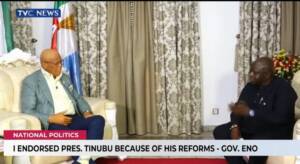
By Emmanuel Nicholas
Governor Umo Eno’s appearance on TVC was measured, reflective, and purposeful. Beyond the headlines of defection, what came through most clearly was the portrait of a leader who sees governance as service, not survival.
He spoke less like a politician defending a decision, and more like a steward explaining a sacrifice made for his people. That tone of calm conviction is what made the interview radiate positivity.
At the heart of his message was a simple philosophy: Akwa Ibom first. He repeatedly returned to the “soul of the state” as his guiding compass.
Via prioritizing peace, development, and unity above partisan identity, he presented himself as a governor guided by statesmanship rather than ego. In a political climate often defined by bitterness, that posture stood out.
One of the clearest demonstrations of foresight was his explanation of alignment with the Senate President. He said, “The Senate president is from Akwa Ibom. I don’t see how we would have maintained the peace trajectory we are talking about with me in another party and the Senate president in another party.”
This was not about personal loyalty. It was about strategic alignment. Governor Eno understands that development in a federal system is a product of access, collaboration, and goodwill.
When the chief executive of the state and the number three citizen of the country are working at cross purposes, the state loses.
Through choosing unity, he ensured that whatever is negotiated in Abuja can be delivered in Uyo, and whatever is needed in Uyo can be tabled in Abuja. That is leadership that thinks several steps ahead.
He reinforced this with humility. “He’s in Abuja doing his work; I’m in Uyo doing my work. Anything he can see up there that will favour the state, he brings it to the table, and anything I can see down here, I put it on the table too.”
There was no rivalry, no attempt to claim credit, no chest-beating. Just two Akwa Ibom sons coordinating for results. It revealed a governor secure enough to collaborate and wise enough to know that no one builds a state alone.
Perhaps the most culturally resonant part of the interview was his reflection on respect for elders and predecessors, a direct restoration of the Ibibio tradition of respect for elders and pathfinders. He said:
“I give respect to these people. They’ve been here. He’s been a governor. I give respect to all past governors, all of them, without exception. Nobody can say I’ve ever insulted one of them. If they say things I don’t like, I simply move away.”
He drove the point home with a deeply Ibibio analogy: “Like a young child whose daddy was spanked, and you go and cry in the bedroom. You don’t stay there to reply to your dad. This is about culture. It’s about upbringing. It’s about your ability to manage situations.”
In the Ibibio culture, elders are not answered back, even when they are harsh. You absorb, you reflect, and you respond with maturity. By living this out publicly, Governor Eno reminded the Akwa Ibom people that leadership must be rooted in peace and humility. It positioned him as a governor who learns before he leads.
On the subject of his defection, Governor Eno was both candid and prophetic. He said the decision followed “three months of wide consultation” and was driven by “admiration for President Bola Tinubu and the need for Akwa Ibom State to align with the federal government to reap continuous benefits.”
He described it as a “progressive move”, not an emotional one. The foresight was clear: to position Akwa Ibom to benefit from federal projects, from the Ibom Deep Seaport to increased allocations and infrastructure support.
He acknowledged the criticism directly: “You can’t be hungry all the time. Why don’t you reject it? The man has done well. Funds are coming. Allocations are coming. And we’re able to have funds to get to work for our people. And so I had to. It was a decision well thought out.”
He also explained the political calculation: “I did not see through how the way my party then, the Peoples’ Democratic Party (PDP), was going, who would endorse my form for a second term. And people said no, it’s too early to judge. But it’s one of the instincts of leadership, your ability to see the future where others can’t see.”
He then asked the question that time has now answered: “Today, you can see who is going to endorse these forms. On which platform will I run? Almost every serving governor, even second-term governors, has now left the party.
Then you expect a first-term governor… So why did they leave? The same people who said I was too quick, I shouldn’t have done that, almost all of them have left. Some of them are with me now in the All Progressive Congress (APC).”
To explain his role, he used a biblical analogy with humility: “I said to them, I came like John the Baptist to prepare the way for you.” And later, “When I left the party PDP, a lot of people judged me, but I was like John the Baptist, who came to clear the way for Christ after almost all Governors joined the APC.”
He was not claiming to be the messiah. He was saying he absorbed the criticism so others could follow later without the same backlash.
That is a sacrifice. He added a principle of leadership: “A leader’s judgement call must be such that over time, people will know if you’re truly a leader or not. What has happened today in this country should vindicate some of us.”
The defection itself was formal and historic. *Governor Umo Eno officially defected from the Peoples Democratic Party (PDP) to the All Progressives Congress (APC) on Friday, June 6, 2025*. The declaration was made at the *Government House, Uyo, Akwa Ibom State*, in the presence of his deputy, Akon Eyakenyi, members of the state executive council, federal and state lawmakers, and local government chairpersons. President Bola Tinubu observed the development. The event also drew the Chairman of the Progressive Governors Forum, Governor Hope Uzodimma, and several APC governors.
The national response affirmed the wisdom of the move. Senate President Godswill Akpabio commended it and called it historic. He wrote: “It is with utmost joy that I received our governor, Pastor Umo Eno… after the historic defection of my brother, Governor Eno.”
He added: Thank you, Mr Governor, for having the interest of our people at heart. Congratulations and welcome to the fold.”
Akpabio further noted that the Governor’s approach had helped “douse political tension in the state” and declared that “No price is too high to pay for peace.”
At a subsequent event in the Government House Banquet Hall, Uyo, Senator Akpabio formally handed over the APC structure in Akwa Ibom to Governor Eno, declaring him “the new leader of the party in the state.”That gesture signaled full confidence from the national APC.
Leaving the PDP after 26 years of its dominance in Akwa Ibom since 1999 was not an easy decision. But the Governor did it “in the state interest” and not for personal gain.
That is humility: putting legacy above label. He consistently refers to himself as “After completing the rounds of my consultation as your servant whom you have elected to serve,” language that frames governorship as stewardship.
He also emphasized that this alignment is about stability. Echoing Senator Akpabio, he noted that without internal support, “external forces will not gain too much access.”He is deliberately building a peace architecture for Akwa Ibom one where political differences do not translate into public destruction.
Even when reflecting on critics, his tone remained gracious, not bitter. “Those who accused me also join, but no one apologizes to me.”He followed it with a call to humility: “And people should be able to be humble enough to say we’re sorry, we were wrong, you were right. But human character, sometimes it’s difficult to apologise.”
In a later broadcast, he also reiterated support for President Tinubu’s 2027 re-election, citing “audacious reforms that have already started to bear fruit.” This shows consistency and long-term planning. He is aligning Akwa Ibom’s development with national policy so the state is not left behind.
First, Governor Eno has restored the *Ibibio tradition of respect as a governance tool*. In the Ibibio land, a child does not argue with his father in public. A younger leader does not insult his elders to prove a point.
By saying “If they say things I don’t like, I simply move away” and comparing himself to “a young child whose daddy was spanked,” he reminded the state that our culture values restraint over reaction.
This is not a weakness. It is the kind of cultural discipline that keeps families, communities, and now a state, from fracturing. It tells civil servants, traditional rulers, and youths that respect is still the currency of leadership in Akwa Ibom.
Second, his use of “I came like John the Baptist to prepare the way for you” reframes political courage. He was not chasing applause. He was preparing the ground. That quote, combined with “You can’t be hungry all the time” and “It was a decision well thought out,” shows a leader who weighed hunger against honor and chose honor for his people.
He absorbed judgment so that today, alignment with the center no longer looks controversial but inevitable. That is foresight turning into vindication.
Third, his closing posture of grace completes the picture. “Those who accused me also join, but no one apologizes to me” could have been said with anger. Instead, it was said with the calm of a man who has made peace with his decisions. Paired with “A leader’s judgement call must be such that over time, people will know if you’re truly a leader or not,” it shows a governor who is playing the long game. He is not interested in winning arguments today. He is interested in winning development for Akwa Ibom tomorrow.
Lastly, Governor Umo Eno’s TVC interview painted the picture of a leader who listens, consults, respects elders, and plans. His defection on June 6, 2025, at Government House, Uyo, endorsed by Senate President Akpabio, was not a gamble.
It was a calculated, humble, and visionary step to secure peace, federal partnership, and progress for Akwa Ibom. In his words and actions, he exposed himself as a governor who leads with a servant’s heart, restores Ibibio values of respect, and keeps his eyes fixed on the future of Akwa Ibom.



NCC moves to strengthen Broadband infrastructure for $1trn economy
Stanley Ihedigbo Nigerian Communications Commission (NCC) has stepped up eff…