

“Shameful spectacle”: Group faults Abuja Bishops’ parade over Tejuoso case


Michael Olumide
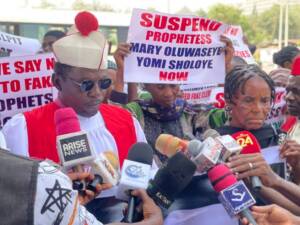
A controversial street protest in Abuja by a group identifying itself as the “College of Bishops and Peace Initiative Movement” has sparked widespread criticism, with observers condemning the demonstration as an attempt to interfere in an ongoing legal matter involving a suspect declared wanted by the Economic and Financial Crimes Commission (EFCC).
The protest, which featured individuals dressed in a mixture of casual clothing, T-shirts, shorts, and clerical cassocks, reportedly called for the release of HRH Halimat Adenike Tejuoso, who has been linked to allegations of obtaining money under false pretence alongside another suspect already apprehended by authorities.
Critics described the demonstration as a “Free Barabas parade,” likening it to the biblical crowd that demanded the release of Barabbas before Pontius Pilate, while condemning Jesus Christ.
Leading the protest was one “Bishop Abel King,” whose church affiliation and ministry address were not publicly disclosed during the gathering. Critics questioned the authenticity and legitimacy of the group, noting that online searches reportedly revealed little or no trace of the so-called “College of Bishops and Peace Initiative Movement” outside the Abuja outing.
The demonstrators reportedly accused Prophetess Sholoye of filing what they described as a “selective and misleading” petition against Tejuoso before the EFCC.
However, legal commentators and concerned observers argued that the matter has already gone beyond the level of a petition and is now before a competent court of law, making public commentary and agitation potentially sub judice.
According to the critics, it was inappropriate for individuals presenting themselves as religious leaders to openly protest a matter already under judicial consideration.
Observers also faulted the mode of protest adopted by the group, arguing that if the intention was genuinely to petition the Christian Association of Nigeria (CAN), there were established and more decorous channels for doing so rather than staging a public demonstration on the streets of Abuja.
Questions were equally raised over claims allegedly made by the protesters that funds collected by Tejuoso were routed through “mutually agreed channels.” Critics asked how the group arrived at such conclusions and whether they were attempting to assume the role of the court by making pronouncements on issues already before the judiciary.
Further criticism followed the display of placards reportedly demanding disciplinary action against the complainant while simultaneously calling for the release of the suspect.
Opponents of the protest argued that such actions contradicted the “peace initiative” identity adopted by the group and instead appeared aimed at intimidating or discrediting parties connected to the case.
Some observers also described the protest as a form of cyber bullying, especially after videos and photographs from the demonstration circulated widely on social media platforms.
According to them, the public display created the impression of an orchestrated campaign intended to sway public opinion and pressure authorities handling the matter.
The critics insisted that every Nigerian, regardless of social or religious standing, retains the constitutional right to seek legal remedies and pursue justice through lawful means, especially in matters involving financial agreements and allegations of fraud.
They argued that the proper venue for determining guilt or innocence remains the courtroom, not the streets.
The Christian Association of Nigeria was also urged to exercise caution in handling petitions or representations connected to the matter, given its legal status before the court.
Observers warned that actions capable of influencing judicial proceedings or creating public pressure around the case could attract allegations of contempt of court.
They therefore called on all parties involved to allow the judiciary and anti-corruption agencies to perform their constitutional duties without interference.
“Let justice be allowed to flow,” one commentator stated, insisting that the rule of law must prevail over emotional demonstrations and public theatrics.




Unlock Nigeria’s ₦25tr fish economy through policy, investment — Nnadi
Stanley Ihedigbo Nigeria’s fish economy, estimated at ₦25 tril…