

WorldStage leader asks Tinubu to engage Trump on joint operations against Nigeria’s terror groups

Stanley Ihedigbo
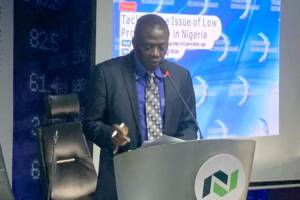
President/CEO of WorldStage, Mr. Segun Adeleye, has advised Nigeria to explore different options for tackling its insecurity challenges, including possible collaboration with the United States on joint military exercises to flush out terrorists operating in the country.
In his opening address at the WorldStage Economic Summit (WES) 2025 held in Lagos, with the theme “Tackling the Issue of Low Productivity in Nigeria,” he noted: “Interestingly, insecurity has been attracting more attention in recent times, including from abroad. Insecurity in parts of the country negatively affects economic activity.”
Adeleye said that as U.S. President Donald Trump has been threatening to launch attacks in Nigeria over insecurity-related issues, the Nigerian government could engage him diplomatically and consider joint military operations that could help eliminate terrorists.
He said: “It will be helpful if the Federal Government can flow with the current momentum and adopt the right strategy, including possible foreign assistance, to finally end insecurity. After all, if Boko Haram has survived since the Olusegun Obasanjo administration of 1999 to 2007, and we are yet to see its end till now, we don’t need anyone to tell us again that we need help.”
The summit attracted top public and business leaders, including the Executive Chairman of the Economic and Financial Crimes Commission (EFCC), Mr. Olanipekun Olukoyede, and the Managing Director/CEO of the Bank of Industry (BoI), Dr. Olasupo Olusi.
Adeleye stressed that economic productivity in Nigeria will remain a mirage without security.
Comparing the current theme to that of WES 2024, “Nigeria: Setting a Stage for Business and Economic Recovery,” he said: “If we ask whether the economy has recovered in one year since WES 2024, the answer we will likely get is yes. Nigeria’s economy has shown strong signs of recovery, marked by significant GDP growth, increased foreign reserves, and a more stable foreign exchange rate.”
However, he noted that despite these improvements, serious challenges remain, including high food inflation, widespread poverty, and a high cost of living.
He explained: “Between WES 2024 and now, four major tax reforms were enacted—specifically in June 2025—to improve revenue collection. The combination of high inflation and a weakened currency has severely eroded household purchasing power. Many households are struggling to afford basic necessities, leading to rationing and shifts to cheaper alternatives.”
He added that the World Bank has projected cautious optimism, with growth expected to rise modestly in coming years if monetary discipline and structural reforms are sustained.
Adeleye said these developments informed WES’s decision to adopt this year’s theme: “Tackling the Issue of Low Productivity in Nigeria.”
He explained that increasing productivity is key, as high inflation, poverty, and rising living costs cannot be addressed without expanding economic output.
Adeleye observed that although many Nigerians are working, nearly half of the population is poor—63% are in multidimensional poverty and 40% in income poverty—mainly because the right kinds of jobs are not available.
He continued: “Flashing back to last year’s theme, if Nigeria’s economy is recovering, how do we get it to deliver higher-productivity jobs that raise living standards?
“Despite evidence of structural transformation, concerns remain that the pace is insufficient to propel industrial take-off. Industry’s share of employment has increased only marginally in the past 20 years, while low-quality jobs characterized by high informality remain at 92.6%.”
Adeleye urged participants not to lose sight of government reforms—such as subsidy removal, exchange-rate unification, and tax changes—which aim to stabilize the economy.
He said the key question for the summit is whether these reforms are effective enough, or whether alternative measures are needed to stimulate economic productivity.
He noted that although Nigeria’s real GDP grew by 3.19% in Q2 2024 and 4.23% in Q2 2025, some analysts forecast lower growth for 2026 due to factors such as lower-than-expected oil production and persistent insecurity.
For years, WES has been consistent in addressing Nigeria’s economic challenges by facilitating dialogue and proposing practical solutions through public and private sector collaboration.
The Guest Speaker at the summit, of the Department of Economics, University of Lagos, Dr. Abidemi Adegboye, described Nigeria’s productivity challenge as both a human tragedy and a defining opportunity.




From court file to social media: How Ajiran suspect’s lawyer allegedly obtained documents now used by VDM
Michael Olumide Alabi The ongoing trial of Ahmed Tajudeen Akanbi, a declared fugitive and …