

WIMB Africa: Omokungbe, Akinpelu, Otufodunrin advocate people-centred policies

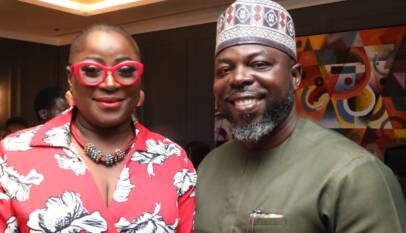
 L-R: Founder of WIMB Africa, Dr Bukola Bello Jaiyesimi, and Barr. Deji Fasunwon, CEO, HONTAR Project, Barr. Deji Fasunwon, during WIMB Africa’s Business Roundtable on “Politics as a Nation-Building Catalyst,” held at the Marriott Hotel, Ikeja, Lagos, recently
Michael Olumide Alabi
Stakeholders from the business, media, engineering, legal, creative and political sectors have called for people-centred policies that translate government decisions into measurable improvements in citizens’ lives.
They made the call at the monthly Business Roundtable organised by the African Women Foundation for Nation Building (WIMB Africa) at the Marriott Hotel, Ikeja, Lagos, where rising transportation costs, inadequate infrastructure, women’s economic empowerment and youth participation in governance featured prominently.
The roundtable, themed “Politics as a Nation-Building Catalyst,” provided a platform for participants to examine the relationship between political decisions, public accountability and sustainable national development.
Among those in attendance were WIMB Africa Founder, Dr. Bukola Bello Jaiyesimi; keynote speaker, Mayor Akinpelu; moderator, Mr. Gbadebo Akinyemi; former Rector of Yaba College of Technology, Engr. Obafemi Omokungbe; Barr. Deji Fasunwon; veteran journalist and media career development specialist, Lekan Otufodunrin; former Chairman of Odi-Olowo Local Council Development Area, Hon. Rasak Ajala; WIMB Africa Project Coordinator, Omotayo Jane; and social-impact artist and climate-justice advocate, Ms. Anjolaoluwa Olanrewaju.
Speaking at the event, Omokungbe stressed that infrastructure investments would have a limited impact without effective policies and institutions to sustain them.
“Policy is not a mere set of government interventions. It is the underlying system that allows families, institutions, markets, communities and citizens to function effectively,” he said.
He identified roads, electricity, water and broadband connectivity as critical infrastructure, noting that their effectiveness depended on the policy frameworks guiding their development, maintenance and utilisation.
According to him, weak policy environments can undermine even well-funded infrastructure projects, making stronger institutions, clear standards and effective implementation essential to national development.
The keynote speaker, Akinpelu, said policy reforms could promote economic stability and create a predictable environment for businesses to plan and invest.
He, however, noted that economic reforms could affect different segments of society unevenly, urging policymakers to introduce targeted interventions for vulnerable groups, particularly women in rural communities.
Akinpelu also encouraged WIMB Africa to promote cooperative societies among women, describing collective economic initiatives as a means of improving access to resources and strengthening financial resilience.
“When women form cooperative societies in different areas, they will be able to pull together resources that will help them as a group instead of trying to survive as individuals,” he said.
Veteran journalist Otufodunrin examined the effects of major government policies on households and businesses, citing the removal of the fuel subsidy as an example of a policy decision with far-reaching economic consequences.
He observed that rising transportation costs had affected household budgets and business operations, underscoring the importance of assessing the wider social and economic implications of government policies.
The roundtable also emphasised the need for greater citizen participation in governance and stronger mechanisms for holding public officials accountable.
Participants urged Nigerians to take a more active interest in government budgets, public expenditure and development projects earmarked for their communities.
They maintained that citizens should be able to obtain information about funds allocated to public projects and demand explanations when implementation falls short of expectations.
The stakeholders also highlighted the role of the media and civil society organisations in promoting public education, scrutinising government activities and providing platforms for constructive engagement between citizens and public institutions.
Discussions further explored constitutional mechanisms for holding elected representatives accountable, as well as the importance of civic participation and sustained engagement in the political process.
In her remarks, the Founder of WIMB Africa, Dr. Jaiyesimi, said the roundtable reflected the organisation’s commitment to community empowerment and nation-building across Africa.
“What we try to do is to lead, learn and leverage impact,” she said.
Jaiyesimi explained that the decision to focus the latest edition on politics was deliberate, given the direct implications of political decisions for governance, development and the everyday experiences of citizens.
Adding a generational perspective, Olanrewaju urged young Nigerians to become better informed and more actively involved in national affairs.
She said the discussions had challenged her to reconsider the perception that politics was exclusively the responsibility of government officials or older generations.
“It has also prompted me to do more research and be more involved in the political affairs of the nation. So, not just leaving politics for governments, I also have a part to play,” she said.

Shyllon Museum deepens global ties with First TheMuseumsLab Residency
Jim Joel Nyakaana Facilitating a Workshop for Pan-Atlantic University Students during TheM…
