

Umo Eno’s defection: Illusions, realities

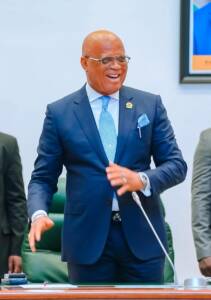
Emmanuel Nicholas
A multitude of discussion points have emerged concerning the purported defection of the Governor of Akwa Ibom State, Pastor Umo Eno, with numerous allegations levied against him by various parties over the matter.
Nonetheless, he has steadfastly maintained that his primary intention is to establish a unified government in which all political parties are beneficiaries, emphasizing his commitment to inclusivity and the state’s cohesion.
His overarching ambition is to forge a unitary governance, a political edifice where diverse parties converge into a singular, harmonious entity dedicated to the holistic development of Akwa Ibom State.
As he emphasizes, “The development of Akwa Ibom transcends party lines; it is a collective pursuit, a State’s imperative,” accentuates his belief that political parties are mere platforms, vehicles for electoral victory, rather than repositories of ideological steadfastness.
During the second anniversary thanksgiving service, Umo Eno explicitly acknowledged the unconstitutionality of independent candidacy in Nigeria. He stated that if such candidacy were legal in the country, he would have loved to declare his intention to run as an independent candidate.
“In a democracy, the voice of the people must supersede the dictates of the party machinery,” he asserted, signaling an intent to prioritize meritocratic leadership over partisan loyalty.
At the empowerment programme orchestrated by Senate President Senator Godswill Akpabio, recently, the Senate President passionately proclaimed that in Akwa Ibom State, party affiliations are secondary to the unity and progress of the state. “What matters most is the unity of Akwa Ibom, not the colours on our political banners,” he emphasized, reinforcing the notion that state-building supersedes partisan politics.
He confidently assured constituents in the Ikot Ekpene Senatorial District that, come 2027, elections will pivot on individual merit and value rather than party allegiance.
Furthermore, the Senate President also has publicly declared that Governor Umo Eno will be the sole gubernatorial candidate endorsed by all political parties in the upcoming electoral cycle, including himself and the President of Nigeria, Bola Ahmed Tinubu.
While some critics have faulted this pronouncement, interpreting it as a political overture with ulterior motives, such concerns may stem from misinterpretations or political mischief.
Although Inter-party Advisory Committee (IPAC), in the state has issued a statement distancing itself from any political affiliation, the leading political parties, Peoples Democratic Party (PDP) and All Progressive Congress (APC), are in agreement with the formation proclaimed by the Senate President.
The Senate President himself has reminded us that “politics is the art of the possible,” and emphasizes that political unity is vital for the State’s stability.
Another contentious issue that has become a topic of discussion in the media is the recent speech by Senate President Akpabio, who referred to the “ten holes in the umbrella” of the Akwa Ibom State PDP. This remark has been misinterpreted by some as an inadvertent slip.
However, it is entirely plausible, and perhaps even more accurate to believe that his true intention was to allude to the complex and multifaceted crises within the PDP at the national level.
These crises include factionalism and leadership disputes, which pose significant threats to the party’s unity and coherence. Such internal struggles could potentially undermine the party’s stability and effectiveness.
It is imperative and empirical to empathize and forgive such lapses“A house divided against itself cannot stand,” as Abraham Lincoln once said, recognizing that the core of Governor Umo Eno’s political philosophy is rooted in genuine reconciliation and strategic unity.
The Senate President is aware of the PDP’s historical dominance and the formidable political platform it represents within Akwa Ibom State, and that it’s the platform that made him a Governor and later Senator.
Turning to the contentious issue of Eno’s prospective defection from the PDP to APC, where critics have expressed concern about the hardships associated with APC, particularly given Nigeria’s recent economic and political upheavals.
However, it should be understood that the hardships in Nigeria were not solely instigated by President Bola Tinubu’s administration; rather, they stem from mismanagement by successive governments and should not be attributed to a single leadership or political party.
Although the situation has become more dire under the APC government, the President is doing everything within the bounds of the law to rescue Nigeria and Nigerians from poverty and untold hardship.
However, the underlying rationale for this potential move is rooted in strategic vision, an acknowledgment that the PDP fractured national politics, exemplified by the existence of multiple factions within the PDP (two national leaders and three secretaries), undermining electoral stability and threatening the legitimacy of Party Primaries.
Participating as a candidate on a fictionalized political platform is inherently fraught with significant political risks. The possibility of a court overturning electoral victories and awarding them to the opposition faction is a peril no rational politician should willingly expose themselves to.
Governor Umo Eno aspires to contest the election under a platform backed by a strong national leadership, one that ensures his primary victories will withstand judicial scrutiny and not be overturned due to factional conflicts.
Critics have also questioned the tangible benefits for Akwa Ibom State should such a political realignment occur. Yet, Umo Eno’s vision extends beyond mere party politics; he aims to catalyze monumental infrastructural projects through political alignment.
Bringing the Ibom Deep Sea Port to reality and being fully operational, establishing an Nigerian National Petroleum Company (NNPC) depot, reviving the Aluminum smelting plant in Ikot Abasi, and attracting additional refineries beyond the BUA Petroleum Chemical Refinery etc.
These initiatives are not mere political rhetoric but strategic political alignment that will come with economic benefits for the State.
In the words of Nelson Mandela, “A good leader can engage in a debate frankly and thoroughly, knowing that at the end he and the other side must be closer and thus emerge stronger.”
Governor Umo Eno’s leadership philosophy echoes this, emphasizing that the pursuit of the State’s unity and infrastructural development is paramount, transcending partisan divides and fostering a future of shared prosperity.
The narrative surrounding his potential defection is not born of desperation or greed but from a visionary commitment to elevating Akwa Ibom’s standing within Nigeria’s political and economic arena.
Critics who argue that linking the center will drain local resources often overlook the strategic importance of national integration. As Mattie Stepanek aptly put it, “Unity is strength; when there is teamwork and collaboration, wonderful things can be achieved.”
Let me assure them that Governor Umo Eno is a leader who will never mortgage the state’s funds for any political jamboree. Instead, he is committed to investing in projects that will genuinely advance the development of the state.
The anxiety and apprehension among the populace are notably heightened at this juncture. Many devout members of the PDP feel a sense of betrayal due to the Governor’s recent intentions, which have caused considerable concern within the party ranks.
Nevertheless, the Governor has explicitly assured the party leadership that his primary objective is not to dismantle or undermine the PDP or to annihilate its organizational structures.
He has reaffirmed his commitment to maintaining the integrity of the party, emphasizing that the party’s existing framework will remain intact and respected.
This reassurance is rooted in his declaration that the forthcoming administration will operate as a unity government, a political arrangement characterized by the inclusion and active participation of multiple political parties, rather than being dominated by a single entity or faction.
Many may not understand how a unity Government operates, a unity government, in its essence, is a coalition wherein diverse political parties come together to govern collaboratively.
Such a government is typically formed to develop unity, with broad consensus for stability and progress.
Governor Umo Eno arranges that all participating parties share executive and legislative responsibilities, with key positions often allocated proportionally based on their electoral strength or negotiated agreements.
The Governor wants an Akwa Ibom where decision-making is shared, ensuring that the interests of various political factions are represented and that the government’s policies reflect a consensus rather than partisan dominance.
It aims to foster the State’s unity, reduce political polarization, and promote stability by integrating diverse viewpoints into the governance process.
The Governor’s assurance of a unity government thus signifies his intent to foster a collaborative political environment where all parties, regardless of their previous affiliations, are stakeholders and beneficiaries of the new administration’s policies.
He designed this approach to promote inclusiveness, ensure broad-based support, and strengthen the democratic fabric of Akwa Ibom State by emphasizing collective responsibility and shared leadership.
Akwa Ibom’s future under Governor Umo Eno’s leadership hinges on trust, strategic foresight, and unwavering dedication to the common good.
His commitment is not driven by personal ambition but by an unwavering resolve to build a resilient, prosperous, and united Akwa Ibom, guided by the timeless wisdom that “Leadership is not about being in charge. It is about taking care of those in your charge.”
If the PDP at the national level has successfully resolved its crises, established a formidable platform, and recreated the party that was once recognized as the largest political entity in Africa, then it is highly likely that Governor Umo Eno, PhD, would not harbour any intention of defecting from the party.
No individual desires to dwell in a house with a weakened foundation and a shattered roof, for such a structure is prone to collapse. As the Bible wisely teaches, wisdom is indeed profitable and beneficial in navigating life’s challenges.
Governor Umo Eno exemplifies prudent leadership through his deliberate and judicious decision-making approach.
I firmly believe that his intentions are centered on fostering significant economic development and improvements that will yield substantial qualitative benefits for the State.
Such benefits are likely to elevate the standard of living, create numerous opportunities, and enhance overall societal well-being.
Consequently, these positive outcomes will reinforce the people’s pride and confidence in their decision to support him, including his notable political shift or “defection,” which they may view as a strategic move aimed at achieving greater developmental goals.
In essence, his leadership and intentions are expected to generate a meaningful and lasting impact that will justify and validate the trust and support he has received from the populace.



APC Campaign Council denies plot to assassinate Atiku, challenges Timi Frank
Stanley Ihedigbo All Progressives Congress (APC) Presidential Campaign Counc…