

Securing Giant: Why General Musa’s leadership is Nigeria’s strategic asset


By Kennedy Elaigwu Awodi
In the complex theatre of West African geopolitics, leadership is the invisible thread holding the fabric of national stability together. For Nigeria, a nation balancing domestic security with regional hegemony, the caliber of its military leadership is a matter of national survival and prestige.
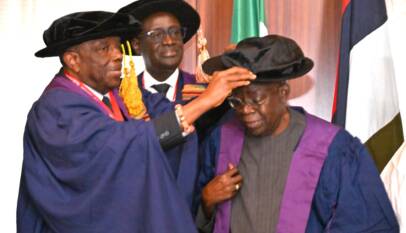
The recent conferment of an Honorary Fellowship on the Minister of Defence, General Christopher Gwabin Musa (rtd), by the Nigerian Institution of Surveyors (NIS) is more than a personal accolade; it is a signal of a nation aligning professional excellence with strategic security goals.
The NIS, tracing its roots to 1934 and the legendary Herbert Macaulay, is one of Nigeria’s most respected institutions. This Honorary Fellowship, only the second in its long history, speaks volumes.
By honoring General Musa, the NIS has highlighted a crucial truth: modern warfare is deeply rooted in spatial intelligence and technical precision.
General Musa’s leadership has moved beyond traditional kinetic operations to embrace a holistic, intellectual approach. The Ministry’s collaboration with bodies like the NIS acknowledges that “safeguarding territorial integrity” in 2026 requires precise terrain mapping and technical data integration. This synergy between the military and civilian professional sectors is exactly what Nigeria needs to modernize its defense architecture.
However, this modernization is not limited to domestic partnerships. General Musa is increasingly looking toward the global stage to fortify Nigeria’s borders. During a recent high-level working visit to Monaco, the Minister reaffirmed the Federal Government’s commitment to modernizing the Armed Forces through strategic international partnerships and local capacity development.
Central to this mission is the implementation of the Multi-domain Hybrid Intelligence Shield (HIS) project. Engaging with MARSS UK Ltd and its Nigerian partner, MPS Mikopowers Ltd, General Musa and his team focused on live demonstrations of advanced command, control, and surveillance technologies.
From AI-enabled threat identification to drone interception capabilities, the “Musa Model” is clearly pivoting toward a future where technology is the primary multiplier of troop effectiveness.
Beyond technical upgrades, General Musa is projecting Nigerian power where it matters most: the Lake Chad Basin. His leadership within the Multinational Joint Task Force (MNJTF) underscores Nigeria’s role as the “big brother” of the region. By degrading terrorist networks at their source, Musa ensures Nigeria does not simply wait for threats to arrive at its borders.
Under his guidance, Nigeria is no longer passive. During sessions in N’Djamena, Musa demanded operational effectiveness and accountability from regional partners while reaffirming Nigeria’s commitment. This proactive stance protects lives and creates the stability necessary for economic growth in the Northeast.
This diplomatic and technical assertiveness serves the Nigerian interest in three distinct ways:
Restoring Public Confidence: The “exceptional record of performance” cited by the NIS acts as a morale booster, proving that the leadership is respected by the nation’s intelligentsia.
Economic Security: By stabilizing the Lake Chad Basin and utilizing NiDAR integrated command systems, the Ministry is reopening trade routes and allowing displaced farmers to return to their lands.
International Prestige: Nigeria’s leadership in the MNJTF and its engagement with international defense stakeholders position the country as the primary guarantor of peace in Africa.
The Ministry of Defence has described these recent achievements as a “reflection of collective efforts.” General Musa consistently deflects personal praise toward the men and women in uniform. This humility, combined with tactical brilliance, fosters a unified military culture essential for overcoming 21st-century asymmetrical threats.
The Minister’s recent engagements in Monaco highlight a critical component of this culture: the establishment of a Centre of Excellence for simulation, training, and doctrine development. By focusing on technology transfer and sustainable defense industrial cooperation, Musa is ensuring that Nigeria does not just consume foreign technology but builds the indigenous capacity to maintain and evolve it.
The decision by the NIS to bring the award ceremony forward due to “service exigencies” highlights a national sense of urgency. We are at a critical juncture where excellence is the only barrier against instability. As General Musa pilots the Ministry, the message is clear: Nigeria is organized, collaborating, and leading.
The Minister recently noted, “We must leverage technology for intelligence, surveillance, and recurring service. We have partners and allies ready to support us, and we will work as a team.” This vision, integrating the NiDAR system, anti-drone technologies, and mobile surveillance platforms, represents a departure from the reactive strategies of the past.
For Nigeria to thrive, the security apparatus must be led by individuals who command respect in both the trenches and the boardroom. In General Musa, Nigeria has found that balance. His Fellowship is not just a certificate; it is a testament to a more resilient nation.
By strengthening the bond between professional institutions, international tech partners, and defense forces, Nigeria is doing more than fighting a war on terror; it is winning a lasting peace for generations to come.
Awodi writes from North Carolina, USA. Email: awodiken@outlook.com




Tompolo-backed PBAT Movement takes free medical outreach to Ugboha
The PBAT Door-to-Door Movement has organised a free medical outreach in Ugbo…