

Receipt of Ibom Deep Sea Port feasibility report: A golden goal

Emmanuel Nicholas
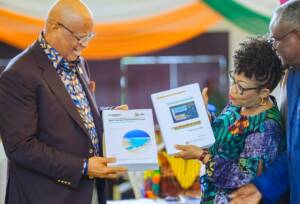
The presentation and handover of the Ibom Deep Seaport feasibility report to Governor Umo Eno marks a decisive milestone in a project that has been gestating for more than two decades.
At the Government House Banquet Hall in Uyo, the Governor received a comprehensive technical document prepared by a specialised committee, showcasing the state’s renewed push to convert long-held ambition into a deliverable national infrastructure asset.
The report crystallises the technical, financial, environmental and institutional pathways necessary to make the deep seaport a functioning reality.
The Ibom Deep Seaport is conceived as a strategic maritime gateway for Akwa Ibom and the wider Gulf of Guinea region. Its proponents envisage a facility capable of handling deep-draft vessels, serving as a major transshipment hub, and catalysing industrialisation through integration with the planned Ibom Industrial City.
For a state with expanding aviation and road infrastructure, the seaport represents the maritime complement to a multi-modal logistics vision that could shift trade patterns and attract manufacturing investment.
A central purpose of the feasibility study was to convert high-level political will into implementable technical and commercial plans.
The study synthesised geophysical and geotechnical surveys, hydrodynamic assessments, engineering design options, traffic and market forecasts, environmental and social impact assessments, and financial models to demonstrate the port’s bankability and operational viability under a public–private partnership (PPP) framework.
On the technical front, the study’s geophysical and geotechnical investigations provided crucial data on seabed conditions, soil profiles and dredging requirements.
These surveys inform foundational design choices such as quay wall types, pile lengths, dredge volumes, and breakwater alignment, and they reduce the engineering and cost uncertainties that typically stall large coastal infrastructure projects.
Engineering design priorities identified in the study include construction of main and secondary breakwaters, container terminal layouts, multipurpose berths, navigation channels, and dedicated Navy berths.
The study evaluated phased capacity build-out, so initial investments can deliver operational throughput quickly while allowing expansion to meet longer-term demand projections.
Multimodal access emerged as a non-negotiable element of the port’s feasibility.
The administration of Governor Umo Eno has already taken measurable steps by constructing access roads that link the proposed port site to the state road network, thereby strengthening inland connectivity.
These roads are intended to support construction logistics in the short term and provide immediate improvements to hinterland access ahead of full port operations.
Financial and economic analyses in the study modelled capital expenditure, operating costs, revenue streams, and returns under various concession and PPP structures.
The report examined tariff regimes, concession terms, and financing packages, seeking to balance investor returns with affordability and competitiveness.
It also mapped potential funding sources, including private equity, commercial loans, infrastructure bonds, and federal support mechanisms.
A notable administrative achievement is that the state government funded, procured and received the completed feasibility study, a full-cycle demonstration of political will by Governor Umo Eno and fiscal commitment.
By underwriting the study, the Governor has removed a major early-stage barrier, providing foreign investors and federal partners with the independent, data-driven foundation required for procurement, contracting, construction and general transaction processes.
Market and demand forecasting in the feasibility study projected the port’s potential to capture both domestic and foreign cargo redirected from congested Lagos ports and regional transshipment traffic.
Projections considered container growth scenarios, bulk and liquid cargo forecasts, and hinterland distribution patterns, emphasising the need for integrated logistics and hinterland connectivity to realise forecasted volumes.
The study situates the port within the Ibom Industrial City and an existing Free Trade Zone, arguing that a combined industrial–port cluster maximises value capture. The Free Trade Zone status is expected to attract export-oriented manufacturers, facilitate value-added processing near the quay, and shorten supply chains, making the port a catalyst for broader economic diversification.
Institutional arrangements were carefully analysed. The study recommends transparent concession processes, engagement of global transaction advisors, appointment of programme managers, and re-engagement with statutory agencies such as the Nigerian Ports Authority and the Nigerian Export Processing Zones Authority.
These arrangements are aimed at clarifying roles, de-risking investment, and aligning federal and state interests.
Environmental and social impact assessments constituted a core element of feasibility. The study mapped potential impacts on coastal ecosystems, fisheries, and shoreline communities, and proposed mitigation measures such as engineered shoreline protection, habitat restoration, compensatory measures for affected livelihoods, and comprehensive resettlement action plans to ensure social licence to operate.
Risk assessment in the study identified political, financial, construction, operational and climatic risks. Mitigation strategies include phased investment to limit upfront exposure, robust contract structuring to allocate risk to the party best able to manage it, climate-resilient designs for sea-level rise and storm surges, and insurance and guarantee mechanisms to support project bankability.
Implementation sequencing and timelines were delineated with realistic milestones: completion of Front-End Engineering Design (FEED), procurement and financial close, priority civil works such as access roads and breakwaters, construction of initial berths and terminal systems, and progressive operationalisation. The study stresses that while acceleration is possible, large seaport projects typically unfold over multiple years.
The state has already operationalised elements of the transaction process described in the study: it engaged programme managers, appointed global transaction advisors, completed due diligence, and ran a transparent international bidding process that yielded preferred bidders. These steps reflect a project-ready posture that should shorten the time from feasibility to construction readiness.
Investor engagement remains a priority. The feasibility study supports investment roadshows and targeted marketing of the Ibom Industrial City and the Free Trade Zone. The committee tasked with the project has been charged with proactively engaging potential equity partners, development finance institutions and strategic shipping and terminal operators to secure both capital and operational expertise.
Human capital and local content requirements were highlighted by Governor Eno, who directed the Commissioner for Special Duties to lead training initiatives for youths. The feasibility study quantifies labour needs across construction and operational phases and recommends training pipelines, apprenticeship schemes and local supplier development programmes to maximise employment and skills transfer.
The administration’s record to date, including funding and receiving the feasibility study, constructing access roads, establishing a project office, commissioning geotechnical work, and preparing investor fact-sheets demonstrates a coherent delivery strategy.
These achievements materially de-risk the project and send a clear signal to markets that Akwa Ibom is ready to host a large-scale port project.
A pivotal political advance in the process is the commitment secured from President Bola Ahmed Tinubu to support the construction of the Ibom Deep Seaport.
Federal backing will unlock access to national infrastructure financing instruments, align federal agencies around necessary approvals and concessions, and expedite intergovernmental coordination, all of which are essential for a project of this magnitude.
The economic impacts articulated in the feasibility study are substantial: direct and indirect job creation across construction and operations, multiplier effects through industrial clustering, increased exports and import efficiency, and enhanced state revenues. As a transshipment node, the port has the potential to reroute regional trade flows and position Akwa Ibom as a logistics and manufacturing hub.
Looking ahead, the feasibility study sets out clear next steps: finalise FEED, complete environmental and resettlement approvals, achieve financial close with private partners, begin priority access and marine works, and continue investor roadshows. Continuous stakeholder engagement and transparent reporting will be essential to maintain public support and momentum.
Lastly, the feasibility study provides a comprehensive blueprint for transforming the Ibom Deep Seaport from a long-standing ambition into a functioning economic engine.
The state administration’s proactive investments, paying for the study, constructing access roads, assembling a project delivery team, and securing federal commitment create a credible pathway to implementation.
While the project remains complex and multi-year in execution, the combination of technical readiness, institutional arrangements and political backing now places the seaport within striking distance of realization.
Governor Umo Eno has assured the people of Akwa Ibom State that, during his administration, the Ibom Sea Port will be realized; the receipt of the feasibility study constitutes a momentous milestone, a golden goal scored by the golden Governor of the golden era.





D’CEM Awards honours Inojie, Mr Raw, Doc Curry, Tray Chaney with Hall Of Fame
Hollywood and Nollywood stars, award-winning filmmakers, musicians, actors a…