

“Nigeria must begin to grow its future before it can secure it”


Founder and Executive Director, Women in Agricultural Sustainability and Advancement Africa (WASAA), Ms. Chi Tola Roberts, unveils the One School, One Food Garden Initiative.
A bold school-based movement designed to reconnect Nigerian children with food, agriculture, sustainability and enterprise.
For decades, agriculture in Nigeria has largely been discussed in terms of farmers, hectares, fertiliser, mechanisation, food imports and government interventions.
Ms. Roberts explained to Editor-in-Chief, Rev. Stanley Ihedigbo, why she believes Nigeria needs to begin treating agricultural education not merely as a school subject, but as a national development strategy.
She asked these three questions: What if the real agricultural revolution Nigeria needs begins somewhere much closer to home, as it begins in the school?
What if a child does not merely read in a textbook that a seed germinates, but actually plants one, waters it, watches it grow, harvests the crop and understands what it took to put food on a family’s table?
What if that same child learns that the tomato in the garden can become a packaged product, that waste can become compost, that the harvest has a market value, and that agriculture can be a technology-driven business?
That is the thinking behind the One School, One Food Garden Initiative (OSOFGI) being championed by my organization.
The initiative proposes that participating public and private schools establish productive food gardens alongside structured WASAA Agricultural Clubs, giving students practical exposure to food production, nutrition, environmental sustainability, entrepreneurship and leadership.
Why the One School, One Food Garden Initiative and what problem are you really trying to solve?
We are trying to solve a problem that is much bigger than agriculture. We are asking a very fundamental question: What kind of Nigeria are we preparing today’s children to become?
For years, we have spoken about food security. We talk about agricultural production, food prices, imports, unemployment and youth empowerment.
These are important conversations, but we cannot build a sustainable food system if we continue to disconnect our children from the very system that feeds them.
A child should understand where food comes from. A child should know what it means to plant.
A child should understand the value of water, soil and sunlight. A child should know that food production requires discipline, patience, science, technology and business.
Most importantly, a child should understand that agriculture is not synonymous with poverty.
Agriculture can be a science. Agriculture can be technology. Agriculture can be entrepreneurship. Agriculture can be innovative. Agriculture can be a career.
Agriculture can be wealth creation. That is what One School, One Food Garden is about.
We want to take agriculture out of the textbook and put it into the hands of the student.
So, this is not simply a school gardening programme?
Absolutely not. The garden is the entry point.
The real programme is about developing a generation of food-conscious, environmentally responsible and economically productive young Nigerians.
Every participating school will have a food garden appropriate to its environment and available space.
It could be a conventional garden. It could be raised beds. It could be a greenhouse.
It could be a container garden. It could be a vertical garden. It could even be a hydroponic system where land is limited.
The important thing is that students participate. They plant. They nurture. They observe. They measure. They harvest. They record.
They learn. And eventually, where appropriate, they can process and market what they produce.
That is hands-on education. “Let the children touch the soil”
Why do you think practical agricultural education is so important now?
Because we are entering a phase where Nigeria cannot afford to raise a generation that only knows how to consume.
We must raise a generation that understands production. Think about it. A child may spend years learning mathematics, but never use mathematics to calculate the cost and profitability of a real agricultural enterprise.
A student may learn biology, but never apply it to plant growth.
A student may study economics, but never calculate the economics of producing and selling food.
A student may study environmental science, but never make compost or understand water conservation. The food garden changes that. The garden becomes a living laboratory.
Mathematics becomes real. Biology becomes real. Economics becomes real.
Environmental science becomes real. Entrepreneurship becomes real.
And the student begins to understand that knowledge is not just something you pass in an examination. Knowledge is something you can use to solve problems.
Tell us more about the Agricultural Club component?
This is one of the most important components of the initiative. We don’t want students to simply come into a garden once a month and take photographs.
We want to create a culture. That is why every participating school will have a WASAA Agricultural Club.
The club will provide a structured platform where students learn and practise agriculture throughout the academic year.
They will learn crop production, soil management, nutrition, food safety, climate-smart agriculture, waste management, entrepreneurship, record-keeping and leadership.
They will also learn about modern agriculture. We want a child to see a greenhouse and understand why it works.
We want them to understand irrigation. We want them to understand technology.
We want them to understand digital agriculture.
We want them to understand that the farmer of the future may be operating with data, sensors, technology and markets.
The Agricultural Club, therefore, becomes a bridge between education and the future economy.
Is the programme only for government schools?
No. We deliberately designed it for both public and private schools. Food security does not belong to a particular socioeconomic class. Neither does sustainability. Neither does agricultural knowledge.
A child in a public school and a child in a private school are both part of Nigeria’s future. The model will be adaptable. A school with two acres may establish a larger production garden.
A school in an urban environment with limited land may use containers, raised beds, vertical farming or other appropriate systems. The principle is: One School. One Food Garden. One Agricultural Club.
The implementation can be different, but the vision remains the same.
How does the programme address Nigeria’s nutrition challenges?
Food security is not only about having food.
We must also understand what we eat, how food is produced and how nutrition affects our lives.
When children grow vegetables themselves, they develop a different relationship with food. They understand freshness. They understand variety. They understand the effort involved in producing food.
The programme will incorporate nutrition education so that students can understand balanced diets and the importance of locally available nutritious foods.
We are therefore connecting: Agriculture → Food → Nutrition → Health → Productivity.
Sustainability is prominent in WASAA’s name. How does sustainability feature in the initiative?
It is fundamental. We cannot talk about the future of agriculture without talking about the future of the environment.
Students will be introduced to practices such as composting, recycling, responsible waste management, water conservation, soil protection and climate-smart agriculture.
Imagine a child learning that the food waste from a school can be converted into compost.
Imagine that same child understanding that compost can improve soil.
That child has learned something that can eventually become an agricultural enterprise.
That is how sustainability becomes practical. We don’t want sustainability to remain a conference word. We want children to practise it.
Is there also an entrepreneurship component?
Very much so. One of our biggest objectives is to change the way young people perceive agriculture. Students will be introduced, at an age-appropriate level, to the economics of food production.
If a school produces vegetables, for example, students can learn: What did it cost? How much was harvested? What can it be sold for? What happens if we process it? What happens if we package it? Who will buy it? What is the difference between revenue and profit?
Those simple questions can change a child’s perception of agriculture.
A student who grows a crop, processes it into a product, gives it a brand and sells it has already experienced the basic principles of entrepreneurship.
We are planting more than crops. We are planting an enterprise.
This sounds like something that could attract government support. How would you get the government involve?
It should. But I want to be very clear about something. This initiative is not partisan.
It should belong to Nigeria. Any governor can adopt it.
Any administration can implement it. Any First Lady can champion it. Any political aspirant can include it in a development agenda. Any corporate organisation can sponsor it. Any foundation can support it.
That is because the beneficiaries are children, schools and communities—not political parties. A government that adopts the programme can say: “We are preparing our children for a food-secure and economically productive future.” That is a legacy worth building.
Where does the private sector fit into this?
There is an enormous opportunity.
Corporate organisations are already spending money on Corporate Social Responsibility, sustainability, education, youth development, food security and community development.
We are saying: let’s connect those investments to something measurable and lasting.
A company can adopt: One school, Ten schools or One Local Government Area.
A complete school district. A state-wide component. A bank could support student agripreneurship. An agricultural input company could support seeds and technical expertise.
A technology company could support digital agriculture. A food company could support nutrition and processing. A telecommunications company could support digital learning. An energy company could support solar-powered irrigation. A manufacturing company could support agricultural equipment.
This creates a new form of Corporate Social Responsibility (CSR): CSR that grows.
You can photograph a donation. But you can also photograph a child harvesting what that donation helped create. The second is much more powerful.
Why should a governor or politicians see this as a strategic opportunity?
Because infrastructure is important, but human capacity determines how infrastructure is used. Governments come and go. But children remain.
If an administration establishes a programme that reaches thousands of children, teaches them food production, environmental responsibility and entrepreneurship, the impact can continue long after that administration has left office.
That is what we mean by legacy. Imagine a state where, over time, 10 schools have food gardens. 100 Agricultural Clubs are active.
Thousands of students have received practical agricultural exposure. Teachers have been trained. Communities are participating. Schools are producing food. Students are developing agricultural innovations. That is not simply a project. That is a movement.
You have described this as a new phase. What do you mean?
Nigeria has spent many years asking: “How do we produce more food?” We now need to ask another question: “How do we prepare the people who will produce, process, distribute, innovate and lead our food system in the future?”
That is the next phase. We need to move from intervention to preparation. From consumption to production. From theory to practice. From short-term empowerment to long-term capability.
From seeing agriculture as an occupation of last resort to seeing it as a sophisticated economic sector. The children sitting in our classrooms today will become tomorrow’s farmers, scientists, agribusiness owners, engineers, investors, policymakers and consumers. If we want a sustainable Nigeria tomorrow, we must educate for it today.
Where do you see One School, One Food Garden in five or ten years?
I would love to see it become a national movement. Not necessarily owned by WASAA forever. Our job is to create a model that can be adopted, replicated, improved and scaled. I want to see: One School. One Food Garden. One Agricultural Club in communities across Nigeria.
I want children in Lagos to grow vegetables. Children in Kano are to understand sustainable dryland agriculture. Children in Plateau to learn about horticulture. Children in Rivers to explore aquaculture.
Children in Oyo are to understand cassava and food processing. Children in Enugu to explore agricultural enterprise. The programme should reflect the agricultural identity of each community.
Nigeria has enormous agricultural diversity.
Our schools should know it. Our children should experience it.
What are you asking Nigerians to do now?
We are inviting people to participate. We are inviting governments to adopt. We are inviting governors and First Ladies to champion the initiative. We are inviting political aspirants to make food security and practical agricultural education part of their development vision.
We are inviting schools to open their gates to practical agriculture. We are inviting parents to encourage their children. We are inviting farmers to become mentors. We are inviting universities and research institutions to bring knowledge.
We are inviting banks and businesses to invest. We are inviting corporate Nigeria to sponsor schools. And we are inviting development partners to help us scale. This is not a programme that one organisation can build alone. It is a national idea that requires national participation.
If you could leave Nigerians with one message about this initiative, what would it be?
I would say this: We often talk about leaving a better Nigeria for our children. But perhaps we should also ask ourselves: What are we teaching our children to do with the Nigeria we leave them?
If we leave them the land but they don’t know how to use it, what have we achieved? If we leave them natural resources but they don’t understand sustainability, what have we achieved?
If we talk about food security, but our children don’t understand food production, what future are we building? The One School, One Food Garden Initiative is a simple idea with a very ambitious purpose.
Put the child in the garden. Let the child plant. Let the child learn. Let the child fail and try again. Let the child harvest. Let the child understand food. Let the child understand business.
Let the child understand sustainability. Let the child understand responsibility. Because when we change the way a child sees agriculture, we may ultimately change the way that child sees Nigeria. We are not simply planting gardens in schools. We are planting the foundation of a sustainable Nigeria.
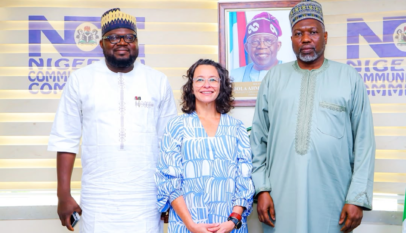




NCC, DBI, ITU deepen partnership to boost digital skills, inclusion in Nigeria
L-R: President/CEO, Digital Bridge Institute, Nigeria, David Daser; Senior Digital Skills …