

Lagos operatives rescue newborn with umbilical cord still attached from Agboju shanties

Fasesin Emmanuel
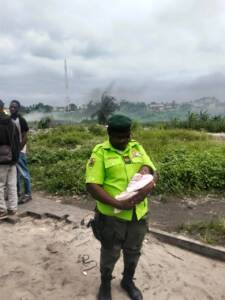
A multi-agency enforcement operation in Lagos has taken a humanitarian turn following the rescue of a day-old baby and the child’s mother from a shanty settlement in the Agboju area of the state.
Operatives of the Lagos Environmental Sanitation Corps reportedly discovered the newborn during an enforcement exercise in the Agboju shanties, where the baby was found with the umbilical cord still attached.
The mother, who was also found at the location, was reportedly in an unstable mental condition, raising concerns about the safety and welfare of both her and the newborn.
The discovery prompted the operatives to immediately intervene and remove the mother and child from the environment.
According to information from the operation, the enforcement team was carrying out its duties within the Agboju shanty settlement when the condition of the newborn attracted the attention of the operatives.
The baby was said to be barely a day old at the time of the discovery, with the umbilical cord still intact, suggesting that the child had been delivered only a short time before the rescue.
The circumstances surrounding the birth and how the mother and newborn came to be living in the shanty settlement were not immediately disclosed.
However, the condition in which the pair was found heightened concerns among the operatives, who moved swiftly to ensure that they were taken away from the potentially dangerous environment.
The mother was reportedly mentally unstable and, according to information from the operation, was subsequently taken to a rehabilitation centre where she could receive appropriate care and attention.
The newborn, meanwhile, was taken for proper monitoring and treatment to ensure that the child’s health was adequately protected following the rescue.
The development has brought renewed attention to the plight of vulnerable people living in informal settlements and other unsafe environments across Lagos.
The Agboju shanties have been identified by authorities as an area occupied by a mixture of squatters and other vulnerable persons, alongside alleged miscreants and hoodlums.
Such environments can expose vulnerable residents, particularly women, children and persons experiencing mental-health difficulties, to significant risks.
For the enforcement operatives, what initially began as an exercise aimed at maintaining environmental order consequently became an urgent humanitarian intervention.
Rather than simply proceeding with the enforcement operation, the team had to respond to the immediate welfare needs of a mother and her newborn child whose condition required urgent attention.
The rescue, therefore, underscores the broader responsibilities that can arise during enforcement activities, particularly when operatives encounter people whose circumstances require protection, medical attention or rehabilitation.
The discovery of a newborn with the umbilical cord still attached also highlights the vulnerability of mothers and children who lack access to safe accommodation, healthcare and adequate social support.
In this particular case, the removal of the mother and child from the shanty environment provided an opportunity for both to receive care in safer surroundings.
The baby is currently being properly monitored and treated, while the mother remains at the rehabilitation centre where she is expected to receive the necessary support.
The agencies involved are also expected to continue monitoring the welfare of both mother and child as they receive care following their rescue.
The incident further demonstrates the importance of cooperation among government agencies in dealing with situations that combine environmental, security, social and humanitarian concerns.
While enforcement operations are primarily aimed at maintaining order and ensuring compliance with relevant regulations, encounters with vulnerable residents can sometimes require immediate intervention beyond conventional enforcement responsibilities.
The rescue at Agboju has consequently added a humanitarian dimension to the ongoing efforts to address activities and living conditions within shanty settlements across Lagos.
It also serves as a reminder of the need for stronger social intervention mechanisms capable of identifying and assisting vulnerable women, children and persons living with mental-health challenges before their circumstances deteriorate further.
For the Lagos Environmental Sanitation Corps and other agencies involved in the operation, the successful rescue of the mother and her newborn represents an important intervention in protecting two vulnerable members of society.
The immediate priority remains the health and safety of the newborn and the welfare of the mother, with the baby receiving medical monitoring and treatment and the mother undergoing rehabilitation after being removed from the Agboju shanties.
The development demonstrates that maintaining a safe and orderly city can sometimes extend beyond enforcement to include compassion, protection and timely humanitarian intervention when vulnerable residents are encountered in distress.




The Mirror Online TV debuts, features Nigerian Tribune Bureau Chief, Netcom Africa President, others
The Mirror Newspaper has expanded its digital media operations with the laun…