

From Bende to national stage: A legislator who delivers results


By Igboeli Arinze Napoleon
In Nigeria’s complex regional political landscape, where ethnic grievances often overshadow effective governance, Benjamin Okezie Kalu has emerged as a different breed of leader—one measured by concrete achievements rather than rhetoric.
As Deputy Speaker of the House of Representatives and representative of Bende Federal Constituency, Kalu has accomplished in two years what many South Eastern politicians have struggled to achieve over decades: breaking legislative deadlocks, creating institutions, and driving sustainable regional development.
Unlike the traditional pattern of loud demands for marginalization redress or symbolic gestures, Kalu has pursued quiet, persistent institution-building that produces measurable results.
The South East Development Commission (SEDC), established by law on July 23, 2024, now operates with a $1 billion regional asset base to address decades-long infrastructure deficits.
The Eastern Rail Line, backed with a $3 billion federal commitment, will connect Aba, Onitsha, Enugu, and Nsukka to national markets. Student loan disbursements totaling ₦45.6 billion have reached South East students, with another ₦50 billion committed.
Agricultural partnerships with the U.S., Belarus, and Brazil are boosting cassava, rice, and palm oil value chains across the region. These are not promises—they are tangible interventions facilitated through Kalu’s advocacy and strategic engagement.
Kalu’s approach contrasts sharply with previous South Eastern political strategies, which often emphasized grievances over actionable results. By framing the SEDC as part of a national policy of regional development commissions, Kalu turned the initiative into a collaborative framework that other regions could support, ensuring political feasibility and durability.
Institution-building defines Kalu’s leadership style. Unlike ad hoc initiatives, the SEDC has statutory authority, dedicated funding, and permanent structures that will outlast individual officeholders.
Similarly, Kalu’s chairmanship of the House Committee on Constitution Review is reshaping Nigeria’s governance framework through proposed amendments on local government autonomy, fiscal federalism, state police, gender inclusion, and electoral reforms.
By bundling reforms strategically and engaging stakeholders across sectors—including international partners like the EU—he has created a blueprint for sustainable legislative change.
Kalu’s innovation extends to security and peace-building. The Peace in South East Project (PISE-P) adopts non-kinetic approaches, addressing the root causes of insecurity—poverty, unemployment, historical grievances—rather than relying solely on military operations.
Initiatives under PISE-P include food distribution, MSME support, infrastructure projects, and community reconciliation programs. In 2025, these efforts contributed to a peaceful Christmas season in the South East, preventing economic losses estimated at ₦10-13 billion from sit-at-home disruptions.
Kalu’s leadership combines intellectual rigor and political acumen. His academic credentials—PhD in Public Policy and Strategic Studies, LL.M in Terrorism and International Humanitarian Law, and an MBA from Oxford Brookes University—inform research-based, evidence-driven policy initiatives. His work in the ECOWAS Parliament and the African Union Pan African Parliament amplifies his influence and positions the South East as a key player in continental governance.
Recognition of Kalu’s accomplishments is both national and credible: the Commander of the Order of the Federal Republic (CFR) in 2024, Legislator of the Year 2025, and the Zik Award for Excellence in Civic Engagement reflect measurable impact. Former Governor Okezie Ikpeazu praised Kalu’s work as transformational for the South East.
Despite challenges, including the dependence of some initiatives on his personal office rather than statutory frameworks, Kalu’s record demonstrates a model of regional leadership focused on institutions, results, and collaboration.
His achievements—SEDC, PISE-P, the Eastern Rail Line, and constitutional reform efforts—illustrate a sustainable approach to governance that moves beyond rhetoric and grievance politics.
At 54, Benjamin Kalu stands as a symbol of strategic, evidence-based leadership, demonstrating that measurable results, durable institutions, and collaborative governance are the keys to long-term regional transformation in Nigeria.
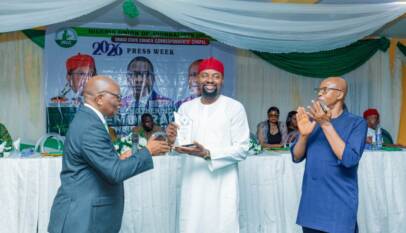




NUJ honours FCC Commissioner Peter Eze for Outstanding Youth leadership in Enugu
Stanley Ihedigbo Nigeria Union of Journalists (NUJ), Enugu State Coun…
