
Enogieru takes Nollywood storytelling to new heights with drone cinematography

Emmanuel Clement
As Nollywood continues its steady transformation from a predominantly low-budget film industry into a globally recognised creative sector, technological innovation is playing an increasingly important role in the way Nigerian stories are presented to audiences.
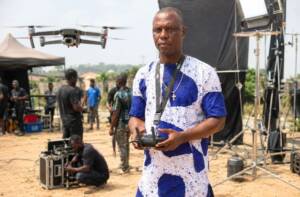
Among the professionals contributing to this evolution is drone cinematographer and pilot Efosa Festus Enogieru, whose work has helped bring a new dimension to visual storytelling in Nigerian film and television productions.
Festus has worked on notable productions, including Toyin Abraham’s Ijakumo: The Born Again Stripper, directed by Adebayo Tijani, as well as the Africa Magic television series Flawsome.
On both productions, cinematography was led by Idowu Adedapo, popularly known as Mr Views, while Festus served as the drone pilot, translating the cinematographer’s visual concepts into carefully executed aerial images.
The significance of the projects was further enhanced when both Ijakumo: The Born Again Stripper and Flawsome received nominations at the 2023 Africa Magic Viewers’ Choice Awards (AMVCA).
For Festus, however, drone cinematography is not simply about putting a camera in the sky and capturing spectacular landscapes.
He sees the drone as another storytelling instrument—one that must serve the narrative, complement the work of the cinematographer and help audiences experience a scene from a perspective that conventional cameras may not easily provide.
“Drone cinematography is more than getting beautiful shots from the air. Before I fly, I want to understand what the shot is supposed to communicate and how it connects to the story. The movement, height and timing all matter.
My responsibility is to use the drone to support what the director and cinematographer are trying to achieve visually,” Festus said.
Turning Technology Into Storytelling
Drone technology has changed the possibilities available to filmmakers.
Aerial cameras can establish the geographical setting of a story, reveal the scale of a location, follow moving vehicles, introduce characters into an environment, create transitions and provide audiences with perspectives that would otherwise require expensive cranes, helicopters or complicated camera rigs.
But while the technology provides new possibilities, the quality of the final image depends heavily on the person operating it.
The drone pilot must understand camera framing, movement, speed, direction, lighting, subject positioning and continuity. At the same time, the pilot must safely operate an aircraft in environments that may contain buildings, trees, power lines, vehicles, crowds and other obstacles.
For Festus, therefore, technical competence must be combined with a strong understanding of filmmaking.
The objective is not merely to impress the audience with an aerial view but to ensure that the shot has a meaningful place within the production.
Aerial footage that does not contribute to the story, he believes, risks becoming nothing more than visual decoration.
A Creative Partnership With Idowu Adedapo
One of the factors that has contributed to Festus’ effectiveness on set is his working relationship with cinematographer Idowu Adedapo.
Having collaborated on different productions, the two professionals have developed a level of understanding that allows them to communicate visual ideas quickly, particularly when production schedules are tight.
Festus explained that repeated collaboration helps a drone pilot understand the creative instincts and expectations of a cinematographer.
“Working with Idowu on different productions has created an understanding between us. When you work with a cinematographer repeatedly, you begin to understand how he sees a scene, the type of movement he wants and what the camera is supposed to communicate.”
According to him, that familiarity makes it easier to transform an idea discussed on the ground into an aerial shot.
“That makes it easier for me to take his vision into the air while still bringing my experience as a drone pilot to the shot.”
The relationship is particularly important in an industry where productions often operate under demanding conditions.
The weather can change suddenly. Natural light can disappear within minutes. Actors and vehicles may have to be repositioned repeatedly, while production teams work against strict schedules.
A drone pilot may therefore have only a brief window to capture a particular shot.
Effective communication between the pilot, cinematographer, director and other members of the production crew can make the difference between a successful shot and a missed opportunity.
Bringing Ijakumo to Life From Above
On Ijakumo: The Born Again Stripper, Festus worked within the demanding environment of a feature-film production where aerial images had to blend naturally with the movie’s broader visual language.
The job required more than flying over locations.
Flight paths had to be considered carefully, taking into account the movements of actors, vehicles and other elements within the scene.
The position of buildings, trees and other environmental features also had to be assessed, while wind and lighting conditions could determine when and how a shot was captured.
Festus’ responsibility was to manage these technical considerations without losing sight of the creative objective.
Every movement of the drone, whether a slow rise, a tracking movement, a reveal or a wide establishing shot, had to be deliberate.
The aerial footage ultimately had to feel like part of the film rather than an isolated demonstration of drone technology.
Adding Visual Scale to Flawsome
His work on Flawsome provided another opportunity to apply drone cinematography within a television production.
Unlike a feature film, television productions often require consistency across multiple episodes, locations and shooting schedules.
Drone footage must therefore fit into the established visual identity of the series while serving practical storytelling purposes.
Aerial shots can introduce a location, establish the relationship between different spaces, connect scenes or provide viewers with a broader understanding of the environment in which the characters operate.
Working once again with Adedapo allowed Festus to build on an existing creative relationship while adapting his drone work to the requirements of a television series.
AMVCA Recognition
The subsequent recognition of both productions at the 2023 AMVCA was a significant moment for Festus.
Having contributed to two productions that received nominations in the same awards year reinforced his belief in the importance of teamwork and consistency in filmmaking.
“Seeing Ijakumo and Flawsome receive nominations in the same AMVCA year was special because I had worked with Idowu on both productions.”
For him, the recognition was not about the contribution of one individual.
“It showed the value of consistency, collaboration and having people who understand each other creatively. Every department contributes to the final work, so when a production receives that kind of recognition, you appreciate what the entire team was able to achieve together.”
His position reflects an important reality about modern filmmaking.
While audiences often associate a film with its actors and directors, the final product is the result of the combined efforts of numerous professionals working behind the scenes.
Directors, cinematographers, camera operators, lighting technicians, production designers, editors, colourists, sound engineers, visual-effects specialists and drone operators all contribute to the final experience.
The Drone Pilot as a Specialist
The emergence of drone cinematography has created another specialised role within the film industry.
A professional drone pilot working in cinema requires more than the ability to operate an unmanned aircraft.
The pilot must understand the language of cinematography and appreciate why a particular camera movement is being requested.
He must know how to maintain composition while the aircraft is moving, anticipate the movement of subjects and ensure that the resulting footage can be edited seamlessly with material captured by other cameras.
Safety is equally important.
Operating a drone around people, buildings, vehicles and other equipment requires careful planning and discipline. Weather conditions, wind speed, available space and potential obstacles must be assessed before and during flight.
This combination of technical and creative responsibilities makes professional drone cinematography considerably more demanding than simply capturing recreational aerial footage.
When the Technology Disappears
Perhaps the greatest measure of successful drone cinematography is when viewers stop thinking about the drone itself.
Instead, they become immersed in the story.
Festus believes that the technology should support the narrative rather than overshadow it.
“The audience should not be thinking about the drone. They should be experiencing the image.”
He added:
“If an aerial shot makes someone understand the environment better, feel the scale of a moment or experience a scene differently, then the technology has served its purpose.”
That philosophy captures the changing role of technology in Nollywood.
As filmmakers gain access to more sophisticated cameras, drones, lighting equipment and post-production tools, the challenge is no longer simply to acquire technology but to understand how best to use it creatively.
Contributing to Nollywood’s Visual Evolution
Nollywood’s growing use of drone cinematography is part of a wider evolution in Nigerian filmmaking.
From the busy streets of Lagos to Nigeria’s rural communities, coastlines, modern city centres and expansive landscapes, aerial photography provides filmmakers with opportunities to showcase the country’s diverse environments in new ways.
Such images can also help Nigerian productions compete visually with international content while giving local stories a distinctive sense of place.
For professionals like Festus, the challenge is to ensure that this technological progress remains connected to storytelling.
His experience on productions such as Ijakumo: The Born Again Stripper and Flawsome demonstrates how specialised technical skills can complement the creative vision of directors and cinematographers.
His collaboration with Idowu Adedapo further illustrates the importance of trust and communication behind the camera.
Ultimately, the drone is only a tool.
It is the creative understanding of the person operating it—and the relationship between that operator, the cinematographer and the wider production team—that determines whether an aerial shot becomes memorable.
For Efosa Festus Enogieru, the mission is clear: to use the sky not merely as a place from which to film, but as another space from which stories can be told.
As Nollywood continues to expand its visual vocabulary, professionals like Festus are helping to ensure that Nigerian stories are not only heard but also seen from new and compelling perspectives.



Adamawa 2027: Wafarninyi, Sudi Abba pledge inclusive governance, youth empowerment
Aaron Anthony, Yola The governorship candidate of the Y…