

EKSU set to graduate pioneer cohort of Securities Trading Diploma programme


Mercy Iheoma Ihedigbo
Ekiti State University (EKSU), Ado-Ekiti, is set to graduate the pioneer cohort of its Professional Diploma Programme in Securities Trading and Financial Markets before the end of 2026, marking a significant step in the institution’s efforts to equip students with practical skills for careers in the financial markets.
The programme, known as the EKSU Financial Markets Training Programme (E-FMTP), is designed to bridge the gap between conventional classroom education and the practical demands of the global financial marketplace.
The impending graduation is expected to represent a major milestone for the university’s financial education initiative, which combines academic instruction, technology, market simulations and exposure to professional trading practices.
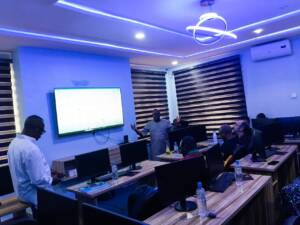
At the centre of the initiative is the EKSU Trading Room, a modern financial dealing facility established through the vision of the university’s Chancellor, Dr. Tunji Olowolafe, with financial support from the Tunji Olowolafe Foundation (TOF).
The eight-month Professional Diploma Programme was approved by the university’s Senate on February 25, 2026, with the pioneer cohort now approaching the completion of its training.
Professor Oke Michael Ojo of the Department of Finance confirmed the development, saying the first cohort of the diploma programme would graduate before the end of the year.
According to him, the programme was conceived to ensure that students do not leave the university with academic certificates alone, but also acquire practical knowledge and experience that could prepare them for the realities of the financial industry.
Bridging the gap between theory and practice
The establishment of the Trading Room reflects EKSU’s growing emphasis on experiential learning, particularly in areas where technology and practical skills are critical to professional success.
Professor Ojo explained that the facility was deliberately created to bridge the gap between financial theories taught in the classroom and the actual operations of financial markets.
He said the curriculum combines theoretical instruction with practical simulations, allowing students to develop an understanding of investment strategies, risk management and trading activities in global markets.
“We combined theoretical instruction with practical simulations so students gain a full, hands-on understanding of risk management, investment strategies, and live trading in global markets,” he said.
The approach also provides lecturers with an opportunity to integrate classroom concepts with real-time simulations, making financial education more practical and engaging for students.
The initiative aligns with the broader national conversation around improving financial literacy and investment education among young Nigerians.
President Bola Ahmed Tinubu had recently spoken about the importance of teaching stock-market knowledge to students as part of efforts to build a sustainable economy.
He was quoted as saying that if stock-market education could be introduced effectively at the undergraduate level, it could contribute to building a nation of succession and prosperity.
Olowolafe: Graduates must be market-ready
Dr. Tunji Olowolafe, whose vision and foundation support have been instrumental to the establishment of the Trading Room, said Nigeria’s higher education system must evolve in response to the changing demands of the global economy.
According to him, many graduates seeking employment in finance-related fields possess academic qualifications but lack the practical skills required to operate effectively in modern capital markets.
He explained that the E-FMTP was conceived to promote a shift from predominantly theoretical learning to practical, real-time financial market experience.
“Our vision with the E-FMTP is to pioneer a fundamental paradigm shift in African higher education — moving from rote theoretical learning to real-time execution,” Olowolafe said.
He added that the programme gives students exposure to professional dealing-room environments, simulated trading and global virtual work experiences.
The objective, he said, is to produce graduates with the professional confidence and practical competence required to compete in the global financial marketplace.
Olowolafe further challenged other Nigerian universities to adopt similar models, arguing that higher education institutions should become incubators for economic development and professional excellence.
Trading room equipped for practical learning
The EKSU Trading Room is described as a major component of the university’s financial education infrastructure.
The facility, technically supported by the CFA Institute, has been designed to simulate the environment of a professional financial dealing room.
It has 20 trading stations equipped with dual monitors, a 75-inch Smart television screen, an optimized sound system, solar inverter backup, three high-capacity air-conditioning units and high-speed internet connectivity.
Students also use professional trading vests as part of the effort to replicate the atmosphere of a live trading floor.
The facility is expected to provide students with practical exposure to the processes and discipline involved in financial-market operations while allowing lecturers to demonstrate concepts in a more interactive environment.
Programme roots in student financial literacy initiative
The development of the E-FMTP can be traced to September 2024, when selected EKSU students travelled to Lagos for a financial literacy programme and study visit to FMDQ Exchange in Victoria Island.
The experience exposed the students to aspects of the Nigerian financial market and subsequently contributed to the establishment of the EKSU Investment Club (ICESU).
The investment club has provided students with access to CFA Institute learning resources, career development opportunities, internship prospects, examination scholarships, project grants and investment conferences.
The initiative subsequently became one of the building blocks for EKSU’s broader financial education strategy.
Through these activities, the university has sought to create a culture in which students understand investment, capital markets and financial decision-making before entering the labour market.
‘Graduates need more than certificates’
For Ms. Bomo Anthony, General Manager of the Tunji Olowolafe Foundation, the significance of the project extends beyond the physical infrastructure and technology provided at the Trading Room.
She said she had witnessed the transformation of students participating in the programme, particularly their progression from learning basic concepts about shares and bonds to gaining practical exposure to trading.
“I’ve watched these students grow, week by week, from learning about shares and bonds to actually placing a trade,” she said.
According to her, that transition represents the point at which financial education moves from being a classroom exercise to becoming a potential career pathway.
Bomo said the founder’s vision was aimed at preparing students for the realities of a modern economy where professional competence and practical skills are increasingly important.
She urged the students to protect the opportunity provided by the programme and build on the knowledge and experience acquired.
“This investment only pays off if the students protect it and build on it,” she said, adding that the objective was not merely to graduate another group of students but to develop young people capable of thinking and operating like professionals.
A new model for university financial education
The impending graduation of the pioneer E-FMTP cohort is therefore expected to serve as an important test of EKSU’s model of combining university education, technology, industry expertise and private-sector investment.
Beyond the award of professional diplomas, the programme seeks to demonstrate how practical financial-market education can complement conventional academic training.
For the pioneer students, graduation will mark the completion of an eight-month journey that has exposed them to both the theoretical foundations and practical dimensions of securities trading and financial markets.
For EKSU, it could mark the beginning of a wider transformation in the way financial education is delivered within the Nigerian university system.
With the pioneer cohort approaching graduation, the Tunji Olowolafe Foundation and EKSU are already looking ahead to the next phase of the programme.
Applications for the next cohort are expected to open at the beginning of the new academic year, providing another group of students with access to the Trading Room and the professional training offered under the E-FMTP.
The expansion would further advance the vision of transforming financial education from a largely theoretical university subject into a practical tool for building financially literate, market-ready graduates.
Ultimately, the success of the pioneer cohort could determine how far the EKSU model travels, particularly at a time when Nigerian universities are under increasing pressure to produce graduates equipped not only with certificates but also with the practical skills required to contribute meaningfully to a changing economy.




Adelabu denies rift with Tinubu, says viral report is false
Media Office of former Minister of Power, Chief Adebayo A. Adelabu, has dismissed a…