

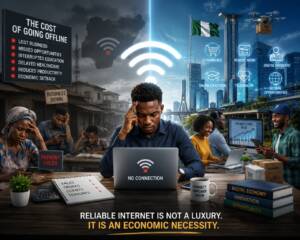
Cost of going offline: Why reliable internet is now an economic necessity

By Caleb Ohaeri
There was a time when internet access was considered a luxury, a convenience reserved for browsing websites, sending emails, or staying connected on social media.
Today, that reality has changed. In the digital age, reliable internet is no longer optional; it is an essential infrastructure that powers economies, creates jobs, enables education, and drives innovation.
For Nigeria, the conversation about internet connectivity is no longer just about speed or affordability. It is about economic competitiveness.
Every day, millions of Nigerians rely on the internet to work remotely, run businesses, access financial services, attend virtual classes, consult doctors, market products, and communicate with clients across the globe.
A network outage no longer means a temporary inconvenience; it means missed business opportunities, delayed transactions, interrupted healthcare services, and lost income.
The rise of artificial intelligence, cloud computing, remote work, digital banking, and e-commerce has made reliable connectivity even more critical. Small businesses now depend on digital platforms to reach customers.
Farmers use technology to monitor weather patterns and market prices. Students increasingly access educational resources online, while startups compete globally from cities such as Lagos, Abuja, and Port Harcourt.
Yet, despite Nigeria’s digital ambitions, millions still struggle with unreliable internet, poor broadband coverage, and inconsistent service quality.
For businesses, downtime translates directly into financial losses. For freelancers serving international clients, unstable connectivity can mean losing contracts. For young entrepreneurs, every interruption reduces productivity and weakens competitiveness.
The stakes are even higher as Africa positions itself within the global digital economy. Countries investing heavily in broadband infrastructure are creating environments where innovation flourishes, foreign investment grows, and technology companies scale. Nigeria cannot afford to be left behind.
Reliable internet should be viewed in the same way we view electricity, roads, and transportation. It is foundational infrastructure for national development.
The government, regulators, telecommunications providers, and private investors all have a role to play in expanding broadband access, improving service reliability, and making connectivity more affordable.
Digital inclusion should not be limited to major cities; rural communities, schools, healthcare facilities, and agricultural hubs also need dependable internet to participate fully in the modern economy.
The future of work, education, commerce, and governance will increasingly depend on digital connectivity. Nations that treat internet infrastructure as a strategic economic asset will be better positioned to attract investment, nurture innovation, and create high-value jobs.
The question is no longer whether Nigeria needs better internet. The real question is whether Nigeria can afford the economic cost of going offline.




Excitement as Akwa Ibom people await presidential visitors
By Solomon Essiet Other things being equal, His Excellency, President Bola Ahmed Ti…