

Coalition raises alarm over exclusion of communities in Africa’s water policy framework

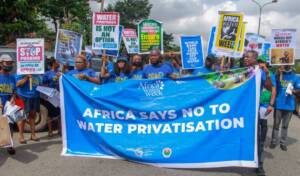
Our Water Our Right Africa Coalition (OWORAC) has raised strong concerns over what it describes as a growing push toward water privatisation in Africa, warning that current policy directions under the Africa Water Vision (AWV) 2063 could undermine public accountability and reduce access to safe water for millions across the continent.
The coalition also criticised the exclusion of communities, civil society organisations, and water workers from key decision-making processes shaping the implementation framework of the continental water agenda.
OWORAC made its position known in a statement following a recent regional consultation in Abuja hosted by the African Ministers’ Council on Water (AMCOW).
The meeting formed part of ongoing discussions on the First Implementation Plan (2026–2033) of the Africa Water Vision 2063 and Policy.
The consultation brought together representatives of the African Union, ECOWAS, development partners, and regional institutions.
It comes at a critical time after the African Union declared 2026 as the Year of “Ensuring Sustainable Water Availability and Safe Sanitation Systems to Achieve the Goals of Agenda 2063.”
While acknowledging the importance of improving water infrastructure across Africa, OWORAC warned that increasing reliance on private sector participation, blended financing, and public-private partnerships could accelerate the privatisation of water services if not carefully regulated.
According to the coalition, such models have in several African countries resulted in rising water tariffs, weakened public accountability systems, deteriorating labour conditions, and unequal access to essential services.
“Across Africa, such models have often resulted in rising water tariffs, weak public accountability, deteriorating labour conditions, and unequal access to water services,” the coalition said. “When essential public services are transferred to corporate actors, the human right to water risks being subordinated to profit-driven interests.”
OWORAC further stressed that water workers are increasingly facing marginalisation and precarious employment conditions under privatised or commercially driven systems.
It insisted that any credible water governance framework must recognise workers as key stakeholders alongside communities and governments.
The coalition maintained that water must not be treated primarily as an economic commodity but as a fundamental human right and public good that requires strong state stewardship.
“Water is first and foremost a public good and a human right,” OWORAC stated.
“Policies that prioritise investor confidence over universal access and public accountability risk deepening inequality and worsening water insecurity for poor and vulnerable communities.”
A major concern raised by the coalition is the alleged exclusion of directly affected communities, civil society groups, and labour unions from the Abuja consultation process.
OWORAC argued that despite AWV 2063 commitments to inclusive participation, the process appeared to be dominated by government officials and institutional actors.
“The people most affected by water shortages and sanitation failures must not be sidelined from decisions about Africa’s water future,” the coalition said.
“Community participation must be real, structured, and guaranteed.”
OWORAC also questioned the lack of clarity surrounding financing mechanisms and safeguards within the implementation plan, warning that insufficient transparency could open the door to increased corporate control of public water systems.
The coalition’s statement drew attention to Senegal’s role in continental water governance, noting its leadership of AMCOW and influence on policy direction. It cited ongoing debates around Senegal’s urban water management model, where distribution is handled by Sen’Eau, a company largely linked to French multinational Suez.
According to OWORAC, concerns have been raised in Senegal over rising tariffs, service delivery challenges, transparency gaps, and reduced public oversight since the arrangement began in 2020.
The coalition also referenced reports of tensions involving water workers and union activity within the system.
The group further highlighted Nigeria’s water sector challenges, noting that despite its influence in regional policy discussions, millions of citizens still lack consistent access to safe drinking water.
It argued that reliance on private vendors, boreholes, and informal water sources reflects long-standing neglect and underinvestment in public water infrastructure.
“Across Nigeria, many communities depend on private water vendors, boreholes, and other informal sources because public water systems have suffered years of neglect and underinvestment stemming from a dogmatic pursuit of the false solution of privatisation,” the statement added.
OWORAC urged African governments, regional bodies, and development partners to prioritise transparency, accountability, and public ownership in the implementation of AWV 2063.
The coalition called for stronger investment in public water systems and insisted that communities, workers, and civil society must be meaningfully involved in shaping water governance across the continent.
“Water is a public good,” OWORAC concluded. “Its future must be determined by the people who depend on it for life and dignity, not by profit.”
OWORAC is a network of grassroots organisations, activists, trade unions, and civil society groups from several African countries advocating that access to clean and affordable water is a fundamental human right, not a commodity for profit.




NUJ honours FCC Commissioner Peter Eze for Outstanding Youth leadership in Enugu
Stanley Ihedigbo Nigeria Union of Journalists (NUJ), Enugu State Coun…
