

Architecture of Excellence: Benjamin Kalu as a representative of possibilities

By Igboeli Arinze
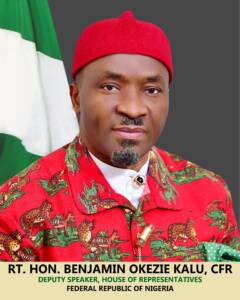
History rarely throws up a kind of public servant who enters the legislature not merely to occupy a seat, but to interrogate it, to ask what the institution owes the people, and then, relentlessly, to pay that debt. Rt. Hon. Benjamin Okezie Kalu, Deputy Speaker of Nigeria’s House of Representatives, is that rare figure.
His parliamentary life is not simply a career; it is the convergence of an extraordinary education, a rigorously examined philosophy of governance, and a deeply humane vision of what law can and should do for the most vulnerable.
A scholar’s foundation
Parliamentary excellence rarely springs from instinct alone. More often, it is forged in the patient discipline of scholarship.
Kalu’s academic journey is, in itself, a statement of intent. Born on May 5, 1971, in Agbamuzu, Bende Local Government Area of Abia State, he pursued law at the University of Calabar, earning his Bachelor of Laws with honours before being called to the Nigerian Bar.
He did not stop there. He returned to the same institution to acquire a Master of Laws in Terrorism and International Humanitarian Law, with distinction, a specialisation that reflects a mind drawn to the most complex intersections of power, human rights, and state accountability.
He then crossed continents to Oxford Brookes University in the United Kingdom, where he earned a Master of Business Administration, sharpening his understanding of institutional efficiency, fiscal discipline, and strategic leadership. Most recently, in 2025, the University of Abuja conferred upon him a Doctor of Philosophy in Public Policy and Strategic Studies, his thesis examining how Nigeria can integrate international climate adaptation strategies into domestic governance.
He has also completed an LL.D., a PhD in Law, his seventh serious academic credential, proof that for Kalu, learning is not a prelude to leadership; it is leadership’s permanent companion.
This breadth matters.
A legislator trained simultaneously in law, business, public policy, international humanitarian principles, and environmental governance does not see policy in silos. He sees it in systems. And it is precisely this systemic thinking that has shaped Kalu’s legislative output, which now runs to over one hundred sponsored bills, a record that distinguishes him as one of the most productive lawmakers in Nigeria’s modern parliamentary history.
A philosophy of purposeful governance
Behind Kalu’s legislative record lies a coherent philosophy: that governance must be deliberate, evidence-led, and morally accountable.
He has never been content with the theatrical dimensions of politics, the speeches that soar and accomplish nothing. His interventions have consistently been anchored in the logic of reform.
As Chairman of the House Committee on the Review of the 1999 Constitution, he has led one of Nigeria’s most consequential national assignments with the temperament of an architect rather than a polemicist — listening, balancing regional aspirations, and insisting on inclusion as a structural principle, not a cosmetic one.
His philosophical commitment to federalism as a living, adaptive instrument is evident in his championing of the State Police Bill, recognising that security cannot be a monolithic response in a structurally diverse nation.
His advocacy for the Special Seats for Women in Parliament reflects a philosophical conviction that democracy is incomplete when half its citizenry is systematically underrepresented. These are not populist positions.
They are the conclusions of a mind that has studied international humanitarian law, absorbed the lessons of governance theory, and applied them to the particular wounds and possibilities of the Nigerian condition.
On the international stage, as Chairman of the ECOWAS Parliament Committee on Finance, Administration and Budget, Kalu carries this philosophy further, advocating for Africa’s voice in global decision-making with the confidence of a man who understands that regional integration is not optional but existential.
His published academic works, spanning international criminal law, climate adaptation, foreign direct investment, and terrorism in Africa, ensure that his contributions to debate are not merely political but scholarly.
The humane impulse
Yet what ultimately distinguishes Benjamin Kalu is not his credentials or his legislative tally, impressive as both are. It is the humane thread that runs through everything he does.
Through the Benjamin Kalu Foundation, he has built programmes for youth empowerment, women’s advancement, and disability inclusion, recognising, as any serious humanitarian must, that the most vulnerable are not peripheral to governance but central to its purpose.
His Peace in the South-East Project (PISE-P) stands as perhaps the most poignant expression of this humane instinct. In a region fractured by tension and grief, Kalu has convened traditional rulers, faith communities, youth groups, and civic leaders to pursue dialogue as a deliberate strategy, not naive conciliation, but the hard, patient work of reconciliation that only those who genuinely love their people are willing to undertake.
Parliamentary excellence, in its truest form, is not measured in the volume of speeches delivered or awards received, though Kalu has received many, from the Zik Award of Excellence to the Commander of the Order of the Federal Republic (CFR), Nigeria’s second-highest national honour.
It is measured in the quiet transformation of institutions, the gradual widening of opportunity, and the slow but stubborn insistence that government can be worthy of the governed.
By that measure, Benjamin Okezie Kalu does not merely occupy the Chair of the Deputy Speaker. He honours it.




Caleb University Postgraduate Students celebrate Bello, Aondover, Okunade’s academic elevations
Mercy Iheoma Ihedigbo 2025/2026 Set of postgraduate students of Mass Communi…
