

Africa must own, finance, govern its oceans, Adalikwu tells Blue Africa Conference

Stanley Ihedigbo
Africa must stop generating maritime value only to export it and begin to own, finance and govern its oceans, the Secretary-General of the Maritime Organization of West and Central Africa (MOWCA), Dr Paul Adalikwu, has said.
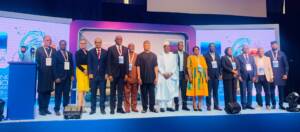
Adalikwu made the call on Thursday, August 13, 2026, at the opening session of the maiden edition of the Blue Africa Conference and Exhibition 2026 in Lagos.
Delivering a keynote address titled “Setting the Course for Africa’s Maritime Future: From Blue Potential to African Maritime Power,” the MOWCA Secretary-General said Africa could no longer afford to remain a major source of maritime resources while foreign interests captured most of the economic value generated from them.
He noted that the continent possesses more than 30,000 kilometres of coastline, strategic maritime trade routes, extensive fisheries and significant offshore energy resources, yet continues to depend heavily on foreign ownership of ships, external financing, imported technology and offshore insurance.
According to him, the situation represents a major contradiction in Africa’s development story.
“Africa generates maritime value but does not retain it. This imbalance must be corrected.”
The two-day Blue Africa Conference, holding in Lagos from August 14 to 15 under the theme “From Maritime Potential to African Maritime Power,” is expected to bring together ministers, industry leaders, financiers, development partners and other key stakeholders to examine how Africa can unlock greater economic value from its maritime resources.
Adalikwu used the platform to advocate a shift from fragmented national approaches to a coordinated continental maritime strategy.
He said African countries must develop a common maritime vision capable of positioning the continent as a significant force in the global maritime economy.
“One Africa. One maritime voice. One strategic direction,” he declared.
He explained that continental cooperation should not be interpreted as an attempt to undermine the sovereignty of individual countries, but rather as a strategy for strengthening their collective bargaining power and economic influence.
“This is not about reducing sovereignty — it is about strengthening it. No African state can shape global maritime systems alone. Together, Africa is a maritime power of global consequence.”
Five-Year Maritime Imperative
The MOWCA chief called for five-years of measurable progress towards deeper maritime integration across the continent.
He urged African governments to place maritime development at the centre of their economic strategies and encourage ports and maritime hubs to collaborate rather than compete in isolation.
He also challenged the private sector to take greater ownership of the maritime value chain while urging financial institutions and investors to regard maritime assets as productive economic capital rather than high-risk ventures.
According to him, the continent’s maritime transformation would remain difficult without a deliberate and sustainable financing mechanism.
Adalikwu Pushes Maritime Bank of Africa
A major part of his address was his call for the establishment of a Maritime Bank of Africa, which he said could help mobilise patient capital, blended finance, guarantees and long-term equity and debt for strategic maritime investments.
He said the proposed financing mechanism should support the development of ports, African-owned shipping fleets, shipyards, fisheries, offshore renewable energy, maritime technology, security infrastructure and human-capital development.
“No maritime transformation is possible without finance. Africa cannot build competitive ports, fleets, shipyards, and blue industries on external capital alone. The question is simple: Can Africa finance its own maritime future? Our answer must be yes.”
He argued that African countries must move beyond dependence on external capital and create indigenous financing structures capable of supporting projects with long gestation periods.
From blue economy slogans to ownership
Adalikwu further challenged policymakers to move the African Blue Economy conversation beyond conferences, declarations and slogans to actual ownership of assets and intellectual capacity.
He said African ownership must extend across the maritime value chain, including vessels, ports and logistics, technology, fisheries processing, marine data, ship repair, maritime finance and intellectual property.
Rather than focusing primarily on what Africa can attract from foreign investors, he said, the continent must increasingly ask what it can own, build and scale.
“Africa must stop asking only what it can attract and start asking what it can own, build, and scale.”
The MOWCA Secretary-General maintained that the continent’s maritime potential would only translate into sustainable economic development when African businesses and institutions occupy strategic positions across the value chain.
AfCFTA, ports and hinterland connectivity
Linking the maritime agenda to the African Continental Free Trade Area, Adalikwu stressed that the strength of a port cannot be measured solely by the quality of its waterfront infrastructure.
He said efficient connections between ports and hinterlands were essential to unlocking the full economic benefits of maritime investments.
According to him, ocean-to-hinterland corridors, efficient logistics systems, rail and road networks, as well as modern customs procedures, must work together to facilitate the movement of goods across African markets.
He noted that without strong hinterland connectivity, even modern ports would struggle to become catalysts for industrialisation and intra-African trade.
Maritime Security Critical to Investment
The MOWCA chief also drew attention to the growing range of threats confronting Africa’s maritime domain.
He identified piracy, illegal fishing, trafficking, cyber risks and climate-related vulnerabilities among the challenges capable of undermining maritime investment, employment and revenue.
He said maritime security should therefore be viewed not merely as an enforcement responsibility but as an essential component of economic infrastructure.
According to him, investors, traders and insurers require confidence and reduced risks before committing significant resources to maritime ventures.
He therefore called for sustained investment in maritime security and the institutions required to protect Africa’s oceans and the economic activities they support.
Youths are Africa’s real maritime infrastructure
Adalikwu also placed human capital at the centre of Africa’s maritime transformation agenda.
He described people as the continent’s most important maritime infrastructure and called for expanded training and career opportunities for young Africans.
He said Africa must develop a new generation of seafarers, naval architects, port professionals, maritime lawyers, data specialists, cybersecurity experts and maritime entrepreneurs.
The objective, he explained, should be to produce professionals who are “African in origin, global in competence, and competitive anywhere in the world.”
He argued that investment in maritime skills would enable African countries to reduce their dependence on foreign expertise while creating jobs and supporting the growth of indigenous maritime enterprises.
Conference must produce action, not just dialogue
Adalikwu challenged participants at the Blue Africa Conference to ensure that the gathering produces concrete outcomes rather than becoming another platform for discussion.
He said the success of the conference should ultimately be measured by stronger continental cooperation, the emergence of a coalition supporting the proposed Maritime Bank of Africa, a pipeline of bankable maritime projects and the development of a clear framework for African ownership of the maritime value chain.
He urged governments, private-sector operators, financial institutions and development partners to work together to transform Africa’s vast maritime potential into sustainable economic power.
Concluding his address, the MOWCA Secretary-General said history would ultimately judge the continent by the extent to which it converted its maritime resources into tangible development.
“History will judge us not by Africa’s maritime potential, but by what we did with it.”
He described the ocean as Africa’s gateway to the future and insisted that the continent must take greater responsibility for its maritime destiny.
“The ocean is not a barrier — it is Africa’s gateway to the future. But it must be owned, financed, and developed by Africans.”
He concluded with a strong call for continental action, declaring:
“Africa must be an owner. Africa must be a partner. Africa must be a leader. The time to act is now. The future is blue. The future is African.”




Delta has lost a distinguished statesman, compassionate leader — Ebie mourns Uduaghan
Chairman of the Governing Board of the Niger Delta Development Commission (N…