

Beyond palliatives: Dr. Doro’s radical blueprint for a resilient Nigeria, ( Re Doro is working)

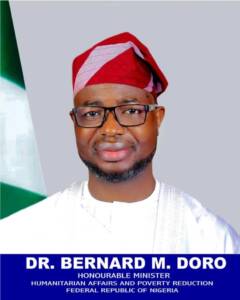
By Kennedy Elaigwu Abwodi
In the traditional theater of Nigerian politics, the “flag-off” of a distribution exercise is often viewed through a lens of skepticism, a fleeting moment of optics where bags of grain are exchanged for camera flashes, leaving the underlying hunger unaddressed once the dust settles.
However, standing on the turf of the Aper Aku Stadium in Makurdi, Benue State, recently, one could sense a shift in the atmosphere. Dr. Bernard M. Doro, the Honourable Minister of Humanitarian Affairs and Poverty Reduction (FMHAPR), wasn’t just there to hand out food; he was there to dismantle a legacy of dependency.
For those who have followed Nigeria’s humanitarian trajectory, the challenges in Benue, the nation’s “Food Basket”, are a painful irony. Armed violence and communal conflicts have turned farmers into IDPs, trading their hoes for relief queues.
Dr. Doro’s address in Makurdi signaled that the era of “managing” poverty is over. The era of ending it through systemic architecture has begun.
The centerpiece of Dr. Doro’s vision is the One Humanitarian, One Poverty Response System (OHOPRS). It is a mouthful of an acronym, but its logic is elegantly simple: humanitarian aid must be a bridge, not a destination.
During the Makurdi flag-off, Dr. Doro was emphatic: “Affected populations must not receive only one-off support.” Under OHOPRS, a family receiving nutrition assistance today is simultaneously integrated into the National Social Register.
This isn’t just paperwork; it is a digital handshake that links a vulnerable citizen to conditional cash transfers, skills development, and micro-enterprise support.
By harmonizing data systems, the Minister is effectively closing the “revolving door” of poverty. It is a move from emergency response to a continuum of care. This shift is vital because, as the Minister rightly noted, humanitarian gaps are widening globally as traditional donor funding shrinks. Nigeria can no longer afford fragmented, disconnected interventions that collapse the moment a specific project cycle ends.
One of the most refreshing aspects of Dr. Doro’s leadership is his impatience with “shelf-ware”, policies that look good in leather-bound folders but do nothing for the man in a displacement camp.
Nigeria’s National IDP Policy was approved in 2021, yet its implementation had largely stalled in the gears of administrative transition. Upon assuming office, Dr. Doro didn’t just “review” it; he weaponized it. By developing a comprehensive Operational Plan and transmitting it to the Federal Executive Council (FEC), he has moved the needle from existence to execution.
As he told international partners from Germany and the United States, policy without operationalization is just humanitarian stagnation. By defining clear federal-state responsibilities and a financing framework, the Minister is ensuring that the “Food Basket” and other affected regions have a structured roadmap for durable solutions and reintegration.
Perhaps the most sophisticated element of Dr. Doro’s agenda is his diplomatic tact in recalibrating Nigeria’s relationship with the international community. For years, the humanitarian response in Nigeria has been perceived as donor-led, particularly through the lens of OCHA and the Northeast-centric HRP (Humanitarian Response Plan).
Dr. Doro is steering a “responsible national maturation.” In high-level meetings with the German Ambassador and the U.S. CDA, he has been clear: Nigeria is preparing for a gradual transition toward stronger national leadership in coordination. “This is not disengagement,” he noted, “it is responsible national maturation.”
By positioning OHOPRS as the institutional backbone, the Ministry is ensuring that the Nigerian government, not just international NGOs, is the primary architect of its own resilience. This includes a bold expansion of focus. While the world’s eyes have been fixed on the Northeast, Dr. Doro is shining a spotlight on the growing vulnerabilities in the North Central and North West, ensuring that no household falls through the cracks of “response geography.”
The Minister’s work extends beyond our borders. The finalization of the Tripartite Agreement between Nigeria, Niger, and the UNHCR is a masterstroke in migration management.
Repatriation is a sensitive, often volatile process. Dr. Doro’s insistence that return must be “voluntary, dignified, safe, and economically sustainable” isn’t just rhetoric, it’s a strategy. By linking repatriation to livelihood tracking, the Ministry is preventing “secondary displacement,” where refugees return only to flee again because they have no means of survival. His scheduled travel to Niger underscores a hands-on approach to diplomacy that prioritizes the human element over the bureaucratic one.
In Dr. Bernard M. Doro, Nigeria has a Minister who understands that compassion without a system is merely a sentiment. He is building a ministry that is data-driven, transparent, and, most importantly, accountable.
Whether it is pushing for public finance reform, expanding the National Social Register, or ensuring that traditional rulers in Benue are part of the distribution transparency loop, Doro is weaving a safety net that is actually made of rope, not cobwebs.
The task ahead is monumental. Poverty is a stubborn foe, and displacement is a complex trauma. However, with the One Humanitarian, One Poverty Response System, Dr. Doro is giving Nigerians more than just food; he is giving them a pathway back to dignity. He is proving that while the government will stand with you in your time of need, its ultimate goal is to empower you to stand on your own.
Kennedy Elaigwu Awodi wrote from North Carolina, USA.
Email: awodiken@outlook.com





Oyo abduction crisis: ‘Nigerians should not relent in prayers,’ Says husband of captive principal
Michael Olumide For Professor Wole Alamu, every passing day has become an exercise in fait…
