

2027: Akwete Women Weavers distance selves from Otti, back Tinubu’s re-election, support Uzodinma, Arodiogbu
..Praise First Lady Oluremi Tinubu’s $2bn intervention in traditional weaving

Stanley Ihedigbo
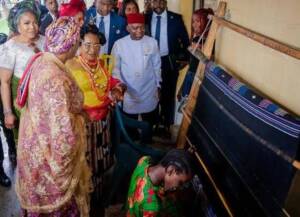
Akwete Women Weavers of Ukwa East Local Government Area of Abia State have publicly distanced themselves from Governor Alex Otti over his recent comments on the political position of the South-East ahead of the 2027 presidential election.
The women, including beneficiaries of the reported $2 billion economic empowerment support facilitated through the Renewed Hope Initiative of the First Lady of Nigeria, Senator Oluremi Tinubu, declared their support for the re-election bid of President Bola Ahmed Tinubu in 2027.
They also expressed solidarity with the Imo State Governor and Chairman of the Progressive Governors’ Forum, Senator Hope Uzodimma, as well as the National Vice Chairman of the All Progressives Congress (APC), South-East, Dr. Ijeomah Arodiogbu, over their calls for what they described as a united and strategic political position for the South-East ahead of the 2027 general elections.
The position of the Akwete women was contained in a statement attributed to the Coordinator of the Akwete Women Weavers Cooperative, Mrs. Nneka Okorie, who said Governor Otti’s recent remarks did not represent the views and aspirations of the women in the Akwete weaving communities.
The development followed comments credited to Governor Otti during a media interaction in which he reportedly rejected the position that any individual governor, including Governor Uzodimma, could speak for the entire South-East on the region’s political direction ahead of the 2027 presidential election.
However, the Akwete women said their priority was practical development, economic empowerment and the preservation of the cultural heritage of their communities.
According to them, political differences should not be allowed to undermine opportunities capable of improving the lives of ordinary people, particularly women and artisans whose livelihoods depend on indigenous industries.
Mrs. Okorie reportedly said the women were grateful for what they described as the intervention of the First Lady, Senator Oluremi Tinubu, in the development of Akwete traditional weaving, noting that the initiative had renewed hope among women who have depended on the ancient craft for generations.
She maintained that no First Lady since Nigeria’s return to democratic rule in 1999 had, in their assessment, demonstrated the same level of practical commitment to the preservation of Akwete cultural heritage and the economic empowerment of women involved in the traditional textile industry.
The women said the Renewed Hope Initiative had demonstrated concern for women, artisans and grassroots communities through interventions designed to improve livelihoods, strengthen local enterprises and promote inclusive economic growth.
They particularly commended the reported $2 billion intervention fund for Akwete weaving, describing it as a major boost to the traditional industry and a potential turning point for thousands of women involved in the production and marketing of Akwete textiles.
According to the women, the intervention is expected to support capacity-building programmes, the acquisition of modern weaving equipment and looms, the establishment and strengthening of cooperatives, improved market access, export opportunities and infrastructure development in Akwete and neighbouring communities.
They expressed optimism that the intervention would help transform Akwete weaving from a largely traditional cottage industry into a modern and commercially viable enterprise capable of creating jobs, generating income and expanding Nigeria’s cultural exports.
The women also said the initiative could contribute significantly to the preservation of the Akwete textile tradition, which has historically served as an important cultural identity and source of livelihood for communities in Abia State.
They argued that government support for indigenous industries should be encouraged regardless of political affiliation, stressing that economic empowerment and development should remain the primary focus of leaders at all levels.
The Akwete women subsequently declared their support for President Bola Ahmed Tinubu’s re-election bid in the 2027 presidential election, saying they believed the Federal Government’s interventions in their sector demonstrated a commitment to grassroots development.
They also backed Governor Hope Uzodimma and Dr. Ijeomah Arodiogbu in their advocacy for a strategic political approach by the South-East ahead of the 2027 elections.
The women said they were particularly interested in political leadership that would attract greater federal attention and development to the region, while insisting that the political aspirations of ordinary citizens should be considered alongside broader regional interests.
They described Governor Otti’s position as divisive and contrary to what they considered the collective interest of the Igbo people, arguing that his views should not be interpreted as representing the position of all South-Easterners.
The women maintained that the people of the South-East, including women and artisans at the grassroots, had diverse political opinions and should be allowed to make their individual choices based on their assessment of government policies and interventions.
They further said that the reported support for Akwete weaving had demonstrated the potential benefits of closer collaboration between grassroots communities and the Federal Government.
The statement came barely 24 hours after Dr. Arodiogbu, the APC National Vice Chairman, South-East, criticised Governor Otti over his comments concerning Governor Uzodimma’s position on the 2027 presidential election.
Arodiogbu had argued that Governor Uzodimma had emerged as an influential voice in South-East politics through what he described as strategic political sacrifices and efforts to foster closer engagement between the region and the Federal Government.
The Akwete women’s declaration appears to reinforce that narrative, with the women positioning themselves in favour of a political strategy they believe could attract more federal investment and development to the South-East.
They said their decision to support President Tinubu was based on what they described as the need to protect their economic interests, preserve their cultural heritage and promote policies that would directly benefit women and artisans.
The women, however, stressed that their position should be viewed as an independent expression of their political preference and not as an attempt to speak for every woman or community in Abia State.
They urged political leaders in the South-East to prioritise peace, unity and development, saying the region could achieve greater economic progress through constructive engagement with the Federal Government.
The Akwete women further appealed for the continued expansion of programmes targeted at women-owned businesses, traditional artisans and indigenous industries, saying such interventions would help reduce poverty and create sustainable livelihoods.
They also called for more investment in the Akwete weaving industry, including access to affordable finance, modern equipment, skills development, digital marketing and international market opportunities.
The women expressed confidence that with sustained government and private-sector support, Akwete textiles could become a major contributor to Nigeria’s cultural economy and a significant source of foreign exchange.
They therefore reaffirmed their support for President Tinubu’s 2027 re-election bid while pledging to continue advocating for policies and programmes that would empower women and preserve the cultural heritage of the Akwete people.
The development adds a new dimension to the emerging political debate in the South-East ahead of the 2027 general elections, as different political actors and community groups continue to express divergent views on the region’s preferred political direction.
For the Akwete women, however, the central issues remain economic empowerment, cultural preservation and access to opportunities capable of improving the livelihoods of women and families across their communities.



Beyond Dangote IPO: What happens when promise is tested
By Tony Usidamen Unless you have been deliberately avoiding the news lately,…