

‘NaviaRide revolutionises commuting, lets riders share trips, cut transport costs’

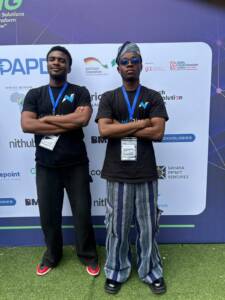
Co-Founder and Chief Executive Officer of NaviaRide, Adebisi Timileyin, and Co-Founder and Chief Technology Officer, Chidozie Green, are combining technology, innovation and a strong understanding of urban mobility to build what they believe could become a new standard for professional transportation in Nigeria.
Adebisi, who graduated Summa Cum Laude from Caleb University as the best graduating student in his class, brings a strong background in software engineering to the venture.
His experience as a former head of the Google Developer Student Clubs (GDSC) Robotics group further strengthened his passion for technology, innovation and building systems designed for excellence.
His co-founder, Chido Green, also a Caleb University alumnus, leads the company’s technology and systems architecture. With a strong focus on backend engineering, security, scalability and sustainable urban growth, Chido is helping to build the technological infrastructure upon which NaviaRide’s long-term ambitions rest.
Together, the two founders are positioning NaviaRide as more than just another transportation platform. Their ambition is to leverage technology to make professional commuting safer, more reliable, efficient and convenient, particularly in some of Nigeria’s most challenging urban environments.
In this interview with Head, ICT and Digital, Caleb Obaeri, Adebisi Timileyin and Chido Green speak about the inspiration behind NaviaRide, the challenges of transforming Nigeria’s transportation ecosystem, the technology powering their platform, their experience as young Nigerian entrepreneurs and their vision for the future of urban mobility.
What has been the biggest challenge you have encountered while building NAVIARIDE in Nigeria, and what has that experience taught you about the country’s transportation ecosystem?
The biggest challenge has been building trust around the idea of sharing a private vehicle with someone you do not already know. Transportation in Nigeria is deeply relationship-driven, and people naturally have concerns about safety, reliability and who they are getting into a vehicle with.
Building NAVIARIDE has taught us that the transportation problem is not simply about the availability of vehicles. It is also about trust, coordination and access to reliable alternatives. Technology can help solve the coordination problem, but trust has to be deliberately built into the product.
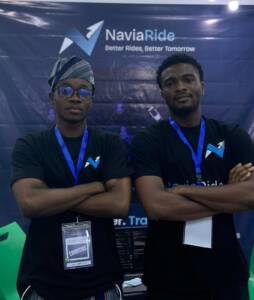
That is why verification and safety are central to NAVIARIDE. We want commuters to know who they are travelling with and have the tools they need throughout the trip.
Carpooling requires people to change deeply established commuting habits. What incentives are you putting in place to encourage private car owners to share their vehicles with other commuters?
We are starting with a simple incentive: helping people make better use of trips they are already taking.
Many private vehicle owners drive the same routes every day with empty seats. Instead of making another trip specifically for passengers, NAVIARIDE allows them to share those existing trips and recover part of their transportation costs.
Beyond the immediate financial benefit, we are also exploring driver-focused incentives such as maintenance and car-care vouchers, loyalty benefits and other rewards as the platform grows.
The important distinction is that we are not asking people to become taxi drivers. We are asking them to share seats on journeys they are already making.
For vehicle owners, fuel, maintenance, insurance and depreciation are major costs. How does NAVIARIDE ensure that participating vehicle owners receive enough economic value to make carpooling worthwhile?
Our model is based on cost sharing rather than treating private vehicle owners as commercial drivers.
A vehicle owner sets a reasonable contribution for passengers travelling along their existing route. This allows the owner to recover part of the cost of fuel and vehicle use, while passengers get a more affordable and predictable commuting option.
NAVIARIDE earns a commission from completed trips rather than charging drivers simply for being on the platform.
As the platform grows, we can use route demand and trip data to help create pricing that works fairly for both drivers and passengers.
How does NAVIARIDE make money, and what does a sustainable business model for structured carpooling look like in the Nigerian market?
Our primary revenue model is a commission on completed carpool trips.
The opportunity goes beyond individual trip commissions. As the network grows, there are opportunities around employer mobility programmes, university transportation, corporate partnerships, priority features and other services built around organised commuting.
We believe sustainability will come from building a large network of recurring daily commuters rather than depending on occasional trips.
Nigeria has millions of people travelling predictable routes every day. If we can make those existing journeys more efficient, the business can grow alongside the transportation network rather than having to create an entirely new one.
What measures are you putting in place to protect commuters and vehicle owners from fraud, harassment, theft or other risks that could undermine confidence in shared mobility?
Safety is one of, if not the most important part of NAVIARIDE.
We are building a verification and trust system that includes identity verification, face-liveness checks, work or corporate identification where applicable, driver-document verification and administrative review.
The platform also provides features such as trip tracking, emergency contacts, emergency-call functionality and communication between drivers and passengers.
We also believe safety is an ongoing process rather than something that can be solved with one verification step. As the platform grows, we will continue improving reporting, monitoring and other safeguards based on real user experiences.
Lagos has a unique transportation ecosystem involving buses, danfo, BRT, motorcycles, tricycles and ride-hailing services. Where exactly do you see NAVIARIDE fitting into this existing ecosystem rather than competing with every mode of transport?
We do not see NAVIARIDE as a replacement for every existing form of transportation.
Lagos has different transportation options because people have different needs. Our focus is on specific gap: people travelling along predictable routes who want a more affordable and trusted way to share existing private vehicle trips.
For example, someone travelling from Ikeja to Lekki every morning may already be making that journey alone in their car. Another person may be travelling along the same corridor. NAVIARIDE connects those two people.
We see ourselves as another layer within the transportation ecosystem, helping utilise existing private vehicles more efficiently and complementing public transportation rather than trying to eliminate it.
How important are employers, universities and large organisations to your growth strategy, particularly in helping employees and students adopt organised carpooling for daily commuting?
They are extremely important to our long-term strategy.
One of the biggest advantages of organised carpooling is that people often travel in predictable communities, the same office, university, estate or business district.
Employers and institutions can therefore help create trusted mobility communities where people have common destinations and schedules. It also allows organisations to reduce commuting challenges for their employees or students without having to operate an entire transportation fleet themselves.
We see partnerships with employers, universities and large organisations becoming an important part of scaling structured carpooling in Nigeria.
Data will become increasingly important as NAVIARIDE grows. What kinds of mobility data are you collecting, and how will you balance the commercial value of that data with commuters’ privacy and security?
We are interested in understanding mobility patterns such as popular routes, travel times, demand levels, trip frequency and the relationship between available vehicle capacity and passenger demand.
The purpose is to make the transportation network more efficient, for example, by understanding where there is high demand but insufficient carpool capacity.
However, we do not believe users should have to sacrifice their privacy for convenience. Personal information and mobility data will be handled according to applicable privacy requirements, with appropriate security measures and controls around how data is accessed and used.
Our goal is to use aggregated and appropriately protected mobility insights to improve the service, rather than treating individual users’ movements as a product.
NAVIARIDE has ambitions beyond Nigeria. Which African cities or markets do you believe are best suited to the model, and what factors will determine where you expand first?
We are particularly interested in African cities that have large populations, significant daily traffic congestion, growing technology adoption and a strong culture of private vehicle ownership.
Cities such as Accra, Nairobi, Johannesburg and other major African urban centres present interesting opportunities, but expansion will not simply be based on population size.
We will look at factors such as commuting patterns, traffic congestion, private vehicle usage, regulatory conditions, smartphone adoption, payment infrastructure and the willingness of commuters to adopt organised carpooling.
Nigeria is our immediate focus. We want to prove the model locally before taking it to other markets.
If you could change just one thing about Nigeria’s transportation system today, what would it be, and how would that change help create the kind of mobility ecosystem NAVIARIDE is trying to build?
I would improve the coordination and integration of the transportation system.
Nigeria does not necessarily need more vehicles on the road. We need to make better use of the vehicles and transportation capacity we already have.
Millions of people travel along similar routes every day, while many private vehicles have empty seats. At the same time, public transportation systems can be overcrowded and unreliable in certain areas.
If we had better coordination between public transport, private vehicles, carpooling and digital mobility platforms, we could move more people with the resources we already have.
That is the kind of ecosystem NAVIARIDE wants to contribute to, one where technology helps people share existing transportation capacity, reduce unnecessary trips and make daily commuting more efficient, affordable and trusted.



The Mirror Online TV debuts, features Nigerian Tribune Bureau Chief, Netcom Africa President, others
The Mirror Newspaper has expanded its digital media operations with the laun…