

Hidden cost of criminalising abortion in Lagos (1)

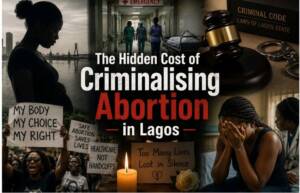

Lagos State’s restrictive abortion laws have contributed to preventable deaths and other life-threatening complications. Yet the true scale of the crisis remains unknown, hidden by inadequate data, secrecy, stigma, and shame surrounding abortion. JULIANA FRANCIS examines the human cost of criminalising abortion, reliving the painful experiences of survivors and trauma borne by families who lost loved ones.
Death after seeking an abortion from a nurse
Pain, despair, and a hint of helplessness crisscrossed Amaka’s face as she recalled the events leading to the death of her younger sister, Ngozi, some years back.
As Amaka struggled to rein in her emotions, she failed; tears streamed down her cheeks.
The reporter spoke with her at Ijegun, in the Alimosho Local Government Area of Lagos State, where her family resides. This was also where Ngozi resided until her death.
Amaka, a Nollywood makeup artist, said that 22-year-old Ngozi died from a horrific abortion experience 10 years ago.
She whispered brokenly: “We were like Siamese twins. People called her my handbag. We were so close. Yet, when she got pregnant, she didn’t tell me. Instead, she resorted to an abortion and died. To this day, I’m still asking myself why she didn’t tell me, why she didn’t keep the pregnancy. We’ve never gotten over her death. The shock killed our father, and our mother has never been the same.”
On the day the family discovered that Ngozi had had an abortion, Amaka was part of a movie shoot in the Ikorodu area of Lagos State.
On that day, she asked Ngozi to come over as usual to assist on set, but Ngozi replied with a video of herself receiving a drip at home, saying she was ill.
Amaka recalled, “She said it was malaria.
The next day, my other sister called to tell me Ngozi had an abortion. None of us knew she was pregnant! She even told the nurse treating her that she had malaria. The nurse gave her antibiotics without running any laboratory tests.
“Nobody would have known if not that my other sister discovered Ngozi’s blood-soaked clothes in a bucket. She had become too weak to wash them. When Ngozi was confronted, she admitted to the abortion.”
Worried sick over the amount of blood in the bucket, the family rushed her to a private hospital.
“A doctor there performed an evacuation and even evacuated the baby’s severed hand. Her condition was already critical, so she was referred to another hospital and eventually to the Lagos University Teaching Hospital (LUTH),” Amaka recalled.

At LUTH, the family was asked to pay ₦350,000 before Ngozi would be moved to the Intensive Care Unit (ICU), but they could only raise ₦200,000.
When the medical personnel noticed Ngozi’s condition had become critical, and life appeared to be quickly slipping away, they then asked for the initial ₦200,000 deposit.
Amaka recounted the harrowing moments: “There was no electricity to operate the lift, and the staff were nonchalant. I ran to plead with the man in charge of the generator, but by the time I returned, my sister was gasping for air. She held my hand tightly, apologised repeatedly, and then passed away right there in the hospital walkway. I carried her body myself, still hoping she could be revived. But when I saw her covered up, I knew she was gone. The loss devastated our family.”
Restrictive abortion laws drive unsafe procedures
Avoidable deaths like Ngozi’s continue to occur in Lagos State because the criminalisation of abortion forces many women and girls to seek unsafe, self-induced abortions or rely on unqualified providers instead of accessing safe medical care.
Unsafe and unlawful abortions are criminalised under the national Criminal Code Act and the Criminal Law of Lagos State.
The Criminal Code Act penalises unlawful abortions with severe penalties.
Sections 228 and 229 of the Criminal Code make unlawfully procuring a miscarriage or a woman inducing her own miscarriage a felony, punishable by up to 14 years and seven years’ imprisonment, respectively.
Section 230 prescribes a three-year prison sentence for supplying drugs or instruments for an unlawful abortion.
The Criminal Law of Lagos State (Chapter C17) largely mirrors these provisions but permits abortion when it is medically necessary to protect a woman’s life or physical health. Sections 145 and 146 prescribe penalties of up to 14 years’ imprisonment for providers and seven years for women, respectively.
World Health Organisation (WHO) says, “An abortion is unsafe when it is carried out either by a person lacking the necessary skills or in an environment that does not conform to minimal medical standards, or both.”
WHO further states that the least safe conditions are when an abortion is carried out by untrained people using dangerous or invasive methods, adding that restrictive abortion laws do not reduce the number of abortions; instead, they drive women to unsafe procedures.
According to the National Library of Medicine, Women make use of abortifacient agents such as livestock droppings, drinking chemicals and detergents, herbal medicines, and overdoses of over-the-counter medications, as well as insertion of sharp objects into the uterus.
ScienceDirect says access to safe abortion is a fundamental human right.
More deaths and complications from unsafe abortions
After Ngozi’s death, her siblings combed through her WhatsApp chats and discovered conversations with a contact identified only as “Nurse.”
When the family traced the nurse to her residence, a single room in a rundown neighbourhood, they discovered she had fled.
According to the family, she had allegedly performed another abortion that ended in a patient’s death, prompting the victim’s relatives to begin searching for her. Amaka described the woman as a quack who had been posing as a nurse.
Amaka said, “In other countries, abortion is treated as a medical procedure, but here it is seen as shameful. Many young women resort to dangerous methods, and countless lives have been lost.”
Although the lack of reliable data on unsafe abortion continues to plague Nigeria, including Lagos State, due to both official and unofficial reporting gaps, the reality is undeniable: women and girls are dying because of unsafe abortion.
The Lagos State Ministry of Health, rightly admitting the prevalence of maternal mortality from unsafe abortions, came up with the Lagos State Guidelines on Safe Termination of Pregnancy for Legal Indications (STOP Guidelines).
The STOP Guidelines were developed to provide a standardised clinical and legal framework for healthcare providers and to clarify when a pregnancy could be safely terminated under existing laws, specifically, in medical emergencies where continuing the pregnancy poses a severe risk to the woman’s life or health.
It was launched on 29 June 2022 but was suspended the following month after opposition from religious bodies and other groups, who argued that the policy could encourage abortion.
Since then, the legal gap has remained, and unsafe abortions have continued.
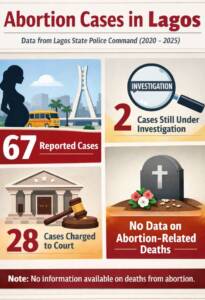
Further strengthening the argument on the reality of abortion, the Lagos State Police Command, in response to a Freedom of Information request, stated that between 2020 and 2025, it recorded 67 reported cases.
Of these, two remain under investigation, and at least 28 individuals have been charged in court.
However, the data did not indicate the number of cases that involved deaths resulting from abortion.
According to the WHO, Worldwide, 25 million unsafe abortions -45% of all abortions- occurred every year between 2010 and 2014, with the majority of unsafe abortions, or 97%, occurring in developing countries in Africa, Asia and Latin America.
According to the National Library of Medicine, induced abortion in Lagos is “slightly less restricted,” as it is permitted to preserve a woman’s life and physical health. Despite Nigeria’s restrictive legal framework, induced abortion remains common, with an estimated 46 abortions per 1,000 women aged 15–49, based on a 2017 confidante method estimate.
The study estimates this translates to about 2.4 million abortions annually, using the 2023 population of women of reproductive age. This represents a sharp increase from the 2012 estimate of 1.25 million abortions annually, based on 33 abortions per 1,000 women aged 15–49 using the abortion incidence complications method.
WHO in the article, Preventing Unsafe Abortion, says: “Mortality from unsafe abortion disproportionately affects women in Africa. While the continent accounts for 29% of all unsafe abortions, it sees 62% of all abortion-related deaths.”
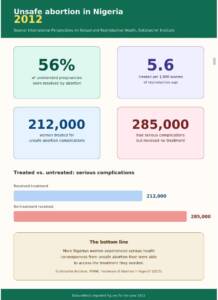
A Journal Of Peer-Reviewed Research, International Perspectives on Sexual and Reproductive Health, says “in Nigeria in 2012, 56 per cent of unintended pregnancies were resolved by abortion. About 212,000 women were treated for complications of unsafe abortion, representing a treatment rate of 5.6 per 1,000 women of reproductive age, and an additional 285,000 experienced serious health consequences.”
The Lagos Sector of the Society of Gynaecology and Obstetrics of Nigeria (SOGON) says that unsafe abortions are responsible for about 13 out of every 100 maternal deaths in Lagos State.
This means that if Lagos recorded 1,000 maternal deaths in a given period, as many as 130 of those deaths could be linked to unsafe abortions.
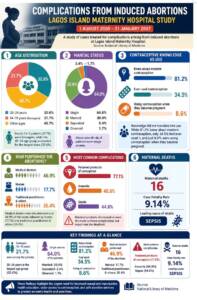
A study conducted at Lagos Island Maternity Hospital, which examined patients treated for complications from induced abortions between 1 August 2005 and 31 January 2007, found that teenagers and single women were more likely to seek abortions after 12 weeks of pregnancy, increasing their risk of severe complications.
The study also highlighted a wide gap between awareness and use of contraception. While 81.2% of patients knew about modern contraceptive methods, only 34.5% had ever used one, and just 8.6% were using contraception when they became pregnant.
Retained products of conception were the most common complication after induced abortion, while sepsis was the leading cause of maternal deaths and the deadliest complication recorded during the study period.
The abortion drugs killed my sister, says Modinat
Our reporter visited two women in the Tinubu Community, Lagos Island Local Government Area, Lagos State, who shared heartbreaking stories of losing beloved relatives to unsafe abortions.
One of them, Modinat, her eyes reddening as tears welled up and painful memories resurfaced, said her niece, 28-year-old Bukola, who lived with her, died last year in August from complications of an abortion.
Recalling Bukola’s final days as though they were yesterday, Modinat said, “One day, she suddenly became sick. We didn’t know what was happening. She kept complaining of stomach pain but refused to tell anyone that it was from the drugs she had taken to abort her foetus.”
No matter what the family did, the pain persisted until Bukola had to be rushed to a government hospital. By then, death was already lurking. She would later write her confession on a piece of paper.
“She died at the hospital,” Modinat said mournfully. “When she discovered she was pregnant, she went to a certain hospital and took some medicine. When she came home, her condition worsened. She died and left behind a child, who now lives with me.”
Modinat urged the Lagos State Government to provide safe abortion services to discourage women from seeking care at what she described as “slaughter slabs.”
She said: “Many women, especially young girls, become pregnant but cannot tell their parents or access proper medical care because abortion is not legalised or available in safe hospitals. They resort to unsafe methods, which often lead to death. If the government established hospitals where women could openly consult doctors and receive safe care, many lives would be saved. Without such facilities, deaths will continue. In our community alone, three women have died from unsafe procedures this year.”
‘Half Abortion’ Procedure Costs a Life
The second woman is Iyabo, who lost her 18-year-old sister, a secondary school student, to complications arising from an unsafe abortion.
Iyabo recalled that her sister initially complained of severe stomach pain and was placed on medication for three days.
However, instead of improving, her condition worsened as she became too weak to get out of bed, sit upright, or even stand. Alarmed, her family members rushed her to a hospital.
Iyabo recounted: “When we got to the hospital, she underwent medical examinations, and we were told she had a ‘half abortion.’ We were shocked and asked what that meant. The doctors explained that she had undergone an abortion, but the procedure was incomplete. The foetus had not been fully evacuated, and the retained tissue was causing the severe abdominal pain.
“We later found out that after she discovered she was pregnant, she and her friend first went to a hospital where the cost of the procedure was beyond what they could afford. They then went to another hospital that charged less. It was there she had the abortion, but unfortunately, it was not properly carried out. She died.”
Iyabo urged parents to pay close attention to daughters who suddenly become withdrawn or unusually quiet, noting that such behaviour could signal an unintended pregnancy and a consideration of unsafe abortion.
My daughter never told me why she had an abortion – Abiola
Our reporter met and spoke with Mrs Abiola in Okiri, Badia East, Iganmu Local Council Development Area (LCDA), Lagos State.
According to Abiola, when her daughter first fell ill, it never occurred to the family that she had attempted to terminate a pregnancy. Although the incident happened several years ago, the pain of losing her daughter remains as fresh as ever.
What still baffles Abiola is that her daughter was already a mother of two. To her, having another child was not a major issue, and she could not understand why her daughter went for an abortion.
Recounting the tragic incident, she said, “When she finally told us she had an abortion, we tried to rush her to a hospital. She was already very weak. We put her in a vehicle, and I held her and prayed desperately for God to save her.
Suddenly, we got caught in a traffic jam. We were still stuck in traffic, with the hospital building already in sight, when she died in my arms.
“Before she died, I told her she should have informed me that she was pregnant. We would have known what to do instead of resorting to an abortion that eventually killed her. She used drugs to terminate the pregnancy.
“I am the one taking care of her two children now, and I don’t even know the whereabouts of their father. She never told me why she decided to terminate that pregnancy.”
This report was facilitated by Women Advocate Research and Documentation Center (WARDC) as part of the Memorial Campaign on Ending Preventable Deaths from Unsafe Abortion in Lagos State. Series 1
Note: Some names have been changed at the request of the women who spoke with our reporter to protect their identities.
To Be Continued



Excitement as Akwa Ibom people await presidential visitors
By Solomon Essiet Other things being equal, His Excellency, President Bola Ahmed Ti…