
‘Government alone cannot end building collapse’ — Experts, Thrivescape Initiative seek community support

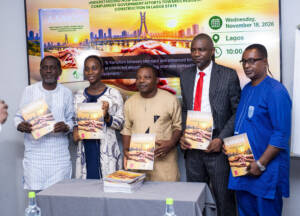 L-R: Deputy Director, District Head, Lagos State Building Control Agency, Engr. Toyin Dada; Team Lead, Thrivescape Initiative, Ms. Tosin Aniramu-Joseph; Professor, Faculty of Environmental Design and Management, Department of Urban and Regional Planning, Obafemi Awolowo University, Ile Ife, Osun State, Prof. Gbemiga Faniran; Deputy Director, Development Permit Department, Lagos State Physical Planning Permit Authority (LASPPPA), TPL. Ramon Adetunji; and Chairman, Christian Association of Nigeria (CAN), Alimosho Local Government Area, Rev. Samuel Adeyemi, at the Public Presentation of Ajumose Report by Thrivescape Initiative in Lagos.
Stanley Ihedigbo
Experts in urban planning, building control, physical planning and community development have called for stronger community participation in efforts to prevent building collapse in Lagos State.
They made the call at the public presentation of the ÀJÙMỌ̀ ṢẸ Research Report, organised by Thrivescape Initiative and founded by Lloyd’s Register Foundation, in Lagos.
The report, titled “Understanding How Community-Led Innovations Can Complement Government Efforts Towards Resilient Construction in Lagos State,” advocates a collaborative approach involving government agencies, professionals, communities, traditional institutions, religious leaders and other stakeholders.
Presenting the report, Professor in the Department of Urban and Regional Planning, Faculty of Environmental Design and Management, Obafemi Awolowo University, Ile-Ife, Professor Gbemiga Faniran, said building safety should no longer be regarded as the exclusive responsibility of government and technical professionals.
Faniran said residents and communities could play a significant role by identifying and reporting suspected building defects before they result in disasters.
He particularly advocated a system that would protect residents who report cracks, structural defects and other warning signs in buildings to the appropriate authorities.
According to him, the concept behind ÀJÙMỌ̀ ṢẸ — meaning “doing things together” — recognises that neither government nor the people can independently solve the problem of building collapse.
“The people cannot be the law. The government cannot be the law. But the people and the government can build a resilient Lagos,” he said.
Faniran also urged residents to understand their rights and follow the appropriate approval processes rather than resorting to bribery or cutting corners.
He said town planners were trained to create safe, functional and aesthetically pleasing environments, arguing that the curriculum of the profession did not train practitioners to be corrupt.
He, however, acknowledged that professionals could be influenced by wider societal pressures, including sentiments, politics and attempts by members of the public to circumvent established procedures.
The don called for greater public enlightenment so that residents would know where to obtain planning approvals and how to report suspected violations.
He said the Lagos State Government should also intensify stakeholder engagement, noting that the research showed that many residents were unaware of existing government initiatives and channels for reporting building-related concerns.
‘Government cannot do it alone’
Earlier in her welcome address, Team Lead, Thrivescape Initiative, Ms. Tosin Aniram-Joseph, said the report was based on the belief that ending building collapse in Lagos was a collective responsibility.
She said communities were critical stakeholders across the building safety value chain, from land acquisition and construction to building occupation, maintenance and reporting of structural concerns.
According to her, residents should not be treated merely as beneficiaries of building safety interventions but as active contributors to solutions.
She said the report explored the perceived causes of building collapse in Lagos and examined community-based solutions to the problem.
Aniram-Joseph said the organisation was envisioning a system where residents could report suspected unsafe buildings, upload photographs and locations, receive acknowledgement and track the progress of their complaints.
She also identified opportunities for artificial intelligence and emerging technologies to help identify potential structural warning signs, map building-risk hotspots and enable authorities to prioritise inspections.
Other recommendations included accessible technology linking residents to material-testing and structural-assessment services, pro bono support from structural engineers for low-income households, and community referral systems linking residents with verified artisans and qualified built-environment professionals.
She stressed, however, that such solutions required collaboration among government, professional bodies, technology innovators, development partners and the private sector.
“Our vision is bold but necessary: zero building collapse in Lagos State,” she said, adding that the objective could not be achieved by one organisation, government agency or stakeholder group working alone.
LASBCA, LASPPPA back community participation
Deputy Director, District Head, Lagos State Building Control Agency (LASBCA), Engr. Toyin Dada described the research as a laudable initiative capable of complementing government efforts.
Dada said that while the government provided policies and regulatory frameworks, communities could provide an additional layer of support by reporting violations and suspected unsafe structures.
He urged residents to report observations to the agency responsible for building control so that appropriate enforcement could be carried out.
He also encouraged Thrivescape Initiative to sustain its public enlightenment activities and deepen engagement with traditional institutions, which he said could help communicate building safety messages to communities.
Similarly, Deputy Director, Development Permit Department, Lagos State Physical Planning Permit Authority (LASPPPA), TPL. Ramon Adetunji described the initiative as timely and commendable.
Adetunji said planning should be approached from the bottom up, with residents carried along in decisions affecting their communities.
He urged Lagos residents to comply with planning and building regulations, stressing that laws were only effective when citizens followed them.
He also encouraged residents to report suspected violations, reinforcing the message: “When you see something, say something.”
CAN urges residents to build right
Chairman, Christian Association of Nigeria (CAN), Alimosho Local Government Area, Rev. Samuel Adeyemi, said the programme had demonstrated that preventing building collapse was a collective responsibility.
He identified government agencies, town planners, religious leaders, community leaders and traditional institutions as important stakeholders in achieving safer communities.
Adeyemi urged residents to obtain the necessary approvals before commencing construction and to avoid patronising unqualified professionals.
He said religious and community leaders had an important role to play in passing building-safety information to residents.
“If we build right, we will live right,” he said, commending Thrivescape Initiative for drawing attention to the need for collective action.
The stakeholders agreed that preventing building collapse required a shift from reacting to disasters after they occur to identifying and addressing risks before they become emergencies.
They also endorsed the central message of the Ajumose initiative: “See something, say something,” as part of efforts to promote safer buildings and a more resilient Lagos.


First Patriot targets ₦55m annual savings with JMG Hybrid Solar system
Michael Olumide Alabi First Patriot Limited, a mining and mineral pro…