
Lanre Shittu, CIG, Mikano showcase Nigeria’s growing auto assembly capacity
Inspects Lanre Shittu, CIG, Mikano plants, backs Nigeria-First procurement policy

Stanley Ihedigbo
Governing Board, National Automotive Design and Development Council (NADDC) has called for deeper local content, the migration from Semi-Knocked Down (SKD) assembly to Complete Knocked Down (CKD) production and stronger government patronage of vehicles assembled in Nigeria.
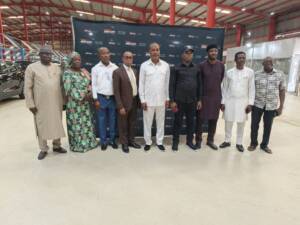
The Board made the call during an oversight visit to the facilities of Lanre Shittu Motors, CIG Motors and Mikano Motors in Lagos, where it assessed their production capacity, local-content utilisation, workforce development and operational challenges.
Chairman of the NADDC Board, Chief Emma Eneukwu, who led the inspection, described the exercise as an eye-opening experience, saying it had provided him with first-hand evidence of the technical capacity of Nigerian engineers and the potential of the country’s automotive industry.
Eneukwu said he was impressed by the scale of operations at the Lanre Shittu Motors facility and the level of involvement of Nigerian engineers in vehicle assembly.
“With a little push, Nigeria will get there,” he said, stressing that local manufacturers required stronger institutional support to unlock their full potential.
According to him, the government must create an environment where locally manufactured vehicles could compete effectively with imported alternatives, noting that transportation remained critical to national economic development.
He said the Board would use its position to bridge the gap between government and private-sector operators by presenting the concerns of manufacturers to the appropriate authorities.
“That is why we are here. We are here to encourage them and make sure we bridge the gap between the government and the private sector. To push their demands and make sure they are actualised,” Eneukwu said.
He also urged the government to lead by example by giving priority to locally assembled vehicles in its procurement decisions.
Eneukwu expressed concern that government patronage of imported vehicles could undermine domestic manufacturing, arguing that government officials and agencies would better appreciate the capacity of Nigerian assemblers if they physically visited their facilities and witnessed their production processes.
He said increased patronage would also help dispel concerns about the quality and durability of locally assembled vehicles, especially when manufacturers provide affordable vehicles, readily available spare parts and reliable after-sales services.
Nigeria-First policy to drive local production
The Director-General of NADDC, Otumba Joseph Osanipin, said the inspection was designed to give the Board direct knowledge of the capabilities and challenges of local vehicle assemblers and provide evidence for future policy decisions.
Osanipin disclosed that the Federal Government had moved the Nigeria-First Policy from formulation to implementation following the signing of a circular by the Secretary to the Government of the Federation directing Ministries, Departments and Agencies to procure Nigerian-made vehicles.
He said the implementation guideline had been released and the final circular had been transmitted to MDAs.
“We started with the Nigeria First Policy, but after we met, we decided to come up with guidelines on the implementation of the Nigeria First Policy, and the guidelines have been released with a final circular now sent to MDAs to encourage patronage and expand the market for local assemblers,” he said.
Osanipin said the policy would expand the market available to domestic assemblers and make government procurement a major driver of local automotive manufacturing.
He also stressed the importance of after-sales support, citing the presence of Lanre Shittu Motors’ warehouses in Lagos, Kano and Port Harcourt, as well as its efforts to train technicians.
According to him, vehicle sales should be treated as a long-term relationship rather than a one-off transaction, with manufacturers ensuring that vehicle downtime is minimised through effective maintenance and availability of spare parts.
Lanre Shittu: 326 Nigerians, One Expatriate
Managing Director of Lanre Shittu Motors, Mr. Taiwo Shittu, said the company had continued to increase the use of locally sourced components in its assembly operations.
He listed seals, lubricants and rubber components among the items sourced locally from Kano and Ogun states.
Shittu said the company currently employed 326 Nigerians and only one expatriate, attributing the development to the increasing technical competence of Nigerian workers.
“Gone are those days when you have five expatriates. Over time, we have seen that Nigerians are even better. What you just need is to give them the opportunity and the working know-how because they have the knowledge,” he said.
He disclosed that the company had the capacity to produce six trucks and six buses, with 12 units in its production pipeline.
The facility, he said, occupies about 40,000 square metres and has four production lanes.
Shittu called for policies that would guarantee investment and provide stronger incentives to local manufacturers, arguing that policy stability would attract more foreign investors and international partners to Nigeria.
He also disclosed that the company had commenced work with partners on electric vehicles, while noting that Federal Government support for CNG and electric mobility was creating new opportunities for cleaner transportation.
He expressed particular pride in the locally assembled buses deployed at the Murtala Muhammed International Airport, Lagos.
According to him, government patronage of local assemblers was improving but could become significantly stronger with appropriate policies.
He disclosed that the company had financing arrangements with Access Bank, Stanbic IBTC, Wema Bank and government-backed CreditCorp to facilitate vehicle acquisition by customers.
CIG calls for deeper backward integration
At CIG Motors, the company’s Special Adviser to the Chairman on Government Relations, Brigadier-General Chukwuemeka Udaya (rtd.), said the visit enabled the NADDC Board to independently verify the company’s activities and understand its challenges beyond periodic reports submitted to the Council.
Udaya said CIG Motors commenced operations in 2022 and had aligned its activities with the Federal Government’s automotive development agenda.
He said the company had invested significantly in young Nigerians, with many of its workers below 27 years, while also maintaining partnerships with universities and Yaba College of Technology for industrial attachments.
He disclosed that Nigerian graduates had been sent to higher institutions in China for 18-month postgraduate training aimed at transferring engineering and vehicle-manufacturing knowledge to Nigeria.
Udaya also said CIG Motors had partnered with the Federal Ministry of Humanitarian Affairs and Poverty Alleviation to train more than 25,000 young Nigerians in automobile maintenance and auto-electrical skills over the past two to three years.
He said CIG vehicles were competitively priced, noting that in some cases, the price of a used imported vehicle could purchase a brand-new vehicle assembled by CIG Motors.
He further disclosed that about 70 per cent of Lagrider vehicles were sourced from CIG Motors.
Udaya advocated restrictions on the importation of older used vehicles, popularly known as tokunbo, proposing an age limit of not more than 10 years for used vehicles entering the country.
NADDC seeks 40% local content
Speaking at CIG Motors, NADDC Board Member, Bawo Omagbitse, said CIG had made significant contributions to Nigeria’s automotive industry but needed to deepen backward integration.
He specifically called for increased utilisation of locally produced components and investment in facilities such as paint shops.
Omagbitse said Nigeria’s automotive industry must move from SKD assembly towards CKD production to achieve meaningful industrialisation.
He added that CIG Motors would need to attain the 40 per cent local-content threshold if it were to play a significant role in the African automotive market.
He urged the company to strengthen collaboration with the Nigerian Association of Automotive Manufacturers (NAMA), Manufacturers Association of Nigeria (MAN), Raw Materials Research and Development Council and other relevant institutions.
Mikano seeks protection for local assemblers
At Mikano Motors, the company’s National Operations Manager, Syam Abdulkadir, said the inspection had demonstrated that Nigerians possessed the technical capacity required for vehicle assembly and manufacturing.
Abdulkadir said the majority of workers at the facility were Nigerians who had acquired practical knowledge of vehicle assembly, production processes and the technical requirements at different stages of manufacturing.
He called for stronger support for local-content development, arguing that domestic manufacturers could not compete effectively when imported vehicles entered the Nigerian market at lower costs due to favourable import regimes.
He also supported restrictions on older tokunbo vehicles and called for clear age limits for used vehicles entering Nigeria.
Abdulkadir urged the government to accelerate the enactment of the NADDC industry law, describing it as essential for protecting investments and providing a stable regulatory framework for automotive manufacturing.
He warned that unrestricted vehicle imports, particularly where import duties are reduced or removed, could undermine domestic manufacturing by allowing imported vehicles to compete below the cost structure of locally produced vehicles.
The Mikano representative said the Board’s direct exposure to assembly plants would enable it to return to the government with a clearer understanding of the industry’s challenges and the policy measures required to transform Nigeria into a competitive vehicle-producing economy.




Bayelsa boat tragedy: NDDC Chairman Ebie expresses condolences, solidarity with families
Stanley Ihedigbo Chairman, Governing Board of the Niger Delta …