

Diversification is no longer optional; it is essential for survival” — Landmark Africa CEO

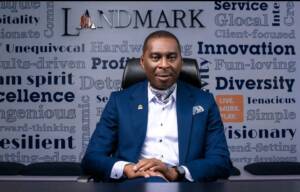
Founder & Group CEO of Landmark Group, Mr. Paul Onwuanibe, with over 35 years of experience in real estate across Africa, Europe, and the US, has led Landmark’s global expansion and built a reputation as a visionary in commercial property and workplace management.
He speaks with Caleb Ohaeri about his organisation’s activities and developments.
Landmark Africa has described its next phase as “Landmark 2.0.” What does this new chapter mean for the company, and what are the key priorities driving this new strategy?
Landmark 2.0 is about taking everything we have learned over almost three decades in
business and building a stronger, more diversified, and more scalable brand – bigger, better, and more efficient.
We started as a business-services company, a serviced office business in 1997, and evolved into real estate, and then developed a much broader model around business, hospitality, tourism, leisure, entertainment, and lifestyle.
Landmark 2.0 takes that integrated ecosystem model and asks: how do we replicate the parts that work best across more cities and ultimately across Africa? So there are three important priorities. The first is geographic diversification.
We do not want the future of the business to depend too heavily on one asset, one city, or even one country.
The second is experience-led development. We are not interested simply in putting up buildings; we want to create destinations that give people reasons to visit, stay, spend, return and bring others. The third is impact, jobs, businesses, tourism, investment and opportunities for the communities around our developments.
At the beginning of Landmark 2.0, we spoke about an ambition to develop iconic leisure
destinations across eight West African cities, including several in Nigeria. What we are doing now in Enugu and Port Harcourt, alongside the continued development of Lagos and our presence in Owerri, shows that this is moving from strategy into execution.
This geographic diversification and the rollout of Landmark’s events, tourism, leisure and hospitality model across West Africa are central to this new phase.
Two years after the demolition of Landmark Beach, what lessons did the company learn from that experience, and how has it influenced Landmark Africa’s approach to growth, resilience and future investments?
The biggest lesson is on resilience and moving forward. Landmark Beach was an important asset, but Landmark was never simply a beach. What was more valuable was the experience, people, brand, relationships, operating capability, business and ecosystem we had built around it.
The demolition reinforced something our history had already taught us. Landmark has gone through several difficult seasons and crises: we had our office blown up on 9/11, we faced the Libyan crisis, the impact of the COVID-19 shutdown and then the demolition of Landmark Beach.
Each time, circumstances outside our control forced us to rethink our business strategy.
The response after 2024 was not to rebuild the same thing in the same way. It was to diversify.
We expanded into new cities- Enugu and Port Harcourt – and honed our wider West African strategy while introducing new experiences within our Lagos location.
It has also changed the way we think about risk, stakeholder engagement and long-term
infrastructure planning. We are much more conscious today of ensuring that Landmark’s future rests on a portfolio of connected destinations rather than one exceptional destination.
Two years after 2024, the evidence of that strategy is visible: Landmark Nike Lake Resort is operational and undergoing phased transformation, Port Harcourt is under redevelopment, Landmark Waterview Apartments is progressing, and newer concepts such as the Landmark Upside Down House and POP Landmark have broadened the Landmark Lagos ecosystem.
Despite the challenges of the past two years, Landmark Africa has continued to expand, including taking over the management of Landmark Nike Lake Resort. What informed the decision to expand further into Nigeria’s tourism and hospitality sector?
Because we believe one of Africa’s biggest underdeveloped opportunities is sitting in plain sight: Africans travelling within Africa.
Nigeria has a huge population of families, professionals, young people, businesses, and
diaspora visitors who want good leisure and hospitality experiences. Too often, we assume that a world-class holiday or weekend experience has to involve getting on a plane and leaving the country.
We disagree. Our thesis is that if you create the right product, people will travel domestically and regionally for it. Our own recent analysis highlighted estimates showing domestic visitor spending in Nigeria, far outweighs international visitor spending.
Nike Lake made sense because we were not starting with a blank piece of land. It is a
recognised tourism asset with a rich history, a beautiful natural environment and significant potential. Enugu also has connectivity, infrastructure, a strong regional market and an administration that clearly wants tourism and investment to grow.
The partnership announced with the Enugu State Government will be significant to the state’s revenue growth phase, job creation, increased visitor numbers and a broader repositioning of the resort.
For us, that is what Landmark 2.0 should look like: finding and developing an asset with
enormous potential, combining it with operating expertise, hospitality, entertainment and destination management, and creating something capable of stimulating an entire local economy.
The company is currently developing the 20-floor Landmark Waterview Apartments. What does this project represent within Landmark Africa’s broader real estate strategy, and what market does the development seek to serve?
Waterview completes an important part of the Landmark Lagos proposition: the “Live” in Live-Work-Play.
People already come into the ecosystem to work, attend events, eat, meet, exercise, stay and enjoy entertainment. A residential development allows people to actually live within that environment.
We don’t see Waterview as an isolated apartment tower. It is a development sitting within an established ecosystem. Every resident is in proximity to hospitality, entertainment, dining, business, wellness, and leisure infrastructure.
The development comprises 290 apartments within a 20-floor high-rise mixed-use development and is being positioned around modern living integrated into the wider Landmark destination. It reflects our broader philosophy that the value of mixed-use property comes from how individual
components reinforce one another, creating a seamless ecosystem where residential, lifestyle, hospitality, and commercial experiences enhance overall value.
The market includes professionals, entrepreneurs, investors, diaspora Nigerians and buyers looking for premium real estate where the lifestyle and surrounding ecosystem are as important as the apartment itself.
The Upside Down House has added another dimension to Landmark Africa’s portfolio. How does the attraction fit into the company’s wider vision?
It represents an important principle for us: real estate has to give people a reason to come.
For us its all about bringing people to our locations, ensuring that they have a great time and then they go back and tell other people.
The Landmark Upside Down House embodies this. Not only is it the first in West Africa, but the house is also a unique tourist attraction.
Our philosophy is that the different parts of a destination should reinforce each other. Someone may come to Landmark specifically for an attraction, but while they are here, they may eat at a restaurant, visit a retailer, attend an event or discover another experience. The attraction, therefore, generates value beyond its own ticket revenue.
That is the ecosystem effect.
The concept has already been extended from Lagos to the Landmark Nike Lake Resort in Enugu, where it is the first of its kind in Southeast Nigeria, demonstrating that individual experiences can become products that we replicate across different Landmark destinations.
The Lagos attraction has received more than 50,000 visitors since it’s launch, while the Enugu location has welcomed over 4,000 visitors since its launch just a few months ago.
So the Landmark Upside Down House is not a diversion from our real estate strategy.
Experience-led real estate is increasingly part of the real estate strategy.
How does Landmark Africa intend to use its developments to contribute to job creation, tourism, local businesses and broader economic growth?
We measure impact beyond the number of people directly employed by Landmark.
A functioning ecosystem creates an entire value chain around itself: hotels need food suppliers; events need production companies; restaurants need employees and vendors; attractions need operators; buildings require security, cleaning, maintenance and facilities management; tourists use transport services; retailers employ people; and creatives produce content and entertainment.
Landmark Beach demonstrated this ecosystem effect very clearly. The beach was not just a standalone destination; it functioned as an economic hub that supported businesses both on-site and across the ecosystem. More than 50 businesses operated directly within Landmark
Beach, while over 100 additional businesses benefited from the customer traffic and activity it generated. Together, the wider ecosystem supported thousands of direct and indirect jobs.
That is the model we want to reproduce.
Across our other locations, the objective isn’t to create a landmark destination in isolation with no relationship with the city. We want local suppliers, food businesses, entertainers, transport operators, employees, entrepreneurs and SMEs participating in the economy generated by the destination.
Our corporate philosophy explicitly treats our developments as platforms capable of generating jobs and opportunities for suppliers, contractors, creatives and other local businesses.
Are there plans to take the Landmark brand and its integrated development model to other Nigerian cities or other African markets?
Absolutely. Geographic expansion is one of the central pillars of Landmark 2.0.
We are currently in Lagos, Owerri, Enugu and Portharcourt with plans to roll out to other West African countries and cities.
Our strategy is not simply to reproduce Lagos in the same way. Every market is different.
Enugu has its own culture, customer base and tourism potential; Port Harcourt has a very different waterfront environment; another African city will have its own strengths.
The objective is therefore to replicate the Landmark operating philosophy across our key industries of hospitality, leisure, events, entertainment, food, culture, tourism and commercial activity coming together within one destination.
We have also previously announced The Gambia as one of the markets in the wider West African expansion programme. Our ambition ultimately is to create a connected portfolio of African destinations, connected by water, land and air, built to international standards but firmly rooted in their local communities.
What reforms or government support would make Nigeria more attractive for large-scale investments in tourism, hospitality and real estate?
The private sector does not need the government to remove every risk. What investors need most is predictability.
When you are developing an asset that may take five, ten or twenty years to reach its full potential, you have to know that the rules you invested under will remain reasonably consistent.
Land administration and title security need to become faster, clearer and more transparent.
Planning and approval processes should be seamless. We need better support infrastructure, roads, power, water, drainage, transport and security because every naira the private investor has to spend duplicating public infrastructure raises the final cost to the consumer.
We also need a deeper long-term financing market. Real estate and tourism infrastructure cannot optimally be financed with short-duration, high-cost money.
And public-private partnerships need credible frameworks in which both government and investors understand their obligations from the beginning. The government does not necessarily
have to build the hotel or attraction.
They only need to create an enabling environment and provide regulatory certainty and infrastructure, and the private sector will flourish.
Looking ahead over the next five to ten years, what does Landmark Africa’s ideal portfolio look like?
Our grand vision is to be globally recognised as a leading destination-development
business.
That portfolio should have a healthy mix of residential real estate, hospitality, events,
entertainment, leisure, food and beverage, wellness and tourism assets.
Beyond all our pipeline projects, we expect technology to become a much bigger part of the Landmark experience, connecting customers across our destinations through platforms such as the Landmark Citizen App.
And geographically, we would expect the Landmark destinations to extend into additional Nigerian and African cities.
The long-term journey is from buildings to destinations, destinations to ecosystems, and
individual ecosystems into a connected African portfolio. That is already how the company describes the ambition behind its next chapter.
What lessons should young Nigerian entrepreneurs and investors take
from Landmark Africa’s challenges, reinvention and expansion?
The first lesson is to build capability and capacity, not simply assets. You may lose an asset. The market may change. Regulation may change. Technology may change. But if you have people, knowledge, relationships and the ability to execute, you can build again.
Second, don’t concentrate your entire future on one customer, one asset, one location or one source of revenue. Diversification is not only a growth strategy; it is a survival strategy.
Third, solve a real problem. Our CEO has often spoken about businesses needing to be
solvable, scalable and sustainable. If there is no genuine problem you are solving for people, the business will struggle to endure.
Fourth, resilience does not mean pretending that setbacks are not painful. It means accepting reality quickly enough to decide what you will do next.
And finally, collaborate. African businesses will not compete globally simply by competing against each other. We need partnerships, knowledge sharing, access and stronger networks.
That is something I have become even more convinced about.




Peak Milk deepens breakfast conversation with ‘Peak Breakfast, Peak Love’ campaign
Mercy Iheoma Ihedigbo Peak Milk has launched a new campaign, “Peak Breakfast…