

NCC challenges innovators to break digital barriers as SORA wins 2026 Hackathon

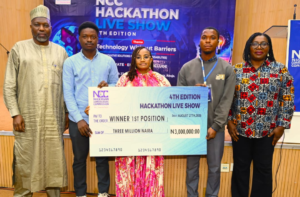
L-R: Director, Research and Development, Nigerian Communications Commission, (NCC), Engr. Babagana Digima; Team Engineer, Sora, Isah Ladan;Director Digital Economy, NCC, Ms Helen Obi; Chief Executive Officer, Sora, Abdulhaqq Somoye; Head, Indigenous Content, NCC, Dr. Beluchi Nwanisobi, during the presentation of Cheques to the winner of the 4th Edition of Hackathon Live Show, at the NCC Annex Office Mbora Abuja On the 27th August 2026.
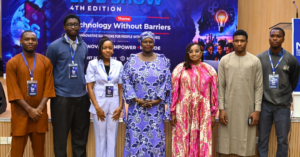
L-R: Chief Executive Officer, Ikor, Victor Akpan; Chief Executive Officer, Gyronics, Abdurrahman Gambo; Chief Executive Officer, Clearssignal, Stephanie Nwangwu; Executive Commissioner, Stakeholder Management, Nigerian Communications Commission (NCC), Barr. Rimini Makama; Director, Digital Economy, NCC, Ms. Helen Obi;Chief Executive Officer, Meertech Ltd, Sani Mahmud Madobi and Chief Executive Officer, Sora, Abdulhaqq Somoye, at the NCC 4th Edition Hackathon Live Show, on the 26 to 27th August 2026, at NCC Annex Office Mbora Abuja
Chinedum Ukaegbu
A new generation of Nigerian innovators has demonstrated the transformative power of technology in promoting digital inclusion, with SORA emerging as the overall winner of the Fourth Edition of the Nigerian Communications Commission (NCC) Hackathon Live Show 2026.
SORA clinched the N3 million grand prize for developing an inclusive job-matching and adaptive skills platform designed to connect verified persons with disabilities in Nigeria to employment opportunities and skills-development resources.
Clear Signal emerged as the second-place winner and received N2 million, while IKOR secured third position with a cash prize of N1 million.
According to the Director, Public Affairs Department, Nigerian Communications Commission, Mrs. Nnenna Ukoha, the winners were announced at the conclusion of the two-day innovation-focused event, which brought together 20 teams of young innovators, software developers, entrepreneurs, researchers, students and persons with disabilities from across the country.
Held under the theme, “Technology Without Barriers,” the Hackathon challenged participants to develop practical, affordable and scalable technology solutions capable of addressing some of the barriers limiting digital participation among persons with disabilities and other underserved communities.
Beyond the cash prizes awarded to the top three teams, all participating teams received consolation prizes and certificates of participation in recognition of their contributions to advancing indigenous innovation, digital inclusion and accessible technology development.
The winning SORA platform stood out for its focus on employment and skills development for persons with disabilities, providing a digital bridge between qualified users and opportunities that can enhance their economic independence and participation in the formal economy.
Clear Signal, which finished second, developed an accessibility-focused electricity outage alert system designed for blind, visually impaired, deaf and hard-of-hearing consumers.
The solution uses voice calls, text messages and visual notifications to ensure that electricity consumers with different forms of disability can receive timely information about power outages.
IKOR, which placed third, developed an artificial intelligence-powered voice dictation and writing tool aimed at removing barriers associated with physical typing, expensive hardware and poor internet connectivity.
The innovations demonstrated how emerging technologies can be adapted to solve everyday challenges and create opportunities for people who are often excluded from mainstream digital services.
Participants at the event welcomed the opportunity to present their ideas before a national audience, interact with industry stakeholders and receive expert feedback capable of helping them refine their solutions and potentially move from prototypes to commercially viable products.
Speaking on the objectives of the initiative, the Executive Vice Chairman and Chief Executive Officer of the NCC, Dr. Aminu Maida, said the Commission remained committed to leveraging innovation to address digital exclusion and ensure that all Nigerians, particularly persons with disabilities and underserved communities, could participate meaningfully in the digital economy.
Representing the EVC at the event, the Executive Commissioner, Stakeholder Management, Rimini Makama, described young Nigerian innovators as a critical resource for the nation’s future economic growth.
She said the country’s greatest economic opportunities could be found in the creativity and ingenuity of its young people.
“Nigeria’s next major oil field is not buried under our soil or offshore in the Atlantic Ocean. It is here, in the ideas, ingenuity, brilliance and determination of the young Nigerians gathered in this room today,” she said.
Maida noted that several factors continued to hinder digital participation across the country, including the high cost of digital devices, inadequate digital skills, limited access to assistive technologies and poor accessibility features on some digital platforms.
According to him, technology must be developed as a tool for removing barriers rather than creating new ones.
“Technology should not create new barriers; at its best, technology should remove them,” he stated.
He explained that the NCC Hackathon serves as a strategic platform for identifying and supporting practical technology solutions capable of addressing real-world accessibility challenges while contributing to the Commission’s broader vision of a digitally inclusive Nigeria.
The EVC further emphasized the economic significance of accessible technology, noting that inclusive digital solutions could open up previously untapped markets and bring millions of Nigerians into the formal economy.
“When we design assistive and accessible technologies, we are unlocking massive untapped markets, expanding consumer participation, and bringing millions of hardworking Nigerians into the formal economy as creators, entrepreneurs, and confident digital citizens,” Maida said.
He therefore encouraged investors, telecommunications operators and other stakeholders to support the commercialisation and deployment of promising solutions emerging from the Hackathon.
Earlier, at the opening ceremony, Makama, represented by Usman Malah, Director, Zonal Operations, said the Hackathon demonstrated the NCC’s commitment to building an inclusive digital society in which technology creates opportunities for everyone.
She said technological advancement should not be measured only by the sophistication of new inventions but also by their ability to improve people’s lives.
“The true measure of technological advancement lies not only in the sophistication of our innovations, but in the extent to which they improve lives, expand opportunities, and empower every member of society to participate meaningfully in the digital economy,” she said.
Makama urged the participating innovators to focus on developing solutions that are affordable, scalable, user-friendly and capable of delivering measurable social impact.
She added that the most valuable innovations were those that removed obstacles and empowered people to achieve their full potential.
The Director, Digital Economy Department of the NCC, Helen Obi, explained that the Hackathon was conceived to promote indigenous innovation while advancing digital inclusion and universal access.
According to her, the participating teams developed solutions addressing a wide range of accessibility and inclusion challenges.
These included healthcare, education, emergency communications, accessible USSD services, artificial intelligence-powered sign language translation, voice-enabled services and assistive technologies for visually impaired persons.
Obi also highlighted the Commission’s indigenous NCC Hackathon Judge Software, which was developed to automate and standardise the judging process during the competition.
The development of the software, she explained, further demonstrated the Commission’s commitment to applying indigenous technology not only to solving societal challenges but also to improving the efficiency and transparency of its own programmes.
In a goodwill message, Chinyelu Chikwendu, Senior Manager, Strategy and Innovation at MTN Nigeria, commended the NCC for what she described as “a regulator with a difference.”
She noted that the Commission had gone beyond its traditional regulatory responsibilities by actively supporting innovation and the development of Nigeria’s digital ecosystem.
Chikwendu particularly praised the focus of the Hackathon on persons with disabilities, stressing the importance of creating technology solutions that improve lives and expand opportunities.
She reaffirmed MTN Nigeria’s commitment to supporting innovation, startups and technology-driven solutions capable of creating positive social and economic impact.
Also speaking at the event, Eneh Omawumi, Head of the Gender Desk Unit at the Federal Ministry of Innovation, Science and Technology, commended the NCC for promoting innovation, empowerment and inclusion through the Hackathon.
She praised the transparency and fairness of the competition and encouraged the participating innovators to continue developing their ideas beyond the competition.
Similarly, Amadi Kenneth of the Consumer Protection and Financial Inclusion Department of the Central Bank of Nigeria (CBN) described the initiative as worthwhile.
He observed that several of the solutions presented during the Hackathon possessed significant potential to deepen financial inclusion among women, youths, persons with disabilities and other underserved communities.
Kenneth expressed the CBN’s willingness to collaborate with the NCC and participating innovators to explore opportunities for deploying some of the solutions in advancing digital and financial inclusion across Nigeria.
The Hackathon also provided an avenue for young innovators to demonstrate that technology can play a major role in addressing some of Nigeria’s social and economic challenges.
From employment and skills development to electricity information, communication and accessible writing tools, the projects showcased at the event reflected a growing interest among Nigerian young people in developing technology with direct human impact.
The NCC commended its technical partners, mentors, judges and other stakeholders for their contributions to the success of the programme.
The Commission reiterated its commitment to strengthening indigenous content development, supporting Nigeria’s local technology ecosystem and ensuring that the benefits of the digital economy are accessible to all Nigerians.
With SORA, Clear Signal and IKOR emerging as the top three solutions, the Fourth Edition of the NCC Hackathon has once again underscored the capacity of Nigerian innovators to develop locally relevant solutions to global challenges.
The event ultimately reinforced the message at the heart of its theme — Technology Without Barriers — that innovation becomes most valuable when it expands opportunity, promotes inclusion and ensures that no segment of society is left behind in Nigeria’s rapidly evolving digital economy.




‘Nigeria’s future is in your hands’ — Olukoyede charges young women to uphold integrity
Michael Olumide Alabi Executive Chairman of the Economic and Financial Crime…