

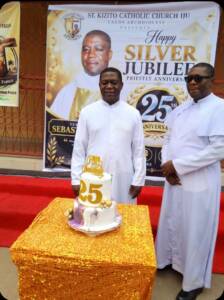
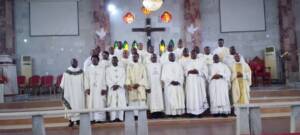
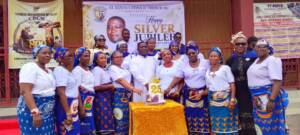
Twenty-five years in vineyard: Celebrating Priestly journey, legacy of Rev. Fr. Sebastian Ngene

By Jerome-Mario Utomi
Some anniversaries simply mark the passage of time, and there are anniversaries that invite society to pause, reflect and take stock of a life poured into the service of others. The 25th priestly anniversary of Very Rev. Fr. Sebastian Ngene belongs unmistakably to the latter category.
Twenty-five years in the Catholic priesthood is not merely a numerical milestone. It represents a quarter of a century of sacrifice, pastoral responsibility, spiritual leadership, human encounters, challenges, prayers and service.
For Fr. Ngene, the Silver Jubilee of his priestly ordination is an occasion to celebrate not only the man and the priest, but also the communities he has served, the people he has influenced and the tangible footprints his ministry has left behind.
Fr. Sebastian Ngene was ordained to the Catholic priesthood on August 18, 2001. The Catholic Archdiocese of Lagos’ directory of priests from other dioceses identifies him as a priest of the Diocese of Awka, with August 18, 2001 recorded as his ordination date. The Diocese of Awka likewise lists him among its priests serving on mission in the Archdiocese of Lagos.
His priestly story, therefore, is also a story of missionary availability: a priest of Awka Diocese whose ministry has, for years, contributed to the pastoral life and growth of the Archdiocese of Lagos.
The Catholic priesthood is often described through its sacramental responsibilities: celebrating the Eucharist, administering the sacraments, preaching the Gospel and accompanying the faithful in their spiritual journey.
But the real test of priestly ministry is often found beyond the sanctuary—in the ability of a priest to build people, strengthen communities, inspire the young, encourage families and translate Christian principles into practical service. It is in this broader understanding of priesthood that the 25-year journey of Fr. Ngene becomes particularly significant.
Over the years, he has served in different pastoral capacities and communities, assuming responsibilities that have required not only spiritual maturity but also administrative competence, interpersonal understanding and a willingness to work with both clergy and laity.
His service in Lagos has placed him in important pastoral positions. At various times, he served as parish priest of St. Michael Catholic Church, Ketu, and later as parish priest of St. Kizito Catholic Church, Iju. His leadership responsibilities eventually extended to the deanery level, where he served as Dean of Agege Deanery. The Archdiocese of Lagos currently lists him as Very Rev. Fr. Sebastian Ngene, Dean of Agege Deanery.
His appointment as Dean was not an honorary decoration. A deanery is a pastoral structure designed to facilitate collaboration, coordination and evangelisation among neighbouring parishes. When the Archdiocese of Lagos appointed him Dean of Agege Deanery, the Church described deaneries as structures intended to facilitate the work of evangelisation.
That responsibility speaks to a level of trust earned over years of priestly service.
One of the defining features of Fr. Ngene’s ministry appears to be his understanding that evangelisation must be accompanied by the development of structures capable of sustaining the life of the Christian community.
His years at St. Michael Catholic Church, Ketu, provide instructive examples. The parish’s own historical records document his involvement in the development of outstations and Mass centres. One particularly striking example is the story of what eventually became St. Maria Faustina Catholic Church. The parish account records that Fr. Ngene released funds in February 2016 for the construction of a temporary Mass-centre structure. Following the first Mass there, attended by 143 people, he approved an extension of the structure. The additional work was financed by him, and on April 3, 2016, he formally declared the centre a Mass Centre.
A Mass centre is, in practical terms, a physical expression of evangelisation. It takes the Church closer to people. It creates a space where families can worship, children can receive catechesis, communities can gather, and the Eucharist can become part of the rhythm of everyday life.
That achievement demonstrates an important aspect of Fr. Ngene’s pastoral philosophy: the spiritual and the physical must work together.
The same disposition was evident during his time at St. Michael Catholic Church, Ketu, where the parish was itself engaged in major infrastructural development. In 2013, during the parish’s 20th anniversary, Fr. Ngene spoke about the church’s construction project and the challenges involved in completing it.
Contemporary reporting also records the substantial financial investment already made by the parish toward the development of its church building.
Yet, perhaps more important than physical structures is the investment a priest makes in people.
A church building can be measured in metres and architectural features. A transformed human life cannot be measured so easily.
Fr. Ngene’s ministry has included efforts aimed at strengthening the capacity and welfare of parishioners. One example is his involvement in skills-development initiatives.
A report on a church partnership with the National Directorate of Employment noted that Fr. Ngene had previously organised a similar programme at St. Michael Catholic Church, Ketu, where about 144 parishioners were trained. This dimension of his ministry deserves special attention.
In an economy where unemployment and lack of practical skills can push families into vulnerability, providing opportunities for people to acquire vocational skills represents a form of social ministry. It reflects an understanding that the Church’s concern for human beings cannot end with Sunday worship.
The Church must also care about livelihoods, dignity, self-reliance and the ability of people to contribute meaningfully to society.
Another important feature of Fr. Ngene’s ministry is his relationship with the laity. The contemporary Church increasingly recognises that evangelisation is not the responsibility of priests alone. The lay faithful have an indispensable role in the mission of the Church, and effective pastoral leadership requires collaboration.
During an Agege Deanery cultural programme, Catholic Herald reported that the deanery’s laity executives worked harmoniously with parish priests and Fr. Ngene, then Dean of Agege Deanery, to make the event successful.
The programme reportedly brought together representatives from 14 parishes and combined Mass and thanksgiving with cultural presentations and other activities.
At another Agege Deanery event, Fr. Ngene, as Dean and Parish Priest of St. Kizito Catholic Church, Iju, addressed newly elected lay leaders and urged them to remain committed to evangelisation and the winning of souls for Christ.
These examples reveal a priest who understands that the vitality of a parish depends not only on the priest at the altar but also on the commitment of the people in the pews.
Twenty-five years of priesthood also create another responsibility: to help those coming behind.
A priest who has spent decades navigating the demands of pastoral ministry inevitably becomes a source of experience for younger priests. His successes, mistakes, encounters and lessons become part of the unwritten curriculum of priestly life.
Fr. Ngene’s public pastoral engagements show a willingness to encourage younger clergy. In addressing a younger priest marking his own priestly anniversary, he emphasised the importance of reflecting on the journey, acknowledging the significance of priestly milestones and using such moments for self-examination and renewal.
This is an important legacy.
The greatest achievement of an experienced priest may not always be a church building that bears his name or a project listed in a parish history. Sometimes it is the priest he encouraged, the seminarian he advised, the young person he inspired, the family he reconciled or the struggling parishioner whose faith he helped preserve.
The temptation at anniversaries is to look backward exclusively. But a Silver Jubilee should also be a moment of looking forward.
Fr. Sebastian Ngene’s 25 years have produced a record of pastoral leadership, missionary service, infrastructural development, skills empowerment, collaboration with the laity and participation in the wider life of the Church. His journey from the Diocese of Awka into sustained missionary service in Lagos illustrates the Catholic ideal of a priest being available for the service of God’s people wherever he is called.
But the real measure of those 25 years will ultimately be found in the lives that continue to bear the fruits of his ministry.
Every Mass celebrated, every confession heard, every homily preached, every sick person visited, every troubled family counselled, every young person encouraged, every community organised and every project undertaken forms part of a priestly legacy that cannot always be captured by statistics.
That is why this Silver Jubilee should be understood not simply as a celebration of longevity but as a celebration of faithfulness.
In an age when institutions frequently celebrate what can be quantified, priesthood reminds humanity of the value of service that is often quiet and unseen. Twenty-five years of priestly ministry means 25 years of repeatedly placing the needs of God’s people ahead of personal convenience.
It means saying “yes” again and again.
It means remaining available.
It means carrying the joys and burdens of other people.
It means standing at the altar for generations of families and witnessing their baptisms, marriages, struggles, losses and moments of thanksgiving.
It means building both churches and people.
As Rev. Fr. Sebastian Ngene celebrates his Silver Jubilee, the appropriate response is gratitude.
Gratitude to God for the gift of his vocation. Gratitude to the Diocese of Awka for the priest it has given to missionary service. Gratitude to the Archdiocese of Lagos and the many communities that have received his ministry. And gratitude to the countless parishioners, families, clergy, religious and lay faithful whose lives have intersected with his priestly journey.
The anniversary is also an invitation to prayer: that the years ahead may be even more fruitful than those behind; that wisdom may deepen with experience; that strength may accompany responsibility; and that the grace that sustained the first 25 years will sustain the years yet to come.
Twenty-five years after August 18, 2001, the story of Rev. Fr. Sebastian Ngene is therefore not a finished story. It is a continuing testimony of what can happen when a man responds to a divine call and remains faithful to it through the changing seasons of life.
The buildings may stand as visible monuments. The programmes may remain in parish records. The appointments may appear in ecclesiastical directories. But the most enduring monument of a priest is the human being whose life has been brought closer to God because of his ministry.
And if the fruits of Fr. Ngene’s 25 years are to be counted in that way, then his Silver Jubilee is indeed worthy of celebration.
Ad multos annos, Very Rev. Fr. Sebastian Ngene. May the Lord who called you continue to strengthen you, renew your zeal and grant you many more fruitful years in His vineyard.
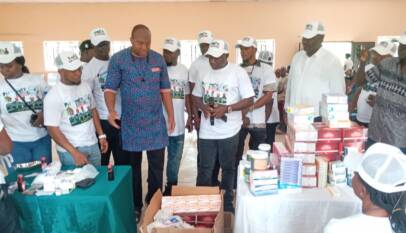

Tompolo-backed PBAT Movement takes free medical outreach to Ugboha
The PBAT Door-to-Door Movement has organised a free medical outreach in Ugbo…