

Umo Eno, his political evolution in Akwa Ibom State

By Emmanuel Nicholas
Since the return to civilian rule in 1999, Akwa Ibom State has stood as one of Nigeria’s most politically stable and electorally predictable states within the Fourth Republic. For over three decades, the People’s Democratic Party ( PDP) maintained an unbroken grip on the governorship, winning each contest by decisive margins that reflected both party structure and incumbency advantage.
Yet beneath this continuity lies a discernible evolution in governance style, electoral contestation, and this evolution has been injected into the political polity of the State by Governor Umo Eno.
Since assuming office, Governor Umo Bassey Eno has ushered in a distinct era of political evolution in Akwa Ibom State, one defined less by partisan rivalry and more by consensus and stability. In a state where elections and party transitions were once marked by tension, mistrust, and heated politicking, his leadership has deliberately shifted the atmosphere toward reconciliation, dialogue, and unity.
Through prioritizing governance over acrimony and extending an inclusive hand across party lines, Governor Eno has redefined the culture of politics in Akwa Ibom.
His approach has calmed previously volatile political spaces, fostered inter-party cooperation, and created an ambience where development, rather than division, drives public discourse. In doing so, he has not only stabilized the polity but also laid the groundwork for a more united and forward-looking Akwa Ibom.
The successful political history
The inaugural election of 1999 set the tone for the new democratic dispensation. Obong Victor Attah of the PDP emerged victorious with 843,360 votes, representing 72.21% of the total, against 317,373 votes for the All People’s Party candidate. With a turnout of 1,167,987 from 1,450,367 registered voters, Attah’s victory was both a product of the PDP’s national dominance and his own standing as a technocrat with a clear developmental agenda.
Attah’s re-election in 2003 underscored the limited opposition presence in the state at the time. The Independent National Electoral Commission recorded 1,028,722 votes for the incumbent, with no opposition votes formally listed in the official tally. Out of 1,624,495 registered voters, 1,338,970 participated, making the contest largely uncontested in practice. This result reflected the early Fourth Republic’s consolidation around the ruling party, rather than a robust multiparty competition.
During his eight-year tenure, Attah anchored his administration on “industrialization and infrastructure.” His government initiated the Akwa Ibom Airport project, the Ibom Power Plant, and laid the groundwork for the Ibom Industrial Park.
He also became a leading voice in the resource control agitation for oil-producing states. Critics, however, pointed to a slow pace of industrial take-off and protracted disputes with the Federal Government over oil revenue allocation.
The political landscape shifted in 2007 with the emergence of Godswill Akpabio. Running on the PDP platform, Akpabio secured 1,044,566 votes against 19,865 for James Iniama of the Action Congress of Nigeria, from a registered voter base of 1,408,197. His campaign promised a break from the technocratic conservatism of his predecessor and a direct engagement with the people’s immediate needs.
Akpabio’s consolidation of power was confirmed in the 2011 gubernatorial election. He defeated John James Akpan Udoedehe of the ACN by polling 957,585 votes to Udoedehe’s 163,449.
The margin was substantial, and the victory was subsequently upheld by both the Governorship Election Petition Tribunal and the Court of Appeal. This legal validation reinforced the legitimacy of his mandate and the PDP’s dominance in the state.
The Akpabio years came to be defined as an era of “Uncommon Transformation.” His administration delivered signature projects such as the Godswill Akpabio International Stadium and the Ibom Tropicana Entertainment Centre. Social policies included free and compulsory education and free healthcare for children and pregnant women, alongside aggressive road construction and rural electrification.
The period was also marked by rising public debt and allegations of contract inflation, illustrating the tension between visibility and fiscal sustainability.
In 2015, the PDP mantle passed to Udom Gabriel Emmanuel, who won with 996,071 votes, or 89.69% of the total, against Umana Umana of the APC, who garnered 89,865 votes. Turnout stood at 1,122,836 from 1,548,531 registered voters.
The election reaffirmed the PDP’s electoral machinery, even as the APC made its first significant inroad at the national level.
Udom’s re-election in 2019 followed a similar pattern, though with a lower turnout. He polled 519,712 votes, representing 74.64%, against Nsima Ekere of the APC with 171,978 votes, or 24.70%. Only 712,037 votes were cast out of 2,119,727 registered voters, a turnout of 33.59%. The reduced participation reflected voter fatigue and the challenges of mobilization in a second-term contest.
Udom’s “Industrialization Agenda” distinguished his administration. He prioritized investor-driven projects, including Ibom Air, the Dakkada Rice Mill, a syringe factory, a toothpick factory, kings floor mill, and a metering company.
His focus on job creation and youth empowerment sought to diversify the state’s economy beyond oil. Critics noted high recurrent expenditure and the fact that several flagship projects had yet to reach full operational capacity. Politically, the PDP maintained near-total control of the House of Assembly, winning 25 of 26 seats in 2019.
The Evolution
The 2023 election marked both continuity and a subtle realignment. Pastor Umo Bassey Eno of Eno, the candidate for the Peoples Democratic Party (PDP), won the March 2023 Akwa Ibom State gubernatorial election by polling 354,348 votes. Senator Bassey Albert scored 136,262 to come second, and Udofia, the candidate for the All Progressives Congress (APC), came in third place with 129,602 votes.
PDP, while Akanimo Udofia of the APC placed third, and Senator Bassey Akpan of the Young Progressives Party came second. Umo Eno’s emergence as Udom Emmanuel’s preferred successor ensured the PDP retained power, preserving the party’s 24-year hold on the governorship.
Umo Eno’s administration has since articulated the “ARISE Agenda,” focusing on Agricultural revolution, Rural development, Infrastructure, Security, and Economic advancement. His early emphasis has been on completing inherited projects, enhancing food security, and expanding rural road networks.
While it is still early in his tenure, his approach signals a shift toward consolidating existing gains and prioritizing grassroots impact over grandiose projects.
One of his trademark that has endears him to the people of the State is the building of unity, peace and runs Government of inclusion, while pulling down tribal and political party divides
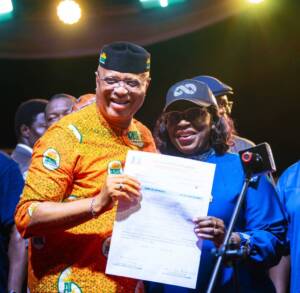
A significant departure from previous political dynamics occurred when Governor Umo Eno became the first governor from Akwa Ibom State to emerge as a consensus candidate during the second-term primary.
This historic realignment was formally affirmed after the State APC Governorship primary, held at ward centres across the state on Thursday, May 21, 2026, where the Governor was declared winner with a total of 392,653 votes by the Chairman of the State APC Primary Elections Committee, Hon. Nwofe Alexander.
This development marked a historic realignment, breaking the state’s long-standing association of the governorship exclusively with the PDP.
The move reflected a growing pragmatic consensus among political stakeholders that party affiliation should yield to continuity and stability.
Umo Eno’s acceptance within the APC was not detached from his performance in office. His commitment to the ARISE Agenda, his consultative leadership style, and his focus on completing ongoing projects created a perception of a governor prioritizing governance over partisanship.
This perception eased his transition and broadened his acceptance across party lines, a rarity in Akwa Ibom’s historically polarized politics.
The implications of this consensus for the 2027 general election are substantial.
With Umo Eno sustaining his performance history, his cross-party acceptance could translate into a broader electoral coalition that transcends traditional party loyalties. Voters who previously aligned with the PDP on the basis of identity and structure may now evaluate the contest through the lens of performance and continuity.
Historically, Akwa Ibom elections have been characterized by overwhelming margins for the incumbent party. Attah’s 72.21% in 1999, Akpabio’s 957,585 votes in 2011, and Udom’s 89.69% in 2015 all demonstrate the power of incumbency and party machinery. However, the 2019 decline in turnout and the 2023 multi-party contest suggest that voter behaviour is becoming more fluid.
The contrast between the elections is instructive. The 1999 and 2003 polls were defined by the PDP’s dominance and weak opposition.
The 2007 and 2011 contests under Akpabio introduced a more populist governance model and higher project visibility. The 2015 and 2019 elections under Udom shifted focus to industrialization and economic diversification. The 2023 election and Umo Eno’s subsequent alignment with the APC signal a potential realignment toward performance-based politics.
Governor Umo Eno’s ability to secure consensus within the APC while retaining goodwill from his PDP base positions him uniquely for 2027.
As his administration will continue to deliver measurable improvements in agriculture, rural infrastructure, and security, the electorate may reward him with a victory margin that reflects both incumbency and cross-party support. Conversely, any perceived underperformance could erode the fragile consensus that currently sustains him.
The broader lesson from Akwa Ibom’s political history is that electoral dominance in the state has rested on a combination of party structure, candidate credibility, and the delivery of tangible dividends of democracy. From Attah’s foundational projects to Akpabio’s visible transformation, and from Udom’s industrial push to Umo Eno’s ARISE Agenda, each administration has sought to leave a distinct imprint.
Lastly, Akwa Ibom’s journey from 1999 to 2024 illustrates the maturation of its democratic process. The state has moved from uncontested PDP dominance to a more competitive, performance-driven political environment.
Governor Umo Eno’s current position places him at the nexus of this evolution, with his 2027 prospects likely to hinge on the alignment between his governance record and the expectations of a maturing electorate.
He has earned the unshakable trust of the people through a firm display of dignified character and moral rectitude
Through systematically dismantling the entrenched alliances that once nurtured political tension, he has cultivated an atmosphere suffused with goodwill and mutual respect.
He has effectively sealed every conduit through which discord and acrimony previously surged, and has institutionalized a disciplined ethos of reconciliation, anchored firmly in the principles of open consultation and inclusive and exclusive dialogue.



Awujale: Fusengbuwa ruling house rejects rival leadership, warns against parallel selection process
Fusengbuwa Ruling House of Ijebu-Ode has expressed concern over the prolonged delay in the…