Sowore rejects ADC alliance, says he alone can defeat Tinubu in 2027

Michael Olumide
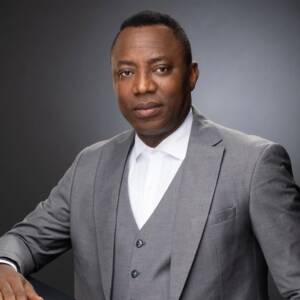
Human rights activist and presidential candidate of the African Action Congress (AAC), Omoyele Sowore, has declared that President Bola Tinubu will be defeated in the 2027 presidential election, insisting that the victory will come through his candidacy rather than any coalition of opposition political figures.
Sowore asserted during an appearance on Frontline, a current affairs programme on Eagle 102.5 FM in Ilese Ijebu, Ogun State, where he dismissed ongoing coalition talks as ineffective and lacking ideological direction.
According to him, alliances being promoted among opposition leaders are fundamentally flawed because they are made up of the same political actors who have previously held power without delivering meaningful change.
“He’s going to lose to me,” Sowore said. “Not to any coalition. The coalition being formed is not designed to defeat him. It is simply a rearrangement of the same set of people who have always controlled the system.”
Sowore was emphatic in his rejection of coalition politics, particularly those involving established political figures.
He argued that such alliances represent recycled leadership and cannot inspire genuine national transformation.
He questioned the credibility of opposition figures who are now positioning themselves as alternatives, noting that many had opportunities in the past to reform the country but failed to do so.
“What did they do when they had the chance?” he asked. “Nothing. This is the country they ran.”
He further alleged that Nigeria’s political space is structured in a way that ensures continuity of the same elite class, regardless of electoral outcomes.
The activist also raised concerns about the credibility of Nigeria’s electoral system, describing recent elections as flawed and unrepresentative of the will of the people.
Referring specifically to the 2023 general election, Sowore argued that the process amounted to a “selection” rather than a genuine democratic exercise.
“Do you, in good conscience, believe that the 2023 election was an election?” he queried. “Votes were allocated. It was not the people deciding.”
He cited low voter turnout as evidence of widespread disillusionment, noting that only about 27 percent of registered voters participated, leaving a significant majority disengaged.
According to him, this presents an opportunity for political change if non-participating citizens can be mobilised.
“There are over 70 percent of voters who did not participate. If they wake up, everything changes,” he said.
A “Coalition of the Oppressed”
Rather than elite-driven alliances, Sowore advocated what he described as a “coalition of the oppressed” — a grassroots movement driven by ordinary Nigerians.
He argued that meaningful political change cannot come from alliances involving individuals he described as part of the problem.
“You don’t need your oppressors to form a coalition for you,” he said. “They cannot save you.”
Sowore criticised several figures linked to coalition discussions, questioning their capacity to deliver reform given their past roles in government. He described them as representatives of a failed political establishment.
Providing insight into internal political engagements, Sowore recounted his experience at a recent meeting involving the Independent National Electoral Commission (INEC) and political party representatives.
He claimed that key opposition figures present at the meeting showed little seriousness, citing instances where some participants were disengaged throughout proceedings.
According to him, such behaviour reflects a lack of commitment to genuine reform and undermines the credibility of coalition efforts.
Electoral History and Performance
Sowore’s own electoral track record has been modest. In the 2019 presidential election, he finished among the top tier of minor-party candidates, polling 33,953 votes on the AAC platform and gaining visibility among youth voters.
However, his performance declined in the 2023 election, where he secured 14,608 votes, finishing near the bottom of the field. He attributed the outcome to systemic irregularities and the emergence of alternative opposition figures.
Sowore rejected the 2023 results, describing them as fraudulent and criticising the failure to electronically transmit results as required.
Beyond political alliances, Sowore called for structural reforms to Nigeria’s electoral system. He argued that current voting processes are cumbersome, expensive, and exclusionary, particularly for rural voters.
He advocated the adoption of electronic voting, stating that modern technology should be used to improve accessibility and transparency.
“This is 2026. People should not have to travel long distances just to vote,” he said.
During the programme, some callers urged Sowore to reconsider his stance on coalition politics, arguing that unity among opposition parties is necessary to address Nigeria’s economic and security challenges.
One caller noted that no single political party could successfully deliver change without collaboration, urging political actors to work together in the national interest.
In response, Sowore maintained that the issue is not the absence of coalitions but the composition of those alliances.
He insisted that partnerships involving established political elites would only perpetuate existing problems.
“The people you are asking me to align with have already failed Nigerians,” he said. “We must build something new.”
He emphasised that his political vision is rooted in accountability, transparency, and redistribution of national resources for public benefit.
“If you stole public funds, you must return them,” he said. “Assets acquired unlawfully should be repurposed for public good — hospitals, schools, and infrastructure.”
As political alignments continue to evolve ahead of the 2027 elections, Sowore’s position signals a rejection of mainstream opposition strategies and a push for grassroots mobilisation.
He concluded by urging Nigerians to take responsibility for shaping the country’s future, insisting that real change will only come through active citizen participation.
“This is not about waiting for politicians,” he said. “It is about Nigerians deciding that they want a different system.”
Sowore maintained that his campaign will continue to focus on systemic transformation, positioning himself as an alternative to both the ruling party and opposition coalitions.


NDLEA, US DEA bust global drug syndicate, arrest billionaire kingpin, two female accomplices
Stanley Ihedigbo Operatives of the National Drug Law Enforcement Agency (NDLEA), working c…